
Learning how to fold a pop up screen tent usually happens at the worst possible moment: the campground checkout is in twenty minutes, the car is half packed, and the shelter that opened in sixty seconds is now fighting you like a wrestling mat with opinions. I have been there with a hub shelter that would not collapse and a spring-open screen room that kept springing back open in my arms. The good news is that every screen house folds with a repeatable sequence, and once you know which type you own, packing it takes about as long as setting it up.
This guide comes straight out of the ten shelters I tested for my best pop up screen tent roundup. They fold in four different ways, so I have split the instructions by frame type, flagged the steps where people actually break poles, and added the drying and storage habits that keep the fabric healthy between trips.
What Type of Pop Up Screen Tent Do You Have Before You Fold It?
You need to identify your frame type before you fold a pop up screen tent, because a hub shelter, a spring-disc screen room, a telescoping-leg frame, and a pole-built screen house each collapse in a completely different order. Using the wrong method is how frames get bent and fabric gets torn. Look at how your shelter opened, and the folding method is simply that motion in reverse.
Here is how the ten shelters in our hub break down:
| Frame Type | How It Opened | Shelters in This Group | Packed Shape |
|---|---|---|---|
| Hub (hexagon or pentagon) | Walls popped out from center hubs | Clam Escape, Clam Venture, Gazelle G6, VEVOR, Aoxun | Long cylinder bag |
| Spring-disc | Burst open from a flat round bag | Alvantor, East Oak, Mars Explo | Flat round disc |
| Telescoping instant frame | Legs extended and clicked into place | Coleman Skylodge | Slim rectangular bag |
| Pole-built | Fiberglass poles threaded and seated | DMH Outdoors | Compact duffel |
If you own a hub shelter, you will recognize the round fabric-covered hubs in the middle of each wall and in the roof center. Spring-disc rooms have no hubs at all; the frame is one continuous loop of flexible wire or fiberglass sewn into the fabric edges. Telescoping frames have visible legs with push buttons, and pole-built shelters have separate poles that slide out.

There is one more thing to check before you start. Some shelters in this group carry add-on parts that must come off first: zip-on wind cloths, door frame poles, telescoping support poles, sandbags, or a hanging projection screen. Folding with any of those still attached is the most common reason a shelter will not collapse fully. I strip everything off and lay the small parts on the open carry bag so nothing gets left in the grass.
If you have folded a camping pop up before, the spring-disc method will feel familiar. My how to fold a pop up tent guide covers the classic figure-eight twist in detail, and the same muscle memory carries straight over to the spring-open screen rooms below.
How Do You Fold a Hub-Style Pop Up Screen Tent?
You fold a hub-style pop up screen tent by pulling the roof hub down from inside, then pushing each wall hub inward one at a time until the panels collapse, and finally gathering the folded walls into a tight bundle for the bag. It is the exact reverse of the pull-out setup, and on most hub shelters it takes under two minutes once you have done it twice.
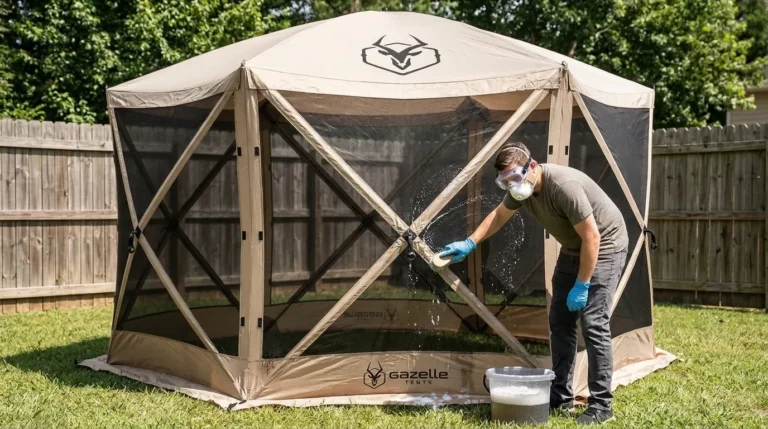
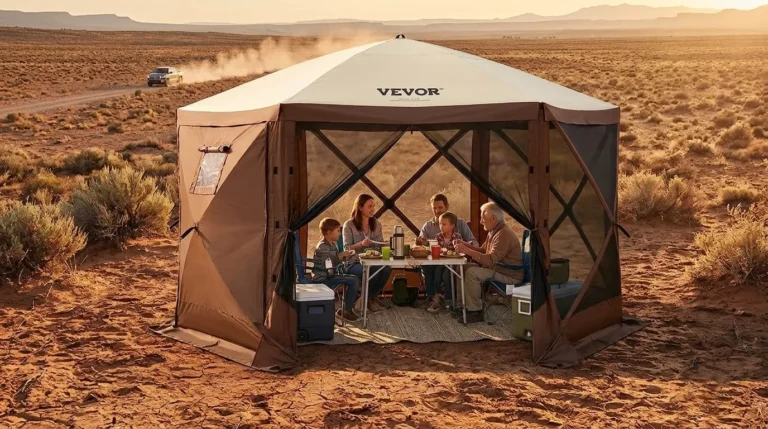
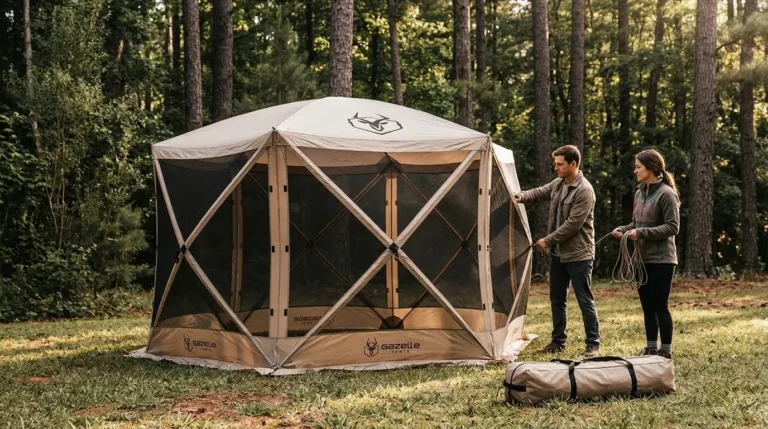
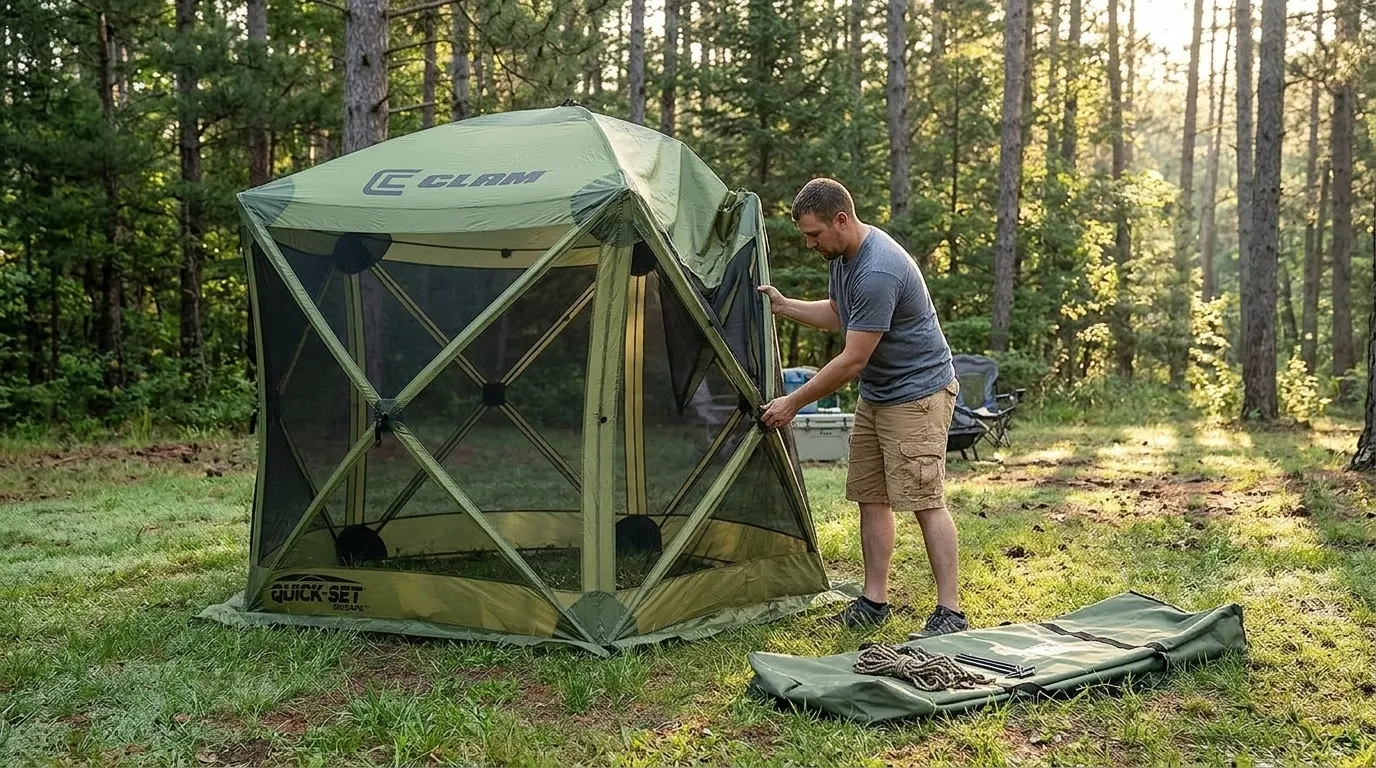
This method covers the Clam Escape screen tent, the 5-sided Clam Venture screen tent, the Gazelle G6, and both 12×12 hexagons, the Vevor screen tent and the Aoxun gazebo. Here is the sequence I use:
- Pull every stake and loosen every guyline. Coil each rope and tuck it into the stake bag before it tangles.
- Remove wind panels or wind cloths and any door frame poles. On the 12×12 VEVOR and Aoxun hexagons, the two door frame poles must come out first or the door wall will not fold.
- Step inside, reach up, and pull the roof hub straight down. Pull the strap or fabric tab, not the plastic hub itself.
- Walk to each wall and push the center of the wall hub inward with a flat palm. The panel will fold toward the middle. Work around the shelter in order.
- With all walls collapsed, gather the poles so they run parallel and the fabric lies flat between them.
- Lay the bundle on the open bag, roll the fabric snug around the poles, and slide it in.
The Clam Escape packs into a bag roughly 72 inches long, and the Clam Venture packs to about 63 inches, so lay the bag out flat first. Both bags are oversized on purpose, which is one of the nicest details on those shelters.
The one mistake I see over and over is pulling the wall from the outside. That bends the pole sections against the hub joint instead of letting the hub pivot the way it was designed. If a wall resists, stop and check for a stake loop or guyline still attached at the bottom corner.
On the bigger 12×12 hexagons, the fabric volume is noticeably larger, so roll more slowly and press air out as you go. The Aoxun weighs 37.5 pounds packed, so I lift it with bent knees rather than yanking it off the grass.
How Do You Fold a Spring-Disc Pop Up Screen Tent?
You fold a spring-disc pop up screen tent by removing the support poles, collapsing the frame in half, and twisting it into stacked loops that lie flat in the round bag. This is the method for the Alvantor screen house, the East Oak screen house tent pop up, and the Mars Explo, and it is the one that frustrates people most until the twist finally clicks.
- Pull all stakes and remove sandbags and guylines. Spring frames bounce when released, so get the anchors off first.
- Retract and remove any telescoping support poles. The East Oak ships with three and the Mars Explo with two; these sit inside the frame and must come out.
- Close the doors but leave one zipper open a few inches so air can escape as you fold.
- Stand at one side, grab the frame edges at shoulder width, and fold the shelter in half so the two sides meet.
- Push the folded frame down toward the ground while twisting your wrists in opposite directions. The frame should start coiling into loops.
- Keep twisting until the loops stack into a flat disc, then hold it tight and slip on the elastic bands or slide it into the bag.
Packed, the Alvantor forms a disc about 39 inches across, while the East Oak and Mars Explo pack to roughly 31-inch round bags. Those numbers matter because they tell you when the fold is complete: if your disc is much bigger than the bag, a loop is out of place.
The biggest safety point here is that a spring frame stores energy. If your grip slips during the twist, the frame can whip open fast. Keep your face out of line with the frame, wear sunglasses if you have them, and fold on soft ground. Fiberglass frames also deserve a quick inspection while folded; the CPSC recalled a line of children’s play tents in June 2026 because their fiberglass poles could shed fibers that irritate skin and eyes. If you see frayed or splintered fiberglass at a sleeve, handle it with gloves and contact the maker.
How Do You Fold a Telescoping or Pole-Built Screen House?
You fold a telescoping screen house by unlocking and shortening each leg, pushing the frame inward until it closes like an accordion, and wrapping the fabric around it. A pole-built screen house is different: you take it down by removing the poles from their sleeves and joints, then folding the fabric separately. Neither method involves twisting.
For the Coleman Skylodge portable screenhouse, this is the order I follow:
- Remove guylines and stakes.
- Press the pinch-free button on each leg and slide the leg to its shortest height, one corner at a time, so the canopy lowers evenly.
- With all legs shortened, stand on one side and walk the frame inward until the scissor sections close.
- Gather the mesh and canopy fabric around the closed frame, keeping it off the joints so it does not pinch.
- Wrap with the strap and slide it into the carry bag.
For the DMH Outdoors tent, remove the hanging projection screen, the detachable mud mats, and the reflective guy ropes first. Then pull each fiberglass pole from its joint protector, collapse the shock-corded sections by pulling them apart at the ferrules rather than from the ends, and fold the body into a rectangle about the width of the bag. The DMH bag measures roughly 8.66 by 27.87 inches, so fold the fabric to that length before rolling.

The common mistake on telescoping frames is shortening one leg all the way while the others stay tall. The frame racks sideways and puts load on the corner joints. Lower all four legs in stages instead.
On pole-built shelters, the risk is pulling shock-corded poles apart from the ends. That stretches the cord inside and leaves you with sections that will not seat next time.
Why Should You Dry a Pop Up Screen Tent Before Folding It?
You should dry a pop up screen tent before folding it because damp fabric packed into a sealed bag is the fastest route to mildew, sour smells, and weakened coatings. Morning dew is the usual culprit. The National Weather Service defines dew as moisture that condenses on surfaces that have cooled to the dew point overnight, and screen house roofs and skirts are exactly the kind of surface it settles on.
My rule is simple: shake off dew, wipe the roof with a microfiber towel, and give the shelter thirty minutes of sun or breeze before folding whenever the schedule allows. If it cannot dry at the campsite, I fold it loosely, then reopen it at home the same day. The EPA’s guide to mold and moisture says water-damaged items should be dried within 24 to 48 hours to prevent mold growth, and I treat that as a hard deadline for any screen house packed wet.
Before you fold, also brush off grass clippings, sand, leaves, and dead insects. Debris trapped in the folds rubs against the mesh during transport and holds moisture against the fabric. A soft brush or a few hard shakes does the job.
If your shelter already smells musty after a wet pack, my how to clean a musty tent guide covers deodorizing without damaging coatings. If mildew spots have actually formed on the mesh, the dedicated mold-cleaning guide in the Helpful Guides list below walks through safe removal.
Take a final lap of the campsite after folding, too. The National Park Service’s Leave No Trace principles start with planning ahead and end with being considerate of other visitors, and a forgotten stake or a torn guyline loop left in the grass fails both.
What Mistakes Damage a Pop Up Screen Tent During Folding?
The mistakes that damage a pop up screen tent during folding are forcing a frame that will not collapse, folding with add-on parts still attached, folding in strong wind, and stuffing the shelter into the bag instead of rolling it. Almost every bent pole or torn sleeve I have seen traces back to one of those four.
| Mistake | What It Damages | How to Avoid It |
|---|---|---|
| Forcing a stuck wall or loop | Hub joints, pole sections, spring frame | Stop, find the stake loop or rope still attached |
| Folding with wind cloths, poles, or sandbags on | Zippers, door frame, fabric seams | Strip every add-on first |
| Folding in gusty wind | Frame springs open or twists out of your hands | Collapse it low and fast, or wait for a lull |
| Stuffing instead of rolling | Mesh creases, bag seams, zipper teeth | Roll snugly around the poles before bagging |
| Packing damp | Fabric coatings, mesh, smell | Dry first, or reopen within a day |
Wind deserves its own warning. A screen house is at its most vulnerable halfway through a fold, when half the walls are collapsed and the rest act like a sail. The National Weather Service’s wind safety advice is to secure loose outdoor items when a High Wind Watch is issued, and I apply that to the shelter itself: fold it down before the wind builds, not during.
Finally, store the folded bag somewhere cool and dry, off a concrete floor, and out of direct sunlight. A garage shelf or a closet is ideal. Long stretches in a hot car trunk are hard on fabric coatings and elastic cords.
How to Fold a Pop Up Screen Tent FAQ
How long does it take to fold a pop up screen tent?
Most hub-style and spring-disc screen houses fold in about two to five minutes once you know the sequence, not counting stakes and guylines. Your first few attempts will take longer, especially with a spring-disc frame, because the twist step needs practice. Telescoping frames like the Coleman are quick too, while a pole-built screen house like the DMH takes the longest because each pole comes out separately. Removing anchors, wind panels, and support poles beforehand often takes as long as the fold itself.
Can one person fold a pop up screen tent alone?
Yes, every shelter in our hub can be folded by one person, though the bigger 12×12 hexagons and the pole-built DMH go faster with a helper. Hub shelters are designed for solo setup and takedown, and spring-disc rooms are actually easier alone because you control the twist with both hands. The trickiest solo job is lifting a heavy packed hexagon into a vehicle, so bend your knees and keep the bag close to your body.
What if my pop up screen tent will not fit back in the bag?
If it will not fit, something is folded out of order or still attached. On hub shelters, check that every wall hub fully collapsed and that the poles run parallel before you roll. On spring-disc rooms, an oversized disc means a loop is out of place, so open it and twist again. Also check for wind cloths, door poles, or telescoping support poles still clipped inside, because those add bulk and stop the fabric from rolling tight.
Is it safe to fold a pop up screen tent when it is wet?
You can fold it wet to get off the campsite, but treat it as temporary. Open the shelter at home within a day and let it dry completely before storing it. Packing a damp screen house for a week is how mildew spots and musty smells start, and they are much harder to remove from mesh than to prevent. Wipe down the roof and shake off the skirt before folding to cut drying time.
Should I fold a pop up screen tent with wind panels attached?
No, remove wind panels, wind cloths, and privacy walls before folding. They add bulk, strain the zippers, and can stop the wall hubs or frame from collapsing correctly. Fold the panels separately, keep them flat, and store them in the same bag if there is room. Clam’s bags are oversized enough to hold panels, while some other shelters pack tighter, so a separate stuff sack is a smart backup.
Helpful Guides
- How to Set Up a Screen House Tent
- Do Screen House Tents Let Dust In?
- How to Clean Mold from a Tent Screen
- How to Fold a Pop Up Beach Tent
What Is the Easiest Way to Remember How to Fold a Pop Up Screen Tent?
The easiest way to remember how to fold a pop up screen tent is this: strip it, dry it, reverse it, roll it. Strip off every anchor and add-on, dry the fabric as much as conditions allow, reverse the exact motion that opened the shelter, and roll it snug instead of stuffing it. That four-word routine works on every frame type in our hub.
If you are still choosing a shelter and folding ease matters to you, the hub-style designs are the most forgiving to pack, the spring-disc rooms are the smallest in the trunk once you master the twist, and the telescoping frame is the most familiar for anyone who has used a canopy. My pop up screen tent guide compares all ten side by side, including weights and packed sizes.
Practice once in the backyard before your trip. Two folds on a calm afternoon will save you a frustrating fifteen minutes on checkout morning, and your poles, zippers, and mesh will last years longer for it. Once your folding routine is solid, the full pop up screen tent reviews hub is the best place to compare frames before your next upgrade.