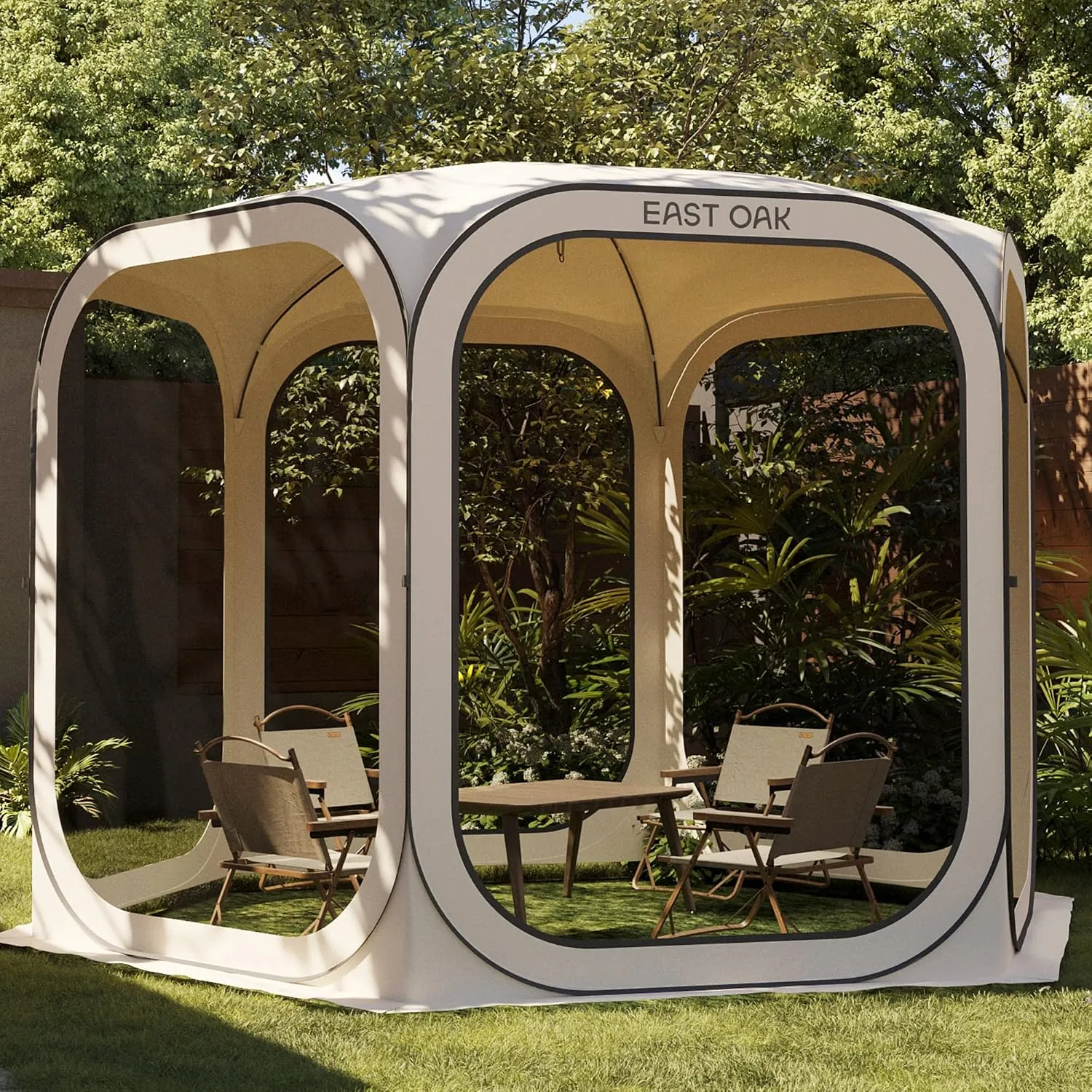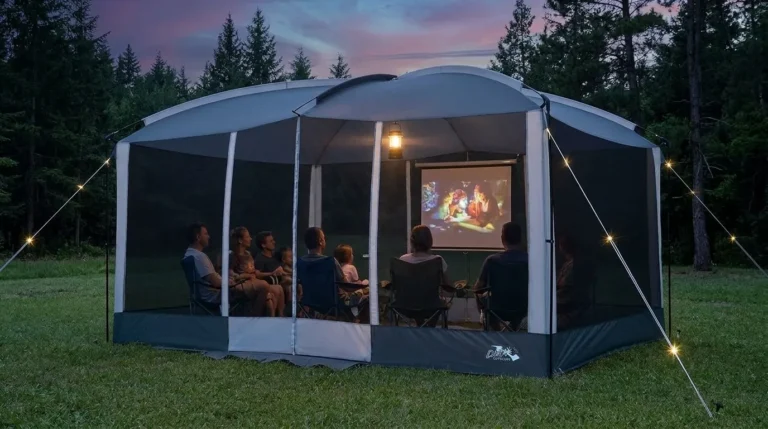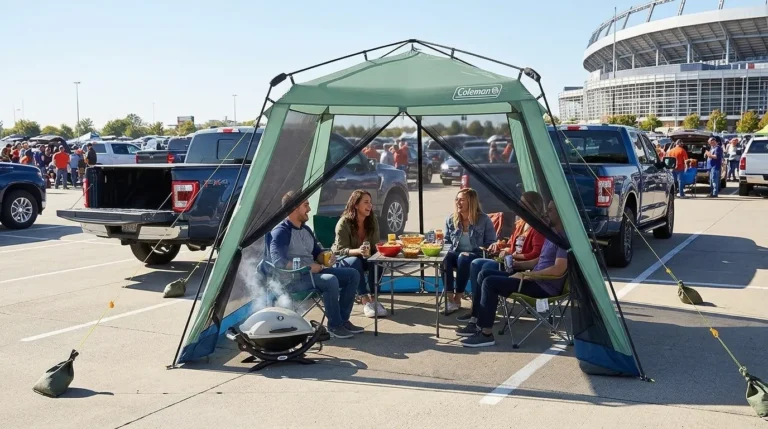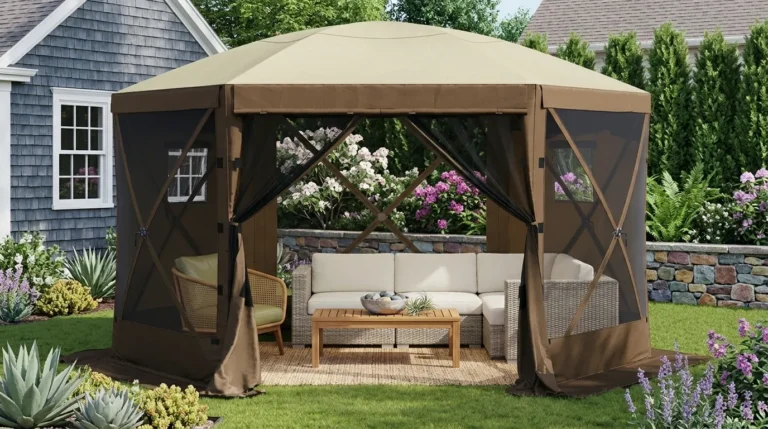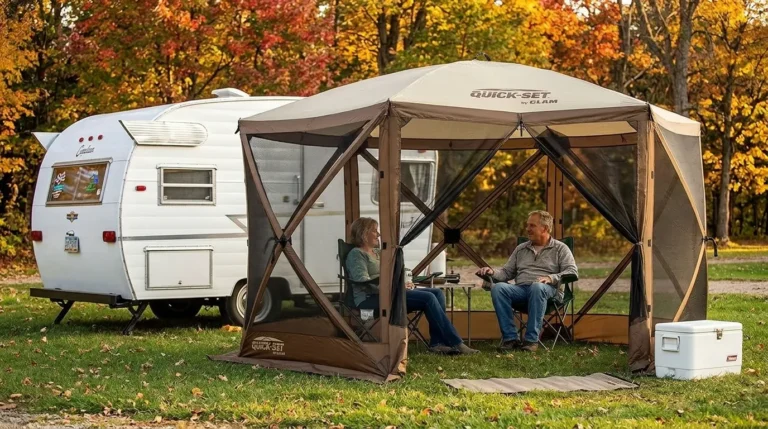
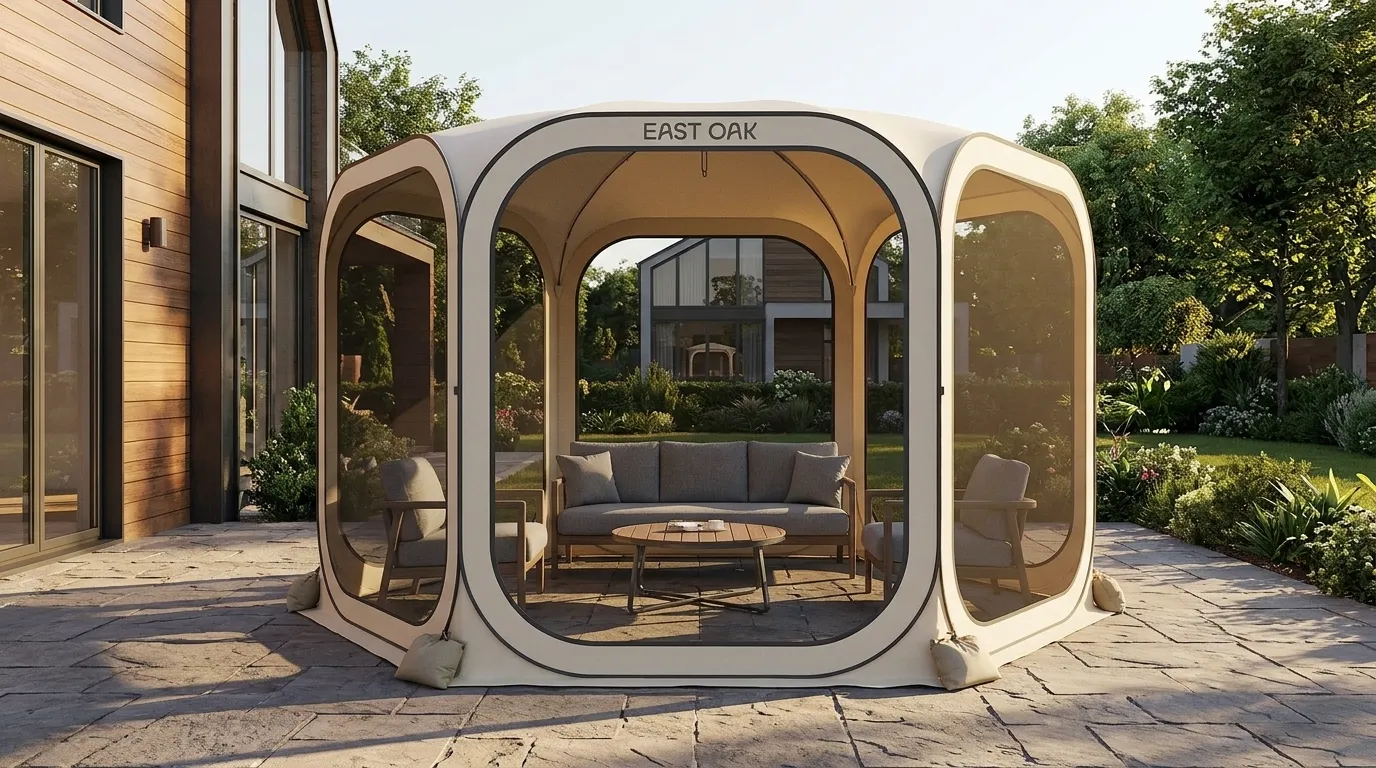

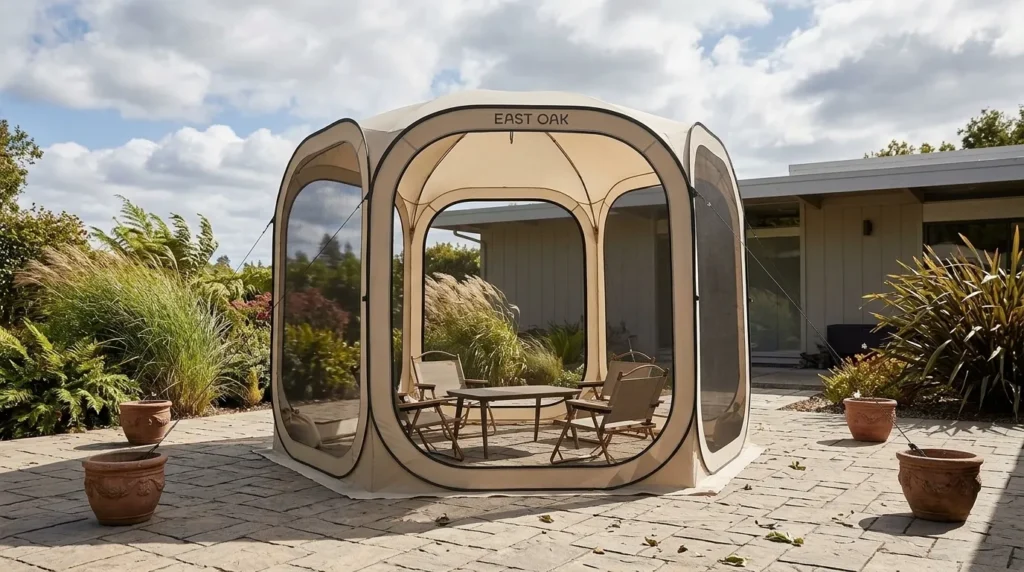
The East Oak screen house tent pop up spent most of the summer on my stone patio, and it quietly became the most used shelter in this whole hub. Following my earlier tests of the Gazelle G6, a rain-ready hub gazebo built for campgrounds, I wanted something that could live outside the back door, go up in seconds whenever the mosquitoes showed up, and look good doing it. The East Oak did exactly that, with one squared-off design choice that made a bigger difference than I expected.
This post contains affiliate links. As an Amazon Associate, I may earn commission from qualifying purchases at no extra cost to you.
The East Oak is a spring-open screen house with a patented vertical structure: a boxy frame with rounded arched mesh panels on every side, UPF 50+ silver-coated Oxford fabric, doors front and back, and a 3-year warranty. In my pop up screen tent guide, I picked it for backyards and patios. This review explains why, and where its limits are.
Overall Rating: 4.5/5
| Rating Question | Score (Out of 5) |
|---|---|
| How quickly did it pop open? | 4.7 |
| How easy was it to fold back down? | 4.0 |
| How much usable headroom did the walls give? | 4.8 |
| How well did the mesh keep bugs out? | 4.6 |
| How well did it cope with a breezy day? | 4.0 |
| How useful were the front and back doors? | 4.7 |
| How much peace of mind does the warranty give? | 4.8 |
What Are the Primary Pros and Cons of the East Oak Screen House Tent Pop Up?
The primary pros of the East Oak screen house tent pop up are its vertical walls that keep headroom to the edges, quick spring-open setup, doors front and back, and a 3-year warranty, while the main cons are fabric that is not water resistant, a 24 mph wind limit, and a fold that takes practice. It is the best patio screen room I tested, as long as you treat it as a fair-weather shelter.
Pros
| 1. Vertical walls keep headroom almost to the edges |
| 2. Pops open in under a minute, solo |
| 3. Doors on the front and back |
| 4. UPF 50+ silver-coated Oxford fabric |
| 5. 3-year warranty, the longest in this hub |
| 6. 12 stakes, 6 guylines, 6 sandbags, and 3 telescoping poles included |
| 7. Folds into a flat round case about 31 inches across |
Cons
| 1. Fabric is not water resistant |
| 2. Not recommended in winds over 24 mph |
| 3. Fold takes a few practice runs |
| 4. 23.4 pounds, heavier than a bubble screen room |
| 5. Telescoping poles add a setup step |
| 6. No wind panel option |
| 7. Lights sold separately |
The pattern is the same one I saw across the spring-open rooms: excellent everyday usability, honest weather limits. What sets the East Oak apart is the shape and the warranty. Its walls stay close to vertical, so a 10×10 feels like a real room, and three years of coverage is three times what most rivals offer. For a full comparison against every shelter in this hub, my best pop up screen tents guide has the side-by-side table.
The Specs of the East Oak Screen House Tent Pop Up
| Feature | Specification |
|---|---|
| Brand and model | EAST OAK, model SCH23002 |
| Size tested | 10 x 10 ft, Beige |
| Dimensions | 117.6 x 117.6 x 90 inches (about 9.8 x 9.8 x 7.5 ft) |
| Floor area | 96 square feet |
| Capacity | 4 to 6 adults |
| Weight | 23.4 pounds |
| Packed size | About 30.7 x 3.9 x 30.7 inches |
| Frame | Fiberglass and carbon steel, spring-open vertical structure |
| Fabric | Oxford with anti-UV silver coating, UPF 50+ |
| Mesh | Fine 4-sided mesh, 360-degree ventilation |
| Doors | Front and back, double-stitched zippers usable from both sides |
| Water resistance | Not water resistant |
| Included | Carry bag, elastic band, 12 stakes, 6 guylines, 6 sandbags, 3 telescoping poles, manual |
| Other sizes | 4×4, 6×6, 12×12 ft |
| Warranty | 3 years |
The specs that matter most are the 90-inch height, the vertical frame, and the warranty. Together they explain why this shelter felt more like an outdoor room than a tent.
How Fast Does the East Oak Screen House Tent Pop Up Set Up?
The East Oak screen house tent pop up sets up in under a minute because the spring frame opens on its own, with another few minutes to fit the telescoping poles and anchor it. It is one of the fastest shelters in this hub to go from bag to shade, and one person can do it easily.
Pull the flat round case out, remove the elastic band, hold it away from your body, and let go. The frame springs into its boxy shape. Walk around, straighten any arch that did not fully open, then fit the three telescoping support poles that ship with it. Finally, stake the loops, attach the six guylines, and set sandbags where stakes cannot go.
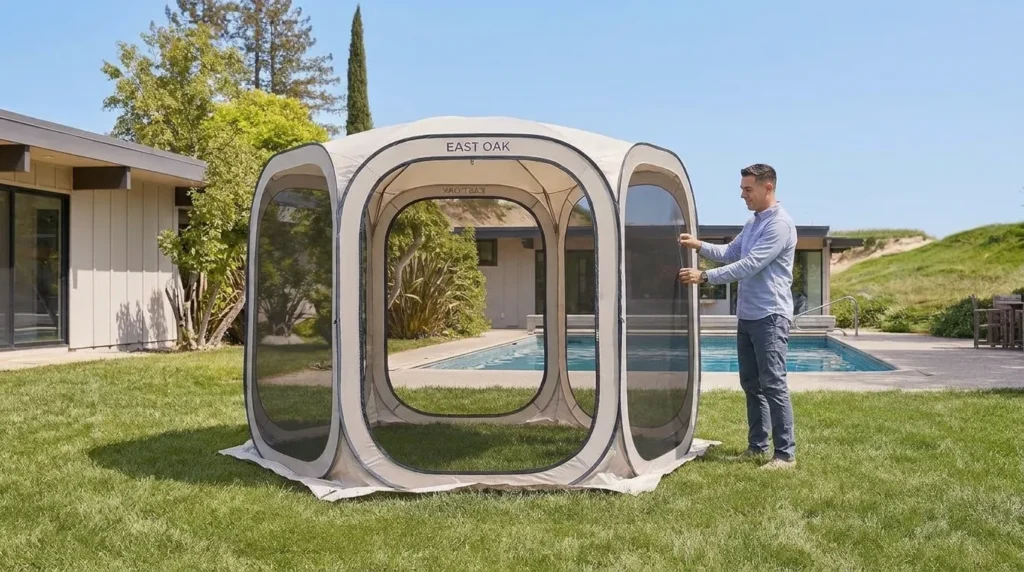
The rounder Alvantor screen house opens the same way and is about half the weight, with no support poles to fit. The East Oak’s poles are the price of its squared-off walls, and I think they are worth it.
Folding reverses everything: remove the anchors and poles, fold in half, and twist the frame into stacked loops until it lies flat. It took me three tries to get smooth. Keep your face out of line with the frame as you twist, because a spring structure can whip open if your grip slips.
On a lawn, call before you stake if the shelter will stay up for the season. The 811 program advises calling 811 before you stake a tent so utility lines get marked, and irrigation lines are a common surprise in backyards.
Why Do the East Oak Screen House Tent Pop Up Walls Matter So Much?
The East Oak screen house tent pop up walls matter because they stay close to vertical before arching over, so the usable headroom runs almost to the edges instead of shrinking the way it does in a dome or bubble. On a 10×10 footprint, that turns the outer foot of floor from gear storage into seating space.
My patio test made the difference obvious. A three-seat outdoor sofa, two armchairs, and a coffee table fit, and nobody had to lean away from the mesh. In a bubble-shaped room of the same size, the same furniture fit, but the sofa had to sit farther toward the center.
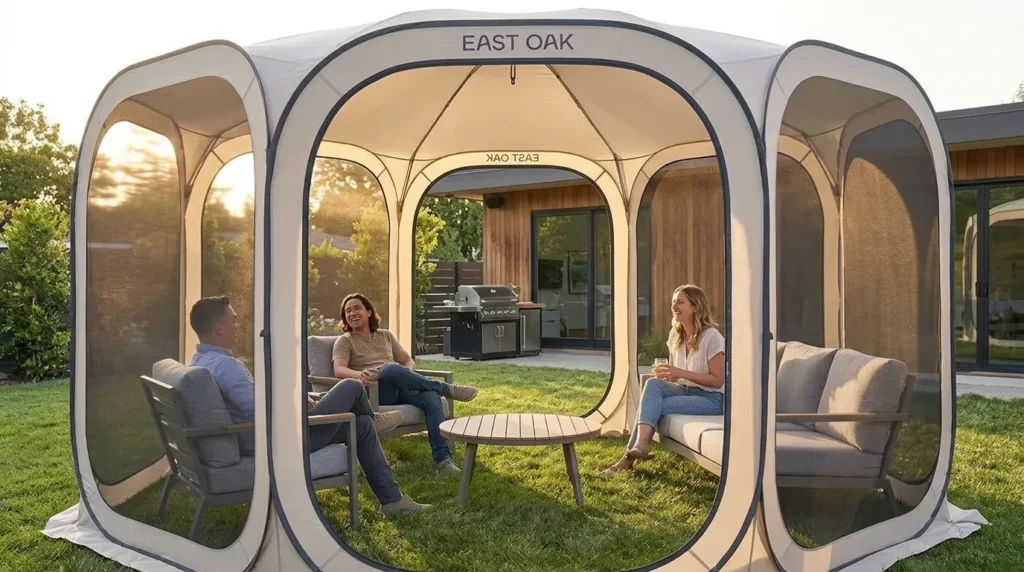
East Oak also points out that its flatter, tighter top prevents water from pooling the way it can on a soft dome. That is useful for dew and sprinkles, but remember the fabric itself is listed as not water resistant, so it is not a rain shelter.
Two doors are the other quiet win. With one door facing the grill and one facing the house, traffic flowed both ways without anyone climbing past the table. The DMH Outdoors tent is the only other shelter here with two doors, using magnets instead of zippers, but it is a much larger pole-built rectangle.
At night, the hook at the top center holds a battery lantern, and a string of lights wrapped around the frame edge looks great. Keep anything with a flame outside; the CPSC warns about carbon monoxide from fuel-burning heaters and lanterns in enclosed camping spaces, and a closed-up screen room on a cool night is exactly where people get tempted.
How Does the East Oak Screen House Tent Pop Up Handle Sun, Wind and Bugs?
The East Oak screen house tent pop up handles sun and bugs very well and wind only up to a point, with East Oak advising against use once winds pass 24 mph. Its silver-coated UPF 50+ fabric threw cool shade at midday, and the fine mesh kept mosquitoes out during every evening session.
Sun is where the coating earns its keep. Even on a hot July afternoon, the patio under the East Oak felt noticeably cooler than the open deck around it, and air moved freely through the mesh on all four sides. My camping in the summer guide covers more ways to stay cool in heat, and a shaded screen room is high on that list.
Wind is the limit. To put 24 mph in context, the National Weather Service’s Beaufort scale places 19 to 24 mph at the top of a fresh breeze, enough to sway small trees. Fully anchored, the East Oak stayed put through gusty afternoons below that, but I folded it whenever the forecast showed stronger gusts. Its reinforced steel main structure helps, but a spring frame still flexes.
Bugs were simply not a problem. With both doors zipped and the skirt weighted, evening mosquitoes stayed outside. If privacy or wind walls matter to you, the 12×12 VEVOR screen tent and Aoxun gazebo both include six zip-on wind cloths, which the East Oak does not offer.
How Does the East Oak Screen House Tent Pop Up Compare to Other Spring Screen Rooms?
The East Oak screen house tent pop up compares as the best-balanced spring screen room in this hub: straighter walls than the Alvantor, a longer track record than the Mars Explo, and the same 3-year warranty as the Mars Explo. The Mars Explo is its near twin, sharing a similar vertical frame, packed size, and wind caveat.
| Spring Screen Room (10×10) | Weight | Center Height | Wall Shape | Rating History | Warranty |
|---|---|---|---|---|---|
| East Oak | 23.4 lb | 7.5 ft | Vertical with arches | 2,000+ at 4.5 | 3 years |
| Mars Explo | 20.9 lb | 7.5 ft | Vertical with flying eaves | Under 50 at 4.6 | 3 years |
| Alvantor | 12 lb | 7 ft | Rounded bubble | 8,000+ at 4.5 | 1 year |
For camping rather than patios, the hub shelters still win. The Clam Escape screen tent handles wind and light rain better, the smaller Clam Venture screen tent suits couples, and the Coleman Skylodge portable screenhouse costs less with a canopy-style frame. But for the backyard, the East Oak is the one I kept.
Frequently Asked Questions About the East Oak Screen House Tent Pop Up
Is the East Oak screen house tent pop up waterproof?
No. The fabric is listed as not water resistant, so treat it as a sun and bug shelter. Its flat, tight top helps prevent water from pooling during dew or light sprinkles, but a steady rain will come through. Fold it before storms, and always let it dry completely before packing it into the round case to prevent mildew.
How many people fit in the East Oak screen house tent pop up?
The 10×10 size is rated for four to six adults. Because the walls stay close to vertical, six people in camp chairs fit comfortably, and a patio sofa set with a coffee table fits with room to walk through either door. East Oak also makes 4×4, 6×6, and 12×12 sizes if you need a smaller or larger room.
What are the telescoping poles for on the East Oak?
The three telescoping poles are part of the East Oak frame kit and go in after the shelter springs open, positioned as the included manual shows. Fit them after opening and remove them before folding, because the shelter will not twist down into its case with the poles still in place. Keep them in the carry bag so they do not get lost.
Can you leave the East Oak screen house up all summer?
Yes, on a patio or lawn, as long as it is fully anchored with the stakes, guylines, and sandbags. Fold it before storms, heavy rain, or winds approaching 24 mph. Check anchors weekly and brush off leaves so moisture does not sit on the fabric. The 3-year warranty also makes it a safer bet for long-term outdoor use than most rivals.
Does the East Oak screen house tent pop up have a floor?
No, it has an open bottom with a fabric skirt, which lets it sit flat on patios and lawns. An outdoor rug inside works well and keeps furniture legs from sinking into grass. On a patio, set the included sandbags on the inside skirt at each corner to seal the edges and hold the shelter in place.
Helpful Guides
- How to Fold a Pop Up Screen Tent
- How to Set Up a Screen House Tent
- Do Screen House Tents Let Dust In?
- How to Clean Mold from a Tent Screen
- How to Prevent Mosquito Bites While Camping
Should You Buy the East Oak Screen House Tent Pop Up?
Yes, buy the East Oak screen house tent pop up if you want a bug-free patio or backyard room that goes up in under a minute, gives real headroom to the edges, and comes with a 3-year warranty. It was the shelter my family used most all summer.
Skip it if you need rain protection, camp in windy places, or want privacy walls. A taped-roof hub shelter or a 12×12 hexagon with wind cloths will handle those jobs better, and my pop up screen tent guide compares every option.