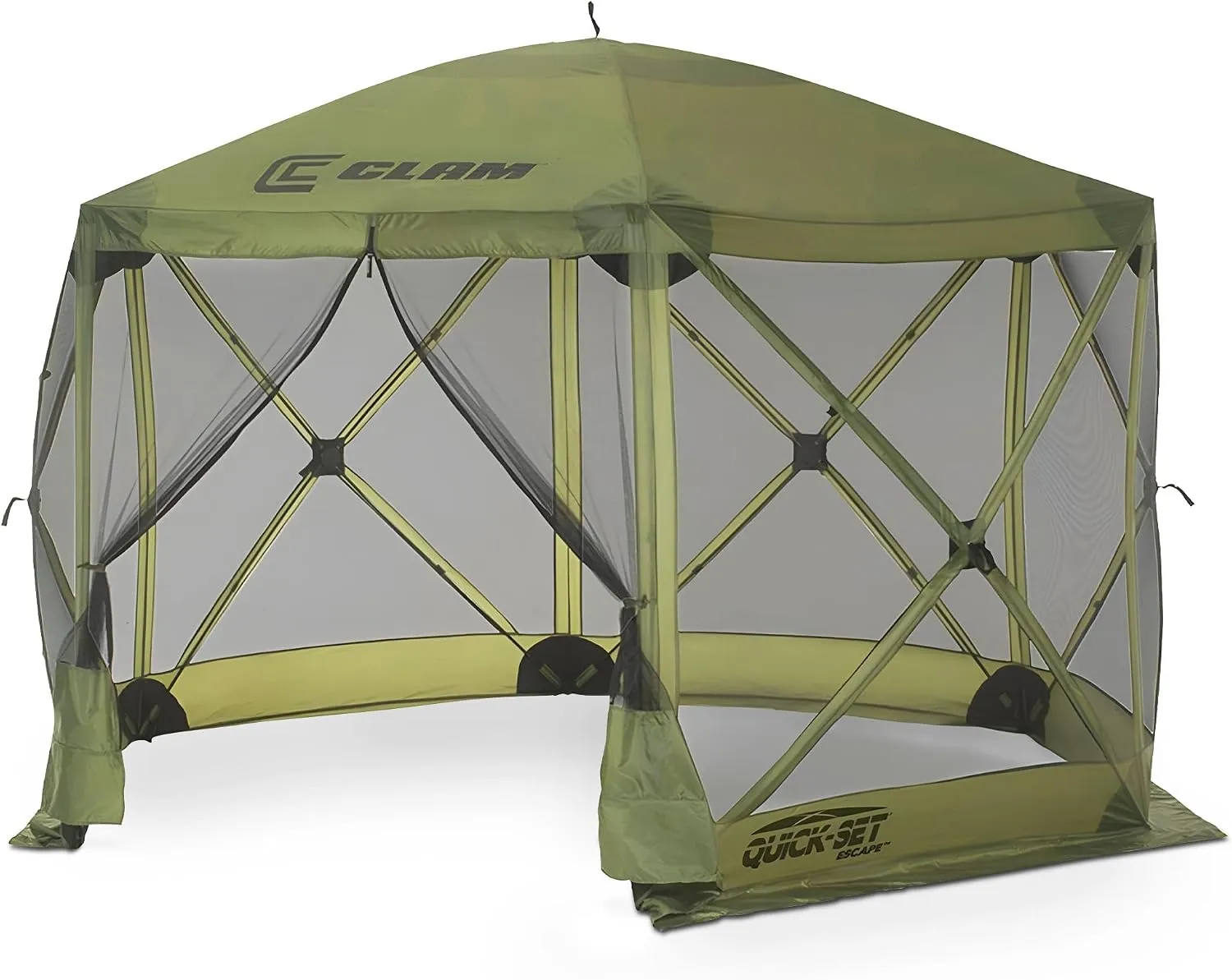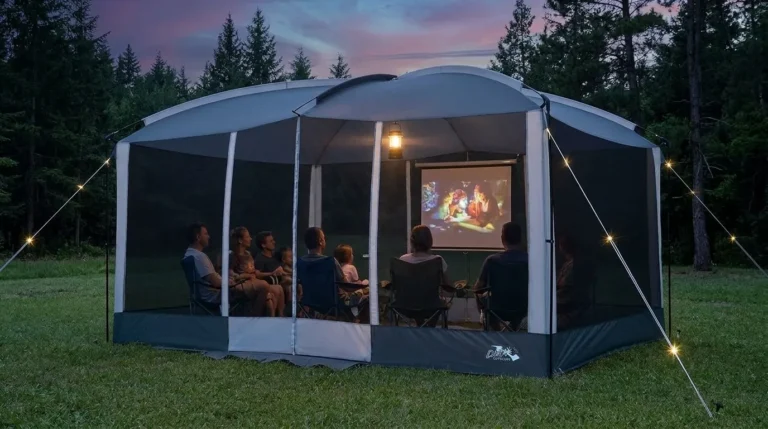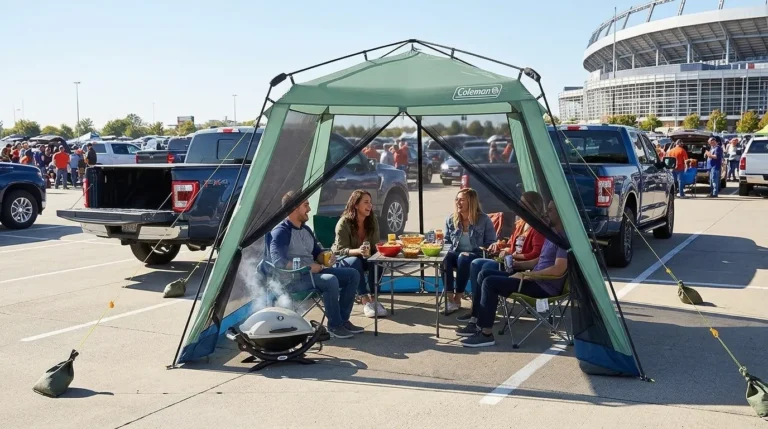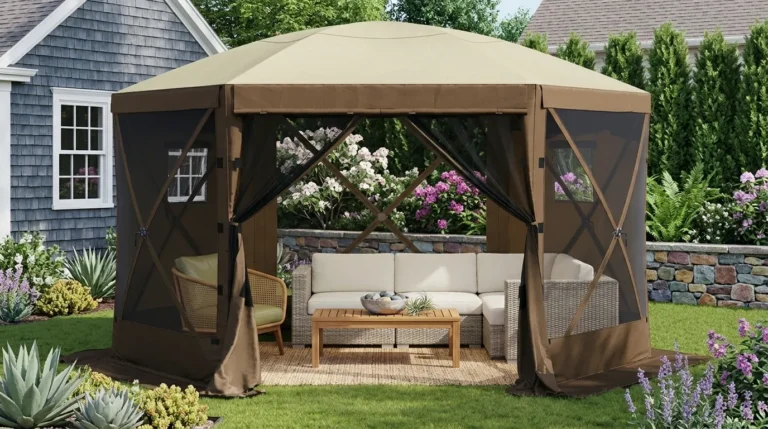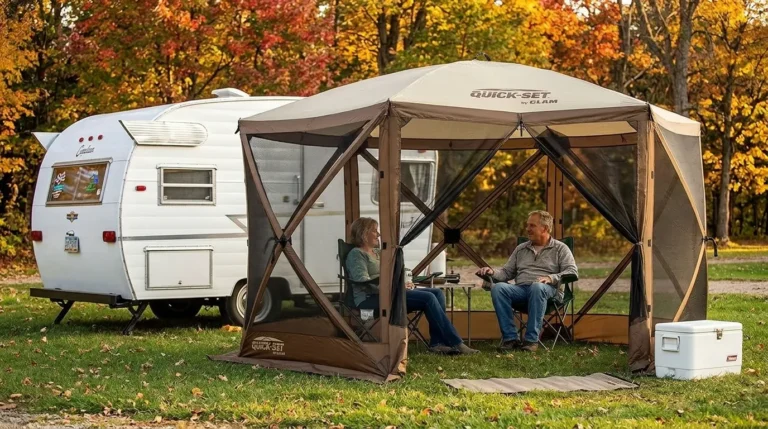
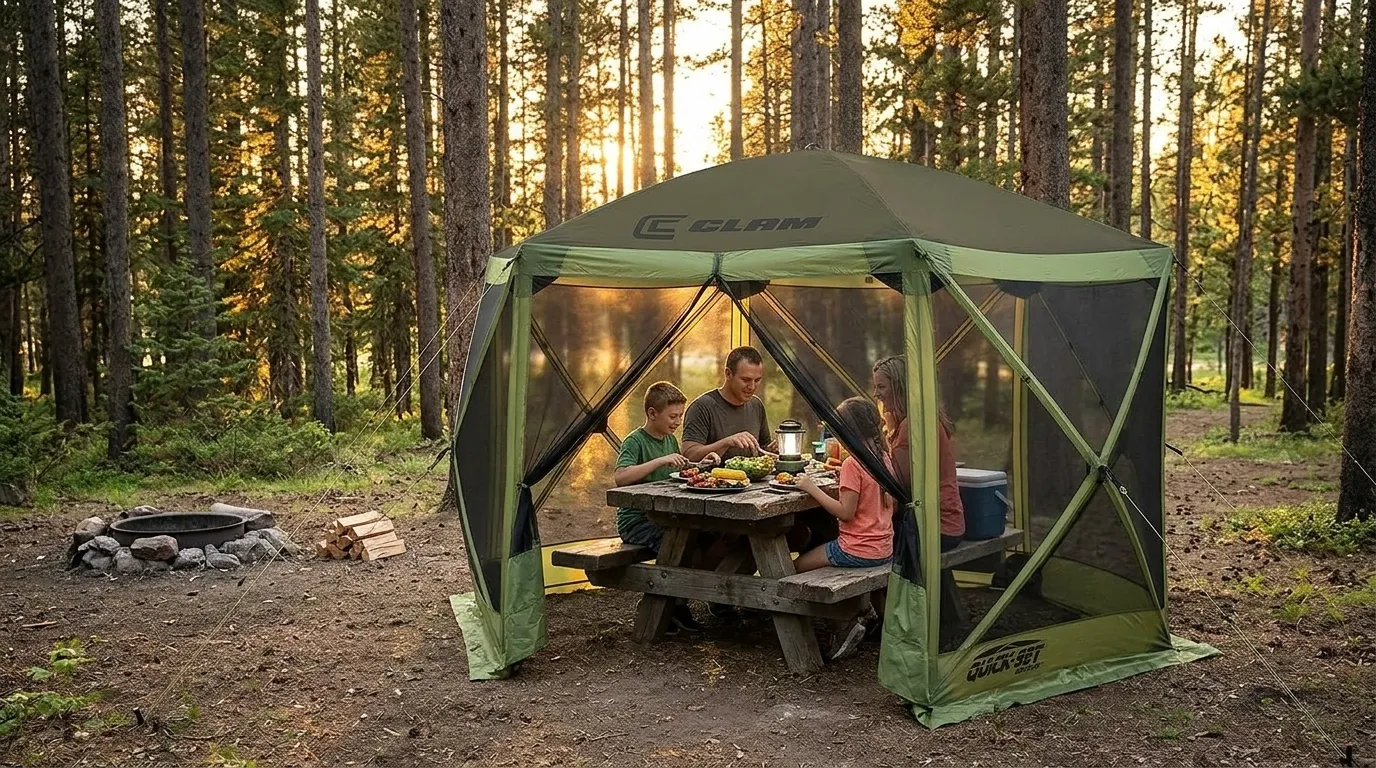

The Clam Escape screen tent was the first shelter I set up for this hub, and it set a bar the other nine spent the rest of the season trying to clear. Picture a campground loop at 7 p.m.: the burgers are coming off the grill, the no-see-ums are rising out of the grass, and the family two sites over is already retreating to their minivan. We stayed at the picnic table, behind a wall of fine green mesh, and finished dinner in peace. That is the job, and the Escape does it better than most.
This post contains affiliate links. As an Amazon Associate, I may earn commission from qualifying purchases at no extra cost to you.
The Escape is a six-sided hub shelter from Clam’s Quick-Set line, an 11.5-foot hexagon that pops open without loose poles and covers a full campground picnic table with room to walk around it. I ranked it as my best overall pick in my pop up screen tent guide, and this review explains exactly why, along with the tradeoffs you should know before spending premium money on it.
Overall Rating: 4.6/5
| Rating Question | Score (Out of 5) |
|---|---|
| How easy was it to set up alone? | 4.7 |
| How much room did it give around a picnic table? | 4.8 |
| How well did the mesh keep bugs out at dusk? | 4.7 |
| How steady was it in afternoon wind once staked? | 4.5 |
| How well did the roof handle light rain? | 4.4 |
| How easy was it to carry and pack? | 4.2 |
| How well did it hold up after repeated setups? | 4.6 |
What Are the Primary Pros and Cons of the Clam Escape Screen Tent?
The primary pros of the Clam Escape screen tent are its fast hub setup, generous 94-square-foot footprint, and fine no-see-um mesh, while the main cons are its 37-pound weight, long carry bag, and wind panels that cost extra. It is a premium shelter that earns its price through space and speed rather than features in the box.
Pros
| 1. Hub frame pops open in about a minute with no loose poles |
| 2. 140-inch hexagon fits over a campground picnic table with walking room |
| 3. 6-foot walls rising to a 7.5-foot peak keep chairs usable at the edges |
| 4. Fine no-see-um mesh plus a wide skirt kept biting bugs out at dusk |
| 5. 210D poly-oxford roof with taped seams sheds light rain |
| 6. Oversized carry bag makes repacking easy |
| 7. Huge rating history with 1,600+ Amazon reviews at 4.6 stars |
Cons
| 1. 37 pounds packed, a two-handed carry |
| 2. Packed bag runs about 72 inches long |
| 3. Wind panels are sold separately |
| 4. No UPF rating listed for the fabric |
| 5. Mesh walls let blowing rain reach gear near the edges |
| 6. Only one door |
| 7. Premium price for a screen room |
Those lists reflect what mattered over many setups. The pros all point to daily usability: fast to open, roomy, and genuinely bug-tight. The cons are mostly about carrying and cost. If you camp somewhere with heavy no-see-um pressure, the mesh alone justifies a lot; the University of Florida’s guide to biting midges notes that regular window screens do not exclude them, which is exactly why fine no-see-um mesh matters on a screen house. For the wider field, my best pop up screen tents roundup shows how the Escape stacks up against all nine siblings.
The Specs of the Clam Escape Screen Tent
| Feature | Specification |
|---|---|
| Brand and model | CLAM Quick-Set Escape, model 9281 |
| Shape | 6-sided hub hexagon |
| Footprint | 140 x 140 inches (about 11.5 x 11.5 ft) |
| Floor area | 94 square feet |
| Peak height | 90 inches (7.5 ft) |
| Wall height | 72 inches (6 ft) |
| Capacity | 6 people with chairs or a picnic table |
| Weight | 37 pounds |
| Packed size | 8 x 8 x 72 inches |
| Roof fabric | 210D poly-oxford with taped seams, water resistant |
| Frame | Fiberglass hub poles |
| Mesh | No-see-um mesh with extra-wide skirt |
| Doors | 1 zippered door |
| Included | Stakes, tie-down ropes, oversized carry bag |
| Floor | None, open bottom with ground skirt |
| Colors | Green, Brown, Gray, plus wind panel bundles |
The specs explain the personality. A 6-foot wall height is what makes the Escape feel like a room instead of a dome, and the long packed bag is the price of having poles long enough to reach that height. If you need something shorter in the trunk, I cover the smaller options further down.
How Fast Does the Clam Escape Screen Tent Set Up?
The Clam Escape screen tent sets up in about a minute once you have done it twice, with no loose poles to assemble. My first attempt took closer to three minutes because the hub method feels backward at first; by the third setup I was spending more time on stakes than on the shelter.
The sequence is simple. Unzip the bag, stand the shelter on its roof hub, and open it with the roof facing up and the poles inside. Then pull the handle at the center of each wall until it pops out and locks, work your way around, and finish by stepping inside and pushing the roof hub up. The first time the roof snaps into shape is genuinely satisfying.
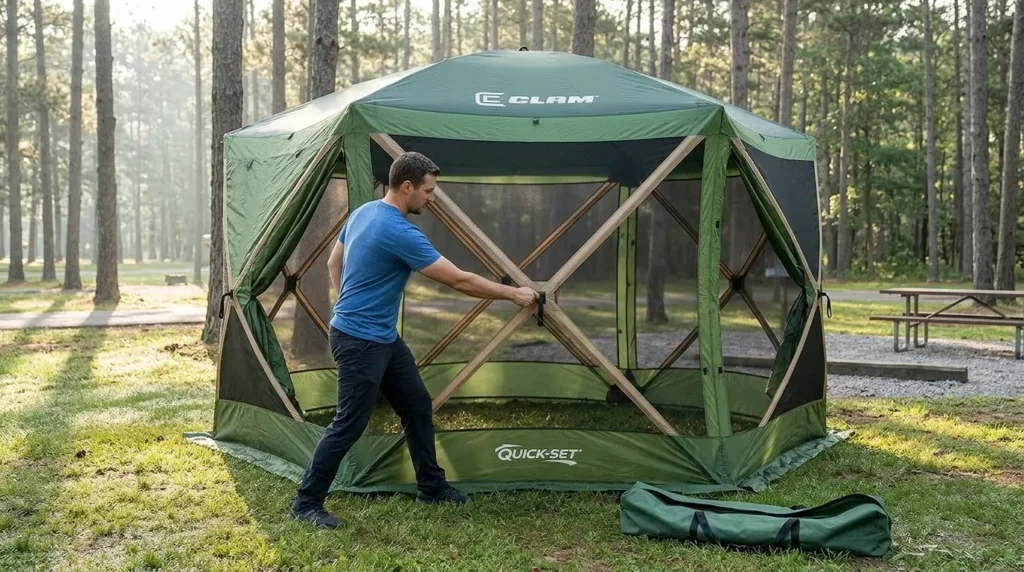
Compared with the spring-open rooms in this hub, the opening is slightly slower but far more controlled. The Alvantor screen house and the Mars Explo burst open on their own the moment you release the bands, which is faster but leaves you wrestling a flexing frame in any breeze. The Escape opens one wall at a time, so you are never fighting the whole shelter at once.
It is also a different feel from a telescoping frame like the Coleman Skylodge portable screenhouse, which unfolds like a canopy and needs room to expand outward before it rises. The Escape opens in place, which matters on tight campsites crowded with a table, a fire ring, and a car.
Anchoring adds about five minutes. Each wall has an eyelet at its center; I tie a rope there and stake it three to four feet out, angled away from the shelter. Do not skip this. The Escape is heavy enough to feel planted, but a hexagon with a 90-inch peak still catches a surprising amount of wind.
Takedown reverses the process: pull the roof hub down from inside, push each wall hub in with a flat palm, gather the poles, roll, and bag. The oversized bag is one of my favorite details, because I never had to fight the shelter back in.
How Much Room Is Inside the Clam Escape Screen Tent?
The Clam Escape screen tent gives you 94 square feet inside a 140-inch hexagon, enough to cover a standard campground picnic table with walking room on every side, or six adults in camp chairs around a folding table. The 6-foot walls are what make that space usable, because chairs can sit right against the mesh without anyone hunching.
In my table test, I set up a 6-foot folding table, six chairs, and a cooler. Everything fit, and I could still walk a full lap around the table. At a state park site, the Escape went straight over the fixed picnic table with the benches fully inside, which is the single best thing a camp screen house can do.

If you camp as a couple or a small family, the 9×9 Clam Venture screen tent gives you the same hub design in a lighter, five-sided package, but it will not cover a picnic table with walk-around space. If you host a crowd around a banquet table, the 13×9 rectangle of the DMH Outdoors tent uses floor space more efficiently than any hexagon, though it is pole-built rather than pop-up.
For patio use, the vertical-wall East Oak screen house tent pop up feels roomier than its 10×10 footprint suggests, but it is a lighter, fair-weather structure. The Escape is the shelter I would choose when the space needs to work as a real camp dining room for a long weekend.
One practical note about space: keep the campfire well outside. Recreation.gov’s campfire safety tips put campfires at least 15 feet from tent walls and other flammables, and screen mesh is no exception. I set the Escape on the far side of the picnic table from the fire ring every time.
The roof center has a hanging loop that is perfect for a battery lantern, and it turned the shelter into the obvious evening hangout. A small rug inside kept the grass from turning to mud under the table on a wet weekend.
How Does the Clam Escape Screen Tent Handle Wind, Rain and Bugs?
The Clam Escape screen tent handles bugs excellently, light rain well, and moderate wind well once every guyline is staked, but it is not a storm shelter. Its strengths are the no-see-um mesh, the wide skirt that seals to the ground, and a taped 210D roof that sheds showers.
Bugs first, because that is why you buy a screen house. With the door zipped and the skirt staked flat, nothing got in during dusk sessions at a lakeside site that was thick with gnats. The extra-wide skirt matters as much as the mesh; on lumpy ground I weighed the windward edge with rocks to close the gaps.

Wind is where staking makes or breaks the experience. With all six guylines out, the Escape stayed steady through a gusty afternoon that bent the tops of nearby saplings. The National Weather Service’s Beaufort scale describes a fresh breeze at 19 to 24 mph as strong enough to sway small trees, which is about where I start watching any screen house closely. Above that, I fold it down. Remember too that adding Clam’s optional wind panels turns the walls into sails, so every guyline has to be out before they go on.
Rain is good with one caveat. The taped roof sheds light and moderate showers, and the inside stayed dry under the roof. But mesh walls let blowing rain through, and the walls bow outward slightly, so anything resting against them gets wet. If you expect weather, the optional wind panels on the windward side make a big difference. If rain is your main concern, the Gazelle G6 lists a 2000mm waterproof roof rating, the only specific number in this hub.
One more honest note: the listing does not give a UPF rating for the fabric, so I treat the Escape as good shade rather than certified sun protection. In practice the green roof threw deep, cool shade at midday.
How Does the Clam Escape Screen Tent Compare to Other Hub Screen Tents?
The Clam Escape screen tent compares well against the other big hub shelters in this hub, winning on track record and footprint, while the 12×12 hexagons win on included wind cloths and the Gazelle wins on its rain rating. All four use the same pull-the-wall hub method, so the differences come down to weight, extras, and fabric.
The two 12×12 hexagons are the obvious alternatives. The Vevor screen tent and the Aoxun gazebo are larger on paper and both include six zip-on wind cloths in the box, which the Escape does not. They are also cheaper. In exchange, the Escape has a far longer rating history at a higher average, and its mesh and hardware felt a step more refined in my hands.
| Hub Shelter | Footprint | Weight | Wind Panels | Roof Rating Listed |
|---|---|---|---|---|
| Clam Escape | 11.5 x 11.5 ft | 37 lb | Sold separately | Water resistant, taped seams |
| Gazelle G6 | 124 in. across | 34 lb | Sold separately | Waterproof to 2000mm |
| VEVOR 12×12 | 12 x 12 ft | 32 lb | 6 included | Water resistant |
| Aoxun 12×12 | 12 x 12 ft | 37.5 lb | 6 included | Waterproof listed |
The Gazelle G6 is the closest premium rival. It costs about the same, lists the stronger rain rating, and uses a tough single-filament mesh. The Escape counters with a slightly larger footprint and years of owner feedback behind it. If your trips are mostly dry and buggy, I would take the Escape; if afternoon storms are routine, the Gazelle deserves a hard look.
If you also own a canopy, think about how the two will work together. My pop up canopy tent guide covers straight-leg canopies, and a canopy over the camp kitchen plus the Escape over the dining table is a combination I used often.
Frequently Asked Questions About the Clam Escape Screen Tent
How many people fit in the Clam Escape screen tent?
The Clam Escape screen tent comfortably fits six adults in camp chairs around a folding table, or a full campground picnic table with the benches inside and room to walk around. The 94-square-foot floor and 6-foot walls let chairs sit right at the edges. You can squeeze more people in standing, but six seated is the realistic number for a relaxed meal.
Does the Clam Escape screen tent have a floor?
No, the Clam Escape screen tent has an open bottom with an extra-wide fabric skirt that lies on the ground and seals against bugs and drafts. That design lets it sit over a picnic table and on uneven ground. I put a large outdoor rug inside on wet or dusty weekends, which keeps chairs from sinking and cuts down on mud and grit under the table.
Is the Clam Escape screen tent waterproof?
The roof is water resistant rather than fully waterproof, made from 210D poly-oxford with taped seams, and it sheds light to moderate rain well. The mesh walls let wind-driven rain through, so gear near the walls can get wet in a blowing shower. Clam’s optional wind panels block that on the windward side. For heavy rain, treat it as a shade and bug shelter and keep valuables in the center or the car.
How heavy is the Clam Escape screen tent to carry?
The Clam Escape screen tent weighs 37 pounds and packs into a long bag about 72 inches in length, so it is a two-handed carry from the car. The bag has a shoulder strap, which helps for short walks. If you regularly carry gear a long way from parking, the 26-pound Clam Venture or a spring-open screen room will be easier on your back.
Can you add walls to the Clam Escape screen tent?
Yes. Clam sells Quick-Set wind panels separately, and they attach to the Escape’s walls to block wind, blowing rain, and sun, or to add privacy. Bundles that include panels are also sold. Stake every guyline before attaching panels, because solid walls catch far more wind than mesh, and leave at least one side open for airflow on warm days.
Helpful Guides
- How to Fold a Pop Up Screen Tent
- How to Set Up a Screen House Tent
- Do Screen House Tents Let Dust In?
- How to Clean Mold from a Tent Screen
- How to Prevent Mosquito Bites While Camping
Should You Buy the Clam Escape Screen Tent?
Yes, buy the Clam Escape screen tent if you want one camp shelter that sets up fast, covers a full picnic table, and keeps no-see-ums out without fuss. It is the shelter I reach for first for multi-night camping trips, and its long track record backs up what I saw in testing.
Skip it if you carry gear a long way from the car, camp mostly as a couple, or want privacy walls in the box. In those cases, the smaller Clam Venture, a lighter spring-open room, or a 12×12 hexagon with included wind cloths will suit you better. For the full lineup, my pop up screen tent guide lays out every option.