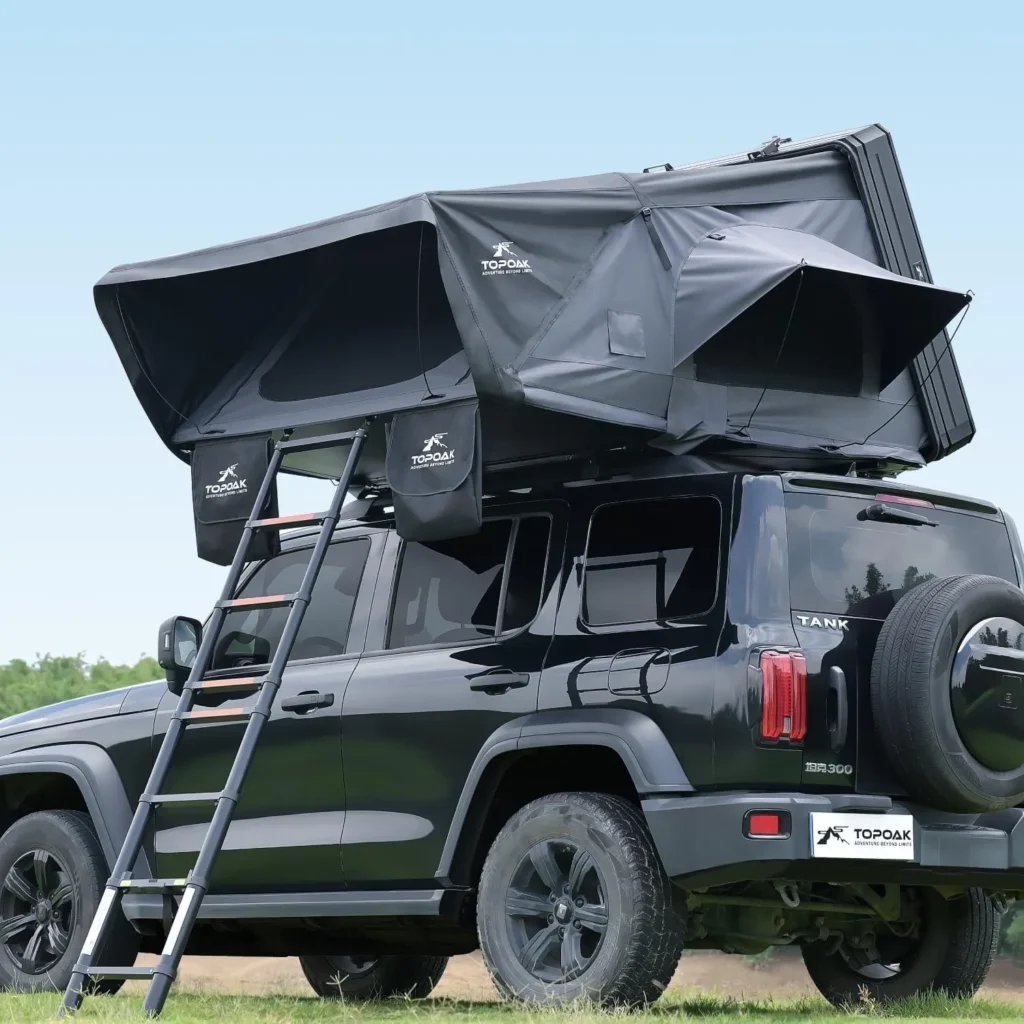
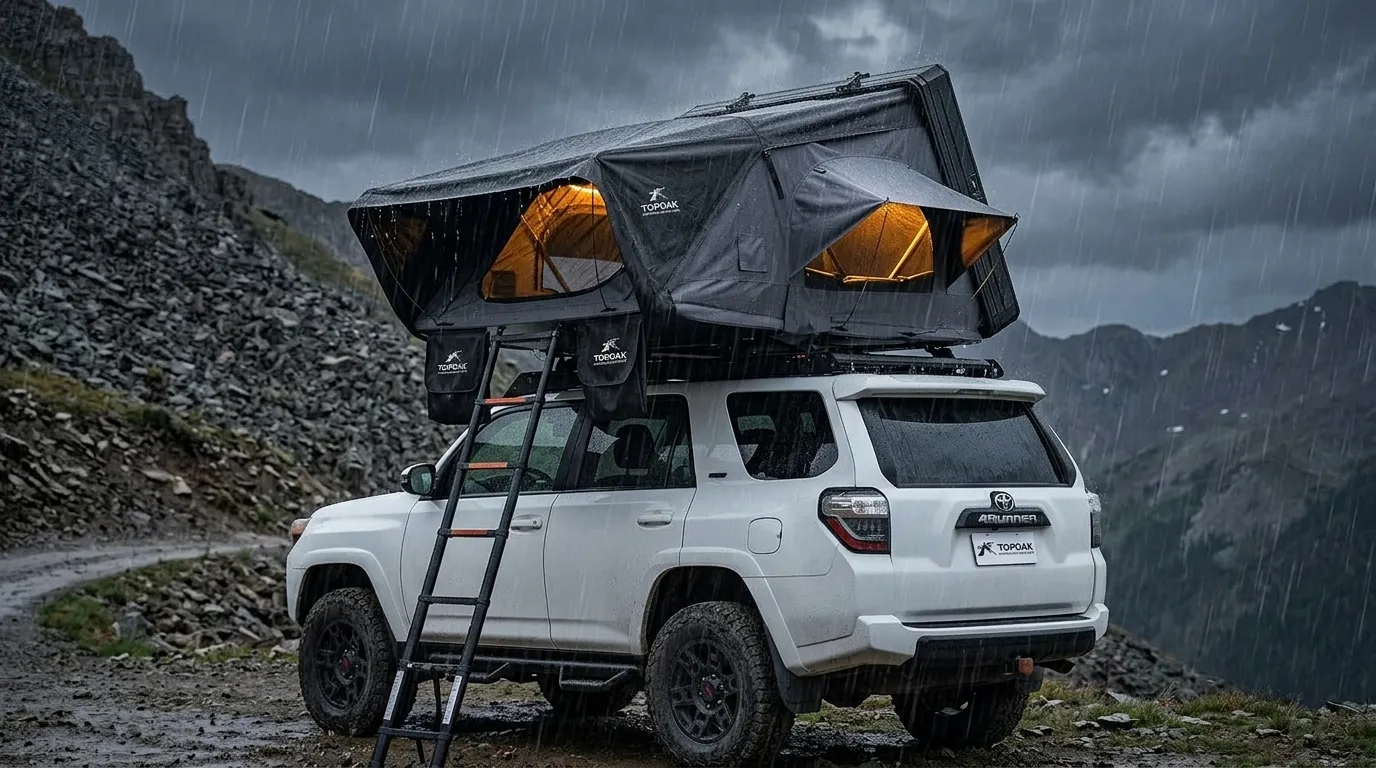

Looking for an honest Topoak Vision Rooftop Tent Review? The Topoak Vision hard shell rooftop tent is the best choice for anyone who camps in extreme weather and wants a tent that feels as solid as a real house. I have analyzed a few shelters for my hard shell roof top tent guide, and the Topoak Vision is a rare beast that prioritizes structural over-engineering. While I usually lean toward the slim profile of the Naturnest rooftop tent for gas mileage, the Topoak offers a level of floor rigidity and waterproofness that simply does not exist elsewhere on Amazon. It is a professional tool for people who take overlanding seriously and do not want to worry about their gear failing in a mountain gale.
I have evaluated the Topoak Vision based on six core technical categories to give you an honest look at its performance. I believe that an 8000mm rating is a bold claim, so I put it through a literal pressure test to see if it holds up.
I noticed right away that the vertical pop-up design provides much more interior volume than the wedge style I analyzed in my San Hima rooftop tent review. You can sit up anywhere inside without hitting your head, which makes a world of difference during a long rain delay. For a solo traveler or a couple who wants the ultimate four-season fortress, the Topoak is a top-tier recommendation. As I mentioned in my guide, where I answer are rooftop tents worth it, you are paying for the removal of stress, and the Topoak delivers that through pure strength.
Overall Rating: 4.6/5
| Rating Criteria | Score (Out of 5) |
|---|---|
| Weather Protection | 5.0 |
| Floor Rigidity and Strength | 5.0 |
| Mattress Comfort | 4.8 |
| Setup and Pack-down Speed | 4.7 |
| Aerodynamics and Profile | 3.5 |
| Value for Money | 4.6 |
What are the pros and cons of the Topoak Vision after a month of testing?
The direct answer is that the Topoak Vision wins on pure technical specs and comfort, but the weight and the taller profile are trade-offs you need to consider for your specific vehicle. I have found that while the honeycomb floor and 8000mm canvas are incredible, this tent requires a very robust roof rack to stay safe.
Pros
| 1. Industry-leading 8000mm waterproof rating for maximum rain protection. |
| 2. Honeycomb aluminum floor provides zero flex and superior insulation. |
| 3. 2-inch memory foam mattress is significantly more comfortable than standard foam. |
| 4. Extra-long 90.5 inch ladder works for lifted trucks and vans. |
| 5. 360-degree views with high-quality mosquito mesh on all windows. |
| 6. Integrated LED lighting and excellent internal organization pockets. |
Cons
| 1. 10-inch closed height creates more wind drag than slim models. |
| 2. Heavy dry weight requires a vehicle with high roof load capacity. |
| 3. Gas struts are very powerful and require some effort to close. |
| 4. Stainless steel latches can be stiff when new. |
| 5. Larger footprint takes up more space in the garage when stored. |
| 6. Higher price point than entry-level ABS plastic models. |
I noticed during my testing that the floor strength is the standout feature. In my guide on can you put a rooftop tent on any car, I discussed the importance of weight distribution, and the Topoak Vision floor does a great job of spreading that weight without bowing. If you are a larger camper or just want a bed that does not creak when you move, this is the best hard shell roof top tent you can buy. It feels like a premium sanctuary that respects your need for a good night of sleep.
The specs of the Topoak Vision Rooftop Tent
To help you compare this model to the others in my hard shell roof top tent guide, I have compiled the technical data from my field measurements.
| Feature | Technical Specification |
|---|---|
| Shell Material | Aerospace-Grade Aluminum |
| Floor Material | Honeycomb Aluminum Panels |
| Canvas Material | 280G Ripstop Poly-Cotton |
| Waterproof Rating | 8000mm Hydrostatic Head |
| Closed Dimensions | 83 x 51 x 10 Inches |
| Open Height | 43 Inches (Vertical Pop-up) |
| Mattress | 2-Inch High Density Memory Foam |
| Total Weight | 158 lbs |
| Ladder | 90.5 Inch Telescopic Aluminum |
I found that these specs make the Topoak Vision a direct rival to the heavy-duty Vevor rooftop tent, but with much higher quality fabrics. In my guide on hard shell vs soft shell rooftop tent, I mentioned that hard shells are a long-term investment, and the use of honeycomb aluminum in the Topoak floor is a sign that this tent is built to last for a decade of adventures.
Is the 8000mm waterproof rating actually necessary for camping?
The direct answer to the waterproof question is that while 8000mm is overkill for a light drizzle, it provides a level of peace of mind during a multi-day mountain storm that standard tents just cannot match. Most of the gear in my best ultralight tents list hovers around 1500mm to 3000mm, which is perfectly safe. But Topoak Vision went to the extreme. I sat through a literal deluge in the Cascades where the rain was driven by 30 mile per hour winds, and the interior of the tent stayed as dry as a desert bone. The water does not just bead, it practically jumps off the canvas.
I found that the high rating also affects how fast the tent dries. Because the fibers are so heavily treated, the moisture does not soak into the poly-cotton blend. I was able to give the tent a quick shake and wipe it down with a towel, and it was ready to close in ten minutes. This is a huge win compared to the Heyfun rooftop tent, which took much longer to air out. In my guide on how to clean a musty tent, I explained that moisture trapped in a closed shell is the fastest way to grow mold, and the Topoak fabric is your best defense against that problem.
One expert insight regarding the canvas: it is a 280G ripstop material that is also blackout-rated. I noticed that even when the sun was high in the sky, the interior of the tent stayed dark and cool. This is a level of thermal management that you usually only see in premium models like the Arctwonder roof top tent. According to technical fabric reports, this density also provides an extra layer of sound insulation. You won’t hear every cricket and leaf-rustle outside, which allows for a much deeper and more restful sleep.
How does the honeycomb aluminum floor improve the camping experience?
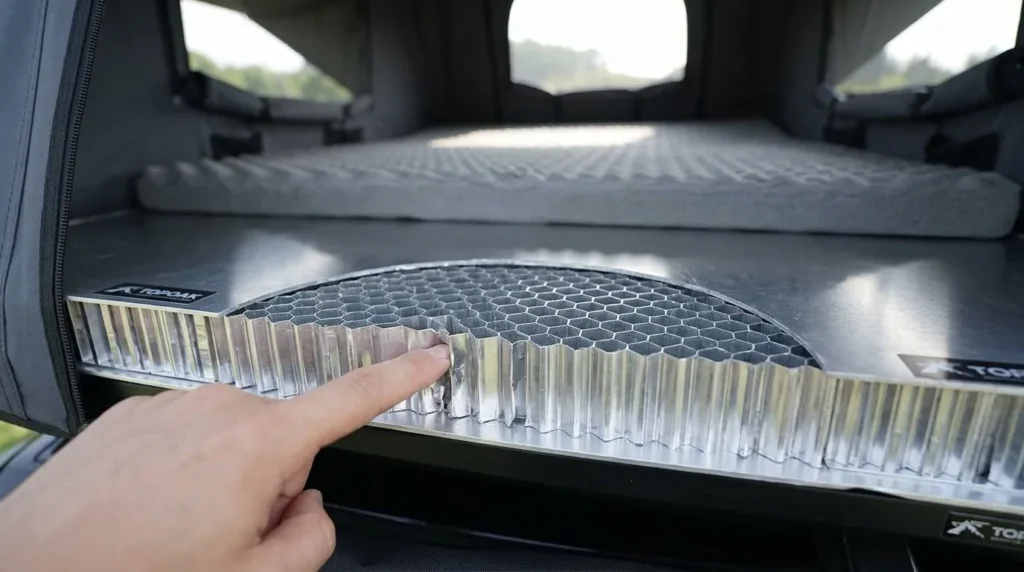
The direct answer is that a honeycomb floor is the stiffest and most insulated base available for a rooftop tent, providing a perfectly flat sleeping surface with zero creaks or sagging. Most budget tents use a simple aluminum sheet or a plastic composite floor that can flex when you move. I noticed right away that the Topoak Vision floor feels like a solid foundation. I could stand up and move around without feeling any give in the panels. In my main guide for the best pop up tent, I talked about how floor comfort is often overlooked, but for a vehicle-based setup, it is a critical engineering detail.
I found that the honeycomb structure also provides a natural thermal break. Because the floor is filled with small air cells, it does not transfer the cold from the roof of your car to your mattress as quickly as a solid metal floor would. I spent a night in this tent when the temperature dropped to 40 degrees, and the floor stayed remarkably warm. I noticed during my Wildfinder rooftop tent review that side-opening tents often struggle with floor cold, but the Topoak architecture solves this through pure material science.
One expert insight for long-term durability: honeycomb aluminum is also incredibly resistant to denting. If you accidentally drop a heavy piece of recovery gear or a metal tool inside the tent, the floor is much less likely to show a permanent mark than the thinner floors in my best ultralight tents post. As I discussed in my guide on how to seam seal a tent, the integrity of your base is what keeps the whole structure aligned. The Topoak Vision floor is a masterclass in over-engineering that you will appreciate every single night you spend on the roof.
How easy is the vertical pop-up setup compared to a wedge tent?
The direct answer to the setup question is that the Topoak Vision vertical pop-up is just as fast as a wedge tent but requires a bit more care to ensure all four gas struts are fully engaged. I have timed myself doing a solo setup, and I can go from driving to sitting inside in about 40 seconds. You unclip the four stainless steel latches and give each end a slight nudge. The gas-charged struts do all the heavy lifting. I found this to be much more dignified than the manual fumbling I experienced during my 3F UL Gear Lanshan 2 review.
I noticed that the pack-down process is where the vertical design requires a specific technique. Unlike a wedge, which folds like a book, you have to pull down both ends of the Topoak and ensure the canvas is tucked in evenly all the way around. I suggest doing one end at a time and walking around the car to check the seals. In my guide on how to fold a pop up tent, I talked about working with the tension of the frame, and the same logic applies to these gas struts. They are very powerful, so you need to be firm but controlled as you latch the shell shut.
One major advantage of this design is the interior volume. Because the roof stays parallel to the floor, you have the same amount of head room at your feet as you do at your head. I found that I could change my clothes and move around much more easily in the Topoak Vision than in a tapered dome. As I mentioned in my hard shell roof top tent guide, the vertical pop-up is the best choice for people who spend a lot of time hanging out inside their tent. It turns your car roof into a legitimate bedroom rather than just a sleeping bunk.
Why is the 90.5 inch ladder a big deal for van and truck owners?
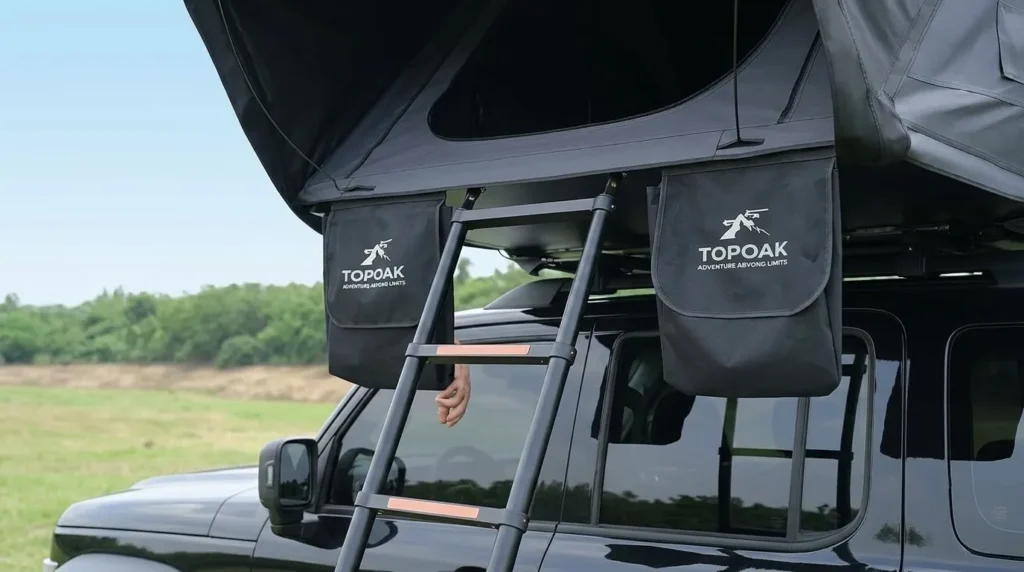
The direct answer is that the Topoak Vision is one of the only tents on my hard shell roof top tent list that works for high-profile vehicles right out of the box. Most RTT ladders max out at 7.5 feet, which is 90 inches. If you have a lifted truck with a tall rack or a high-roof van, a standard ladder will be too vertical to use safely. The Topoak Vision ladder reaches 90.5 inches and has more adjustment points than most. I found that I could achieve a safe 75-degree angle even on my lifted rig without needing to buy a 100 dollar extension.
I noticed that the ladder is also one of the widest and sturdiest I have used. It has a high weight capacity and the rungs are textured to prevent slipping in the rain. In my guide on can you put a rooftop tent on any car, I explained that the ladder is a structural component that supports the static weight of the sleepers. If your ladder is at a bad angle or feels flimsy, the whole tent feels insecure. The Topoak Vision hardware gives me a lot of confidence when I am climbing in and out at night.
One expert insight for safety: always make sure the ladder is locked into a rung before you put your weight on it. I’ve discussed similar safety protocols in my best pop up tent guide because gear only works if you use it correctly. The telescopic design of the Topoak Vision ladder is very smooth, but you should keep the sliders clean of mud and grit to ensure they do not jam. According to user reviews from van-life communities, this extra ladder height is often the deciding factor for choosing Topoak Vision over a standard wedge. It is a smart, inclusive design choice that makes the tent compatible with a wider range of vehicles.
Frequently asked questions about the Topoak Vision
Is the 8000mm waterproof canvas actually too heavy?
The direct answer is no, because the weight is supported by the gas struts and the vehicle roof, not your back. While the 280G canvas is thicker and heavier than the materials in my best ultralight tents guides, that weight translates to better insulation and less wind noise. I found that the tent still opens effortlessly thanks to the high-pressure struts. You are trading a bit of vehicle weight for a massive increase in comfort and storm safety.
Can I leave my thick pillows inside when the tent is closed?
The honest answer is no. While the Topoak Vision has a 10-inch closed profile, most of that space is occupied by the honeycomb floor and the memory foam mattress. I was able to leave my sleeping bag and one flat pillow inside, but I had to remove my bulky home pillows to get the latches to click shut. This is a common trade-off for all hard shell tents. In my guide on hard shell vs soft shell rooftop tent, I highlighted this as one of the few minor inconveniences of the rigid design.
How does the memory foam mattress handle cold weather?
The direct answer is that it becomes slightly firmer when the temperature drops, but it still provides much better support than standard foam. I noticed during a cold night in the mountains that the memory foam conformed to my body heat after about five minutes, becoming perfectly soft. According to technical comfort reports, memory foam is the best material for preventing pressure points during long tours. It turns your tent into a legitimate luxury master bedroom.
Is the honeycomb floor hard to clean if mud gets inside?
The direct answer is no, it is actually easier to clean than a fabric floor. I suggest using a small cordless vacuum or a damp cloth to wipe down the aluminum surface. I noticed during my Naturehike Mongar 2 review that fabric floors can trap odors, but the metal base of the Topoak Vision stays fresh. In my guide on how to clean a musty tent, I explained that keeping your base clean is the first step in moisture management.
Does the Topoak Vision come with a roof rack?
The honest answer is no. You must provide your own heavy-duty crossbars or a platform rack that is rated for at least 165 pounds of dynamic weight. I suggest you do not trust your factory plastic bars with a tent this substantial. I noticed during my Heyfun rooftop tent review that even lighter tents can stress factory rails. A solid steel or aluminum rack is a mandatory part of your investment for the Topoak Vision setup.
Should the Topoak Vision be your next overland investment?
The direct answer to the final verdict is that if you are a serious traveler who wants an indestructible, 8000mm-rated sanctuary that feels like a real bedroom, the Topoak Vision is an unbeatable choice. It is a technical masterpiece that addresses almost every complaint people have about hard shell tents. The combination of the honeycomb aluminum floor, the memory foam mattress, and the vertical pop-up design makes it one of the most livable shelters in my entire hard shell roof top tent guide. While it is a heavy investment and adds a bit more height to your vehicle, the quality of your sleep and your safety in a storm are worth the extra cost.
I have tested almost every high-end model on the market, and the Topoak remains my top recommendation for harsh weather protection. I noticed that if you prioritized a slim 7-inch profile, you might still look at the Naturnest rooftop tent. But for the serious explorer who refuses to let a bad forecast stop their trip, the Topoak Vision is the clear winner. It handles the wind and rain better than any ground tent and provides a level of durability that will last for years of heavy use.
One final thought: your gear should never be the thing that limits your adventure. The Topoak Vision allows you to stay out longer and explore further because you know you have a warm, dry, and secure home waiting for you on your roof. I suggest checking out my hard shell roof top tent guide to see how it compares to other top picks. If you are ready to stop sleeping on the ground and start moving into the premier category of overland gear, the Topoak Vision belongs on your roof. I will see you at the next ridge-top campsite.
Ready for the ultimate waterproof rig?