

The Quictent pop up canopy is the one I would pick if I had to turn an empty parking spot into a shaded, semi-enclosed market stall for under $160. After my earlier test of the Eurmax 10×10 canopy review, which won my toughest pick on a certified top and a heavy frame, I wanted to know how much of that setup a cheaper canopy could deliver with walls and an awning included. The answer is a lot, with a few honest catches about weight, setup, and wind.
This post contains affiliate links. As an Amazon Associate, I may earn commission from qualifying purchases at no extra cost to you.
This review is part of my pop up canopy tent guide, where I ranked ten 10×10 canopies on setup, weight, anchoring, and price. The Quictent 10×10 pop up canopy tent is my pick for the best vendor booth kit in the hub, and below I explain who it suits and who should skip it.
Overall Rating: 4.3/5
| Rating category | Score (Out of 5) |
|---|---|
| How complete was the walled setup for a vendor booth? | 4.7 |
| How well did the fire retardant 600D top handle sun and rain? | 4.4 |
| How well did it hold up in wind? | 4.0 |
| How easy was it to set up? | 3.9 |
| How easy was it to carry and store? | 3.9 |
| How complete was the anchoring kit? | 4.5 |
| How good is the value for the price? | 4.5 |
What are the primary pros and cons of the Quictent pop up canopy?
The main pros of the Quictent pop up canopy are its three sidewalls and awning, its 600D fire retardant top, and its complete anchoring kit, while the main cons are its weight, its manual setup, and a wind limit that walls make tighter. Here is the full list from my time with it.
Pros
| 1. 3 removable sidewalls plus a removable awning, all with roll up mesh windows |
| 2. 600D PU coated fire retardant top with UPF 50+ |
| 3. Full kit: 4 sandbags, 8 stakes, and 4 guy lines |
| 4. 800D wheeled bag included |
| 5. Tall clearance, with a peak from about 10 to 10.7 ft |
| 6. 1 year frame warranty plus a half year on the cover |
| 7. $159.99 with walls and an awning is cheaper than the Eurmax or Cobizi |
Cons
| 1. 52.2 lb is heavy and best handled by two people |
| 2. Manual expand setup takes about 3 minutes with no center lock |
| 3. Only 116 ratings so far |
| 4. Walls and awning add sail area, and the maker says not to use it above 35 mph |
| 5. Some buyers report the bag zipper separating |
| 6. Durability feedback from buyers is mixed |
| 7. No named fire standard such as NFPA 701 is listed |
If you plan to enclose a booth, the pros are exactly what you need. If you want a quick, light, solo canopy, the cons will bother you more than they would bother a vendor. A canopy with walls behaves differently in wind, and the National Weather Service Beaufort scale is a good reference for judging a breezy day. For the full ranking of every canopy I tested, my pop up canopy tent guide shows where the Quictent lands.
The Specs of the Quictent Pop Up Canopy
| Feature | Specification |
|---|---|
| Brand | Quictent |
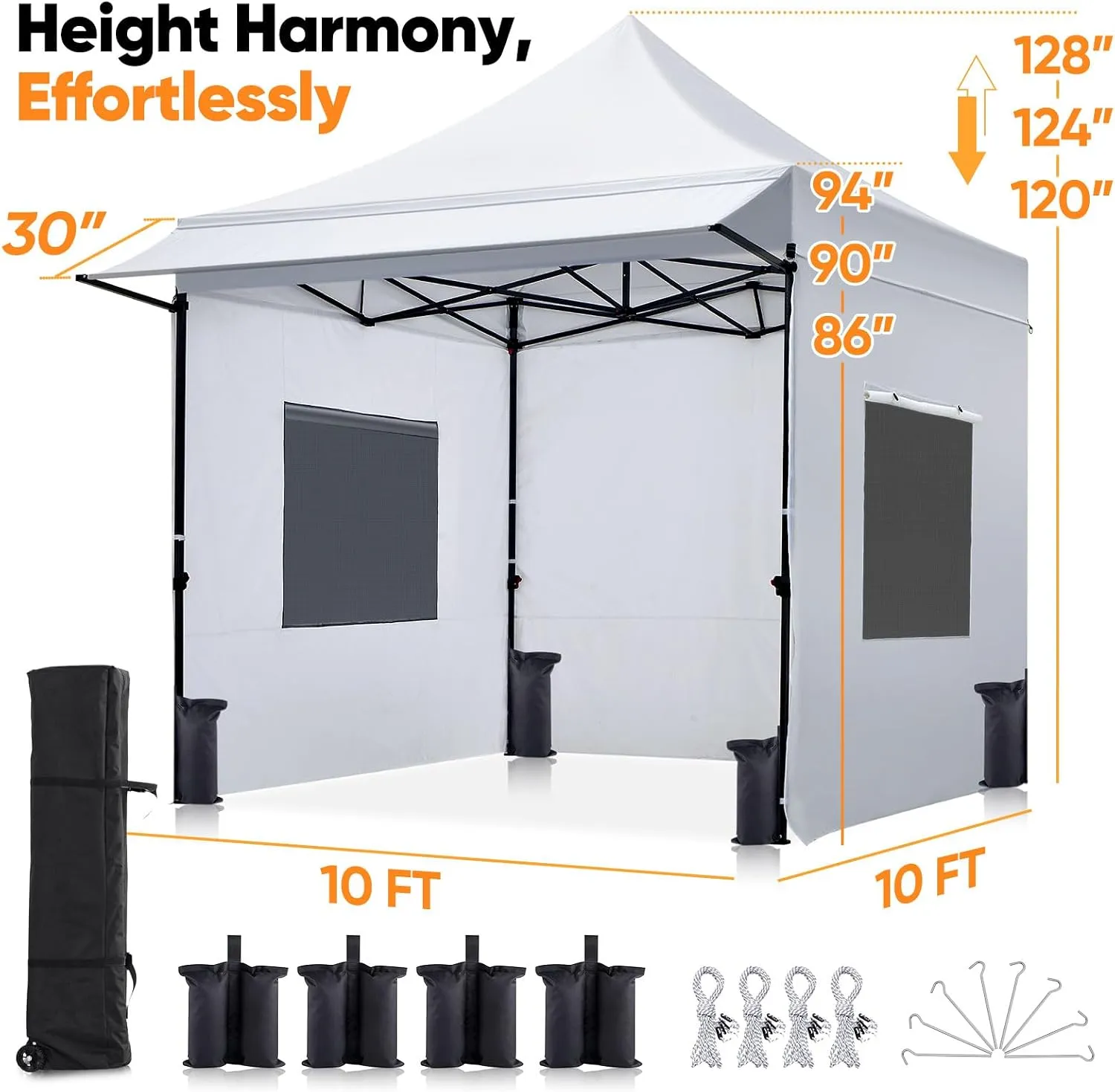
| Roof size | 10×10 ft, with the awning the brand quotes 125 sq ft of shade |
| Dimensions | 120 x 120 x 128 inches |
| Height positions | 3 settings, peak about 10 to 10.7 ft |
| Weight | 52.2 lb |
| Frame | Alloy steel truss |
| Top fabric | 600D PU coated fire retardant fabric, UPF 50+ |
| Walls and awning | 3 removable sidewalls and 1 removable awning, roll up mesh windows |
| Setup | Manual expand, about 3 minutes, no center lock |
| Bag | 800D wheeled bag |
| In the box | Top, frame, wheeled bag, 3 sidewalls, 1 awning, 4 sandbags, 8 stakes, 4 guy lines |
| Warranty | 1 year on the frame, half year on the cover |
| Amazon rating | 4.4 out of 5 from 116 ratings |
At 52.2 pounds it is far heavier than the 33 pound Eagle Peak canopy 10×10 review frame and a bit lighter than the 62 pound Cobizi canopy review model. That weight is the cost of a sturdier frame and extra walls, and it is why I treat this as a two person canopy.
What do the three sidewalls and awning on the Quictent pop up canopy actually do?
The three sidewalls and the awning on the Quictent pop up canopy turn an open roof into a semi-enclosed booth, giving you wind blocking, low sun shade, and privacy on three sides. They are the reason this canopy exists, and they are the best part of the package.
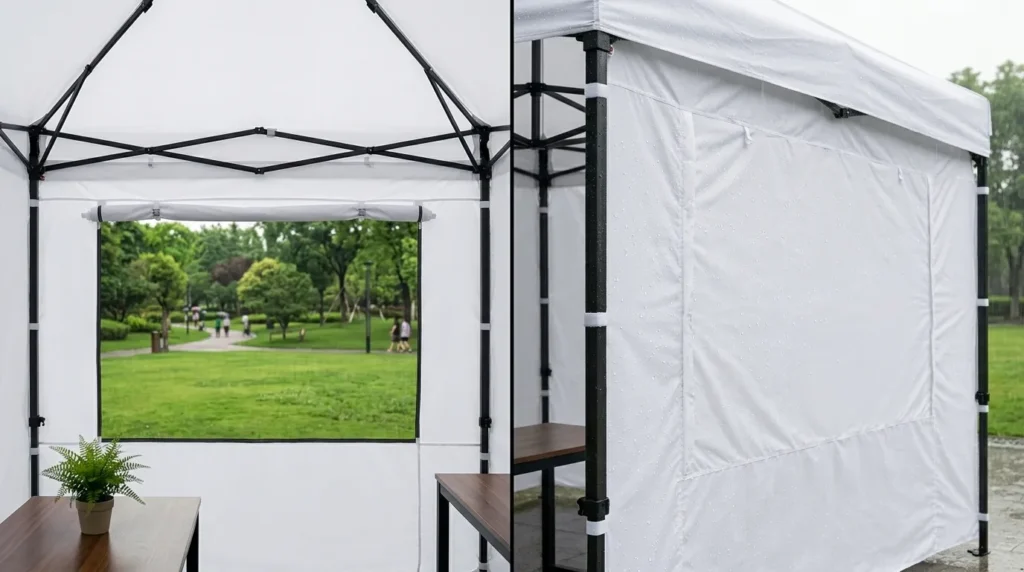
Each wall has roll up mesh windows, so you can open them for airflow or close them against drizzle. The awning extends the roof outward, and with it the brand quotes about 125 square feet of shade, up to 10 to 12 people. That is more than the 100 square foot roof alone, and it is enough for a vendor with a table and a customer line.
Here is how I use the walls:
- Two walls on the sunny side for low afternoon sun.
- One wall on the back for a display or a changing cloth.
- The awning on the front for a service counter.
- All walls off in a stiff breeze.
You can attach them in any order, and they detach quickly, which is the key to using them safely in changing weather. A wall adds sail area, so when gusts rise I take the walls off first.
Most other canopies in my hub skip this entirely. The ABCCANOPY durable easy pop up canopy tent review covers a lighter canopy with just one pocketed storage wall, which is great for a camp kitchen and not enough for a booth. If you sell at the beach, my beach camping tents guide has anchoring ideas that matter even more with walls.
For community picnics and playground parties of 10 or more, my tents for families guide covers how much shade space a crowd needs. The Quictent’s awning is helpful in those cases, since it adds a covered edge for serving food.
How easy is the Quictent pop up canopy to set up and carry?
The Quictent pop up canopy is moderately easy to set up and carry, and I found it easiest with two people. There is no center lock, so you expand the frame by hand, which takes about three minutes once you know the order.
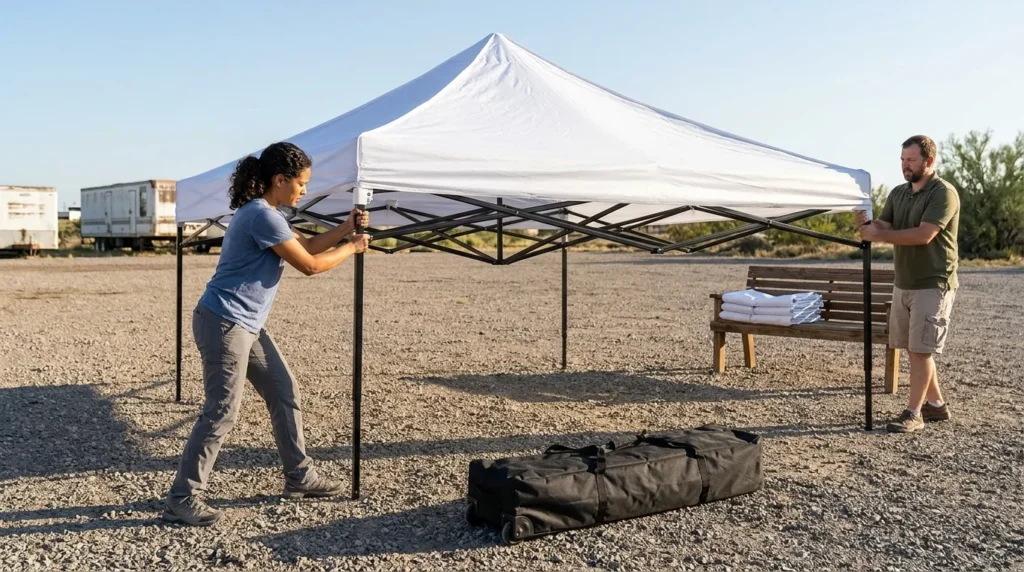
Here is how setup goes:
- Take the frame out of the wheeled bag and extend it on a level spot.
- Drape the top over the frame and secure it at the corners.
- Expand the frame fully and lock each leg at your chosen height.
- Anchor the legs and attach the walls and awning last.
Weight is the real hurdle. At 52.2 pounds, the frame is awkward to handle alone, and I would not try to lift it into a car by myself. The 800D wheeled bag makes moving it easy, but some buyers report the bag zipper separating, so I treat the bag as the part to check first.
Compare that with the lighter, faster options. The 10×10 ft pop up canopy tent with sidewall review covers the Sannwsg, which has three windowed walls and a one touch lock at 37.4 pounds, and the 10×10 slant leg canopy review covers the 22 pound Oneofics, which is much simpler and much smaller.
The Quictent is slower than both, and it is also sturdier than both. If you plan to set up the canopy once and leave it all day, the three minutes hardly matter. If you set up and tear down for several events a week, the weight adds up.
The step by step setup for any canopy is also in the Helpful Guides below.
How does the Quictent pop up canopy hold up in wind, rain, and sun?
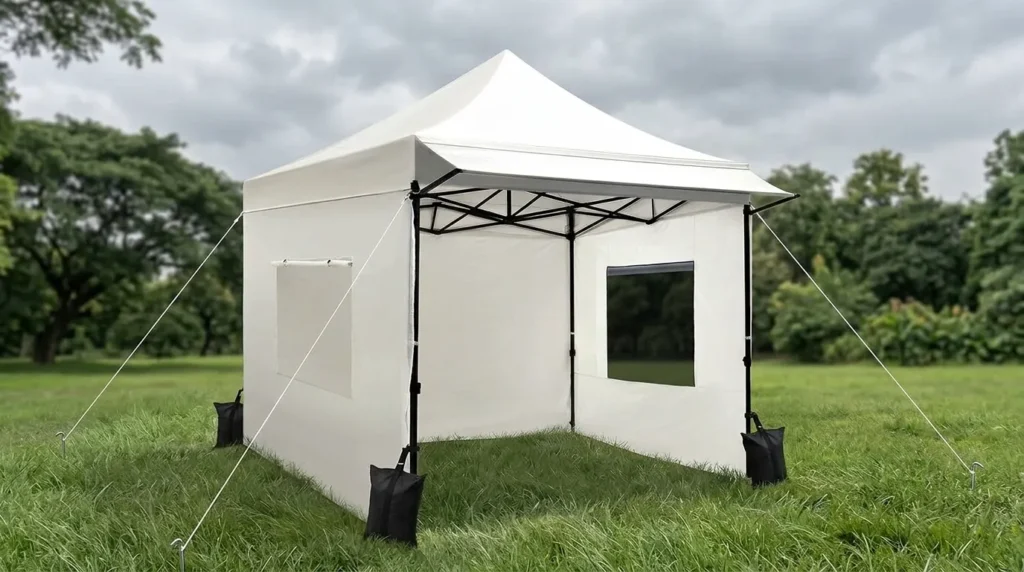
The Quictent pop up canopy holds up well in sun and rain, but wind is its limit, especially with the walls on. The 600D top is heavy and fire retardant, but the maker’s own safety notes say not to use the canopy in winds above 35 miles per hour.
For sun, the top is UPF 50+, and the EPA UV Index scale helps you judge how harsh the day is. The walls and awning add side shade that open canopies lack, which is a real comfort in late afternoon.
For rain, the 600D PU coated fabric is heavier than the 150D tops on many rivals, and the roll up mesh windows close against drizzle. I treat the canopy as water resistant, not waterproof.
For wind, the kit is generous: four sandbags, eight stakes, and four guy lines. I weight every leg, stake the lines, and still treat 35 miles per hour as the absolute ceiling, which is a near gale on the Beaufort scale. The National Weather Service wind safety page is worth a read before any outdoor event. If you do not need walls, the MasterCanopy 10×10 review covers a lighter roof only canopy, and the one push pop up canopy review covers a budget model with its own full anchor kit. The Yaheetech canopy review covers another full kit with twelve stakes.
On fire safety, the top is described as fire retardant, but I did not see a named standard like NFPA 701. Fire marshals often ask for labeled certification, as this city fire marshal tent guide explains, so ask your organizer what they accept before you rely on it.
For a certified top, the Eurmax is the safer pick, and for all ten canopies, my pop up canopy tent guide has the details.
How does the Quictent compare to other canopy tents with sidewalls in the hub?
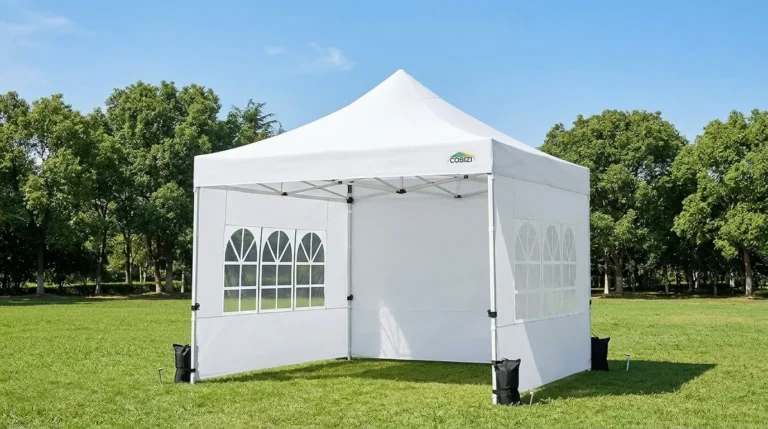
The Quictent is the best walled canopy for a vendor booth because it is the only one with three walls and an awning, but it is also the heaviest of the walled canopies except for the Cobizi. The Sannwsg, the Cobizi, and the ABCCANOPY are its walled rivals.
Here is how they compare on the shared point of included walls:
| Canopy | Walls included | Weight |
|---|---|---|
| Quictent 10×10 | 3 walls plus awning | 52.2 lb |
| Sannwsg 10×10 | 3 windowed walls | 37.4 lb |
| Cobizi 10×10 | 4 PU coated walls | 62 lb |
| ABCCANOPY 10×10 | 1 storage wall | 31 lb |
The Sannwsg is lighter and about $12 cheaper, but it has no awning and a lighter frame. The Cobizi has four walls and the thickest poles, but it weighs about 10 pounds more and costs about $10 more. The ABCCANOPY is the lightest and cheapest, but it is a roof with one wall, not a booth.
If you want a booth with an awning, the Quictent is the best fit. If you want the lightest walled canopy, the Sannwsg is better. If you want full enclosure with the sturdiest frame, the Cobizi is the pick. For all ten side by side, my pop up canopy tent guide has the full table.
One more thought: the awning is the feature the others lack, and it makes the Quictent feel like a small storefront rather than a shade tent.
What are the most common questions about the Quictent pop up canopy?
The most common questions about the Quictent pop up canopy are about sidewalls, setup time, wind, fire retardancy, and the warranty, and the answers below cover each one.
Does the Quictent pop up canopy come with sidewalls?
Yes, the Quictent pop up canopy comes with three removable sidewalls and one removable awning, all with roll up mesh windows. That leaves one side open for a service counter or for walking in, and you can change which sides get walls to suit the sun and wind. The walls zip or strap on, and I take them off when the breeze picks up. If you want all four sides enclosed, Quictent sells other versions with four sidewalls.
How long does it take to set up the Quictent pop up canopy?
It takes about three minutes to set up the Quictent pop up canopy, and I found it easiest with two people. The frame expands manually and there is no center lock, so it feels more like a traditional canopy than a one push model. The first setup takes longer while you learn how the walls and awning attach. Adding the anchors and the walls stretches the job to about ten minutes.
Can the Quictent pop up canopy handle 45 mph wind?
No, I would not trust the Quictent pop up canopy in 45 mph wind, even though the marketing mentions that figure. The maker’s own safety notes say not to use it in winds above 35 mph, and that is the number I respect. A 35 mph wind is in the near gale range on the Beaufort scale, and walls and an awning add sail area. I weight every leg, stake the guy lines, and take it down far earlier than that.
Is the Quictent pop up canopy fire retardant?
The Quictent pop up canopy top is described as a 600D fire retardant fabric, but I did not see a named standard such as NFPA 701 or CPAI-84. That matters because fire marshals and event organizers often ask for a labeled certification, not just a description. If you need proof, ask the organizer what they accept before you buy. For a certified top, the Eurmax lists CPAI-84, NFPA 701, and ULC.
What warranty does the Quictent pop up canopy have?
Quictent lists a one year frame warranty and a half year warranty on the cover. That is shorter than I would like for a canopy that works every weekend. The frame is the more expensive part, so the one year frame cover is the more useful of the two. Keep your order details and check the frame, joints, and top for damage soon after your first few uses.
Helpful Guides
- How Durable Are Pop-Up Canopy Tents in Severe Weather?
- How to Clean a Canopy Tent
- How to Put Up a Pop Up Canopy Tent
- How to Choose Between Cheap and Premium Pop-Up Canopy Tents
- How to Fold a Pop Up Beach Tent
Should you buy the Quictent pop up canopy?
Yes, I recommend the Quictent pop up canopy if you want a walled vendor booth with an awning for under $160 and you have a helper and a roomy vehicle. The three sidewalls, the awning, the 600D top, and the full anchoring kit give you more in the box than almost any canopy in this guide.
Skip it if you want a light, one person canopy, since the Eagle Peak or the Vinabilia is easier to handle. Skip it if you need a named fire standard like NFPA 701, since the Eurmax lists one. And skip the walls in strong wind, since the maker says not to use it above 35 miles per hour. My pop up canopy tent guide ranks all ten.