
Do you know how to fold pop up play tent and why it’s so difficult for most parents? Pop up frames are built with high-tension spring steel or fiberglass that stores a massive amount of kinetic energy, and if you do not release that energy in a specific geometric sequence, the tent will simply fight you until it pops back open. I have been that parent, standing in the middle of a messy playroom, red-faced and sweating as I try to shove a stubborn circle of nylon into a bag that feels three sizes too small. In my guide on the best kids play tent, I talked about the luxury of a 1-second setup, but the trade-off is almost always a 10-minute teardown if you do not know the secret.
People assume they can just crush the tent flat and it will fit. That is the fastest way to permanently warp your frame. I’ve tested dozens of models for my technical reviews, such as the Dinosaur play tent review, and I’ve realized that once you understand the figure-8 secret, you can pack up any of these kids adventure play tents in under 30 seconds. It is a technical skill that relies on finesse rather than raw strength. According to a 2025 consumer survey, over 30% of pop-up gear is thrown away simply because the owner could not figure out how to fold it back into the original carry bag.
I’m writing this guide to ensure you are never the person leaving a half-folded tent in the corner of the garage. Throughout this ‘how to fold pop up play tent’ guide, I will break down the taco-fold, the wrist-twist, and the air-purging techniques I use on everything from small domes to the massive structures. As I mentioned in my guide on what to look for kids play tent safety, a bent or broken frame is a legitimate safety hazard for children. My goal is to make sure your teardown is as effortless as your setup so you can get back to enjoying your home.
What is the step-by-step process for the classic figure 8 fold?
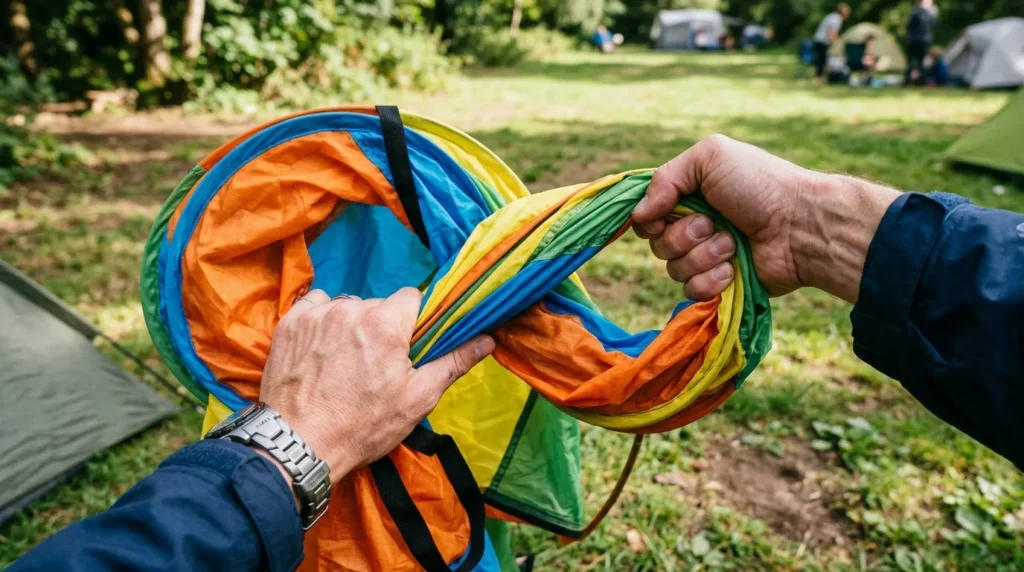
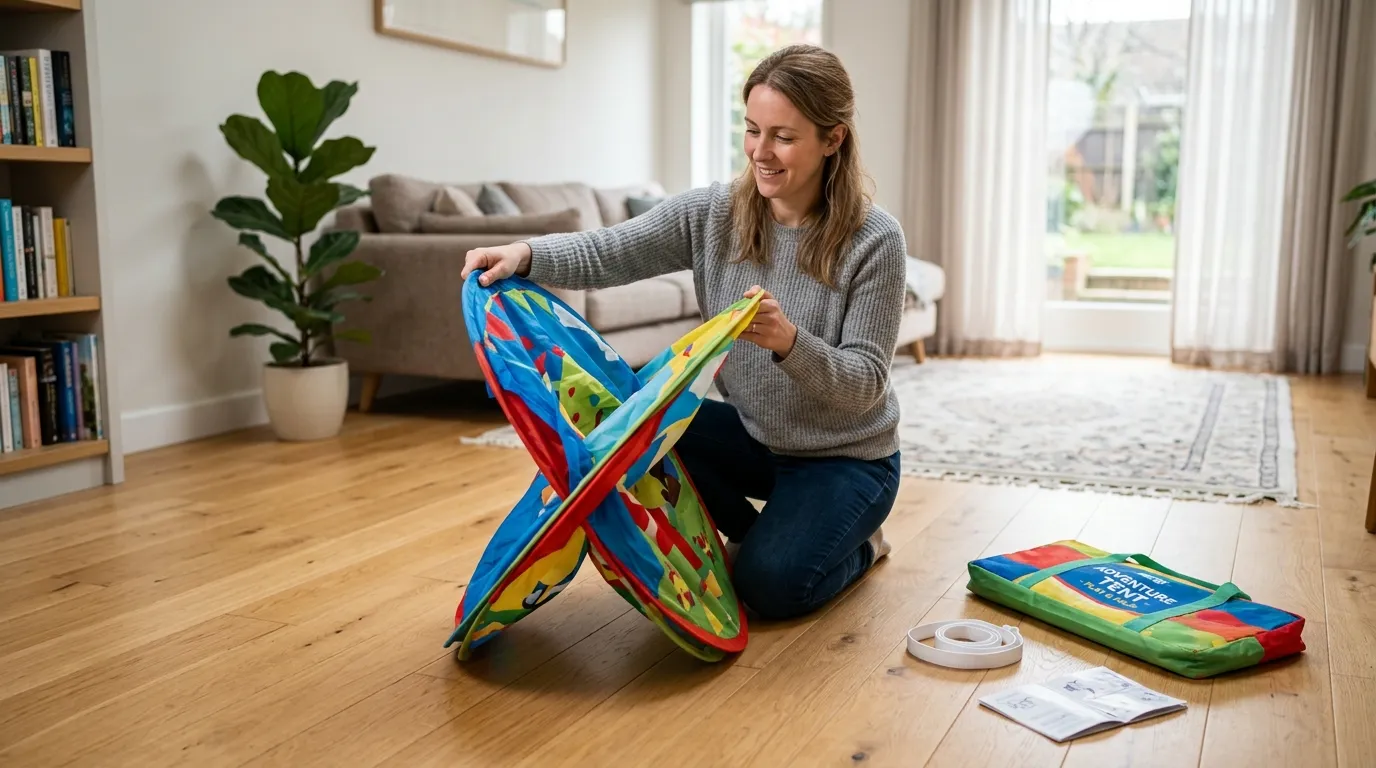
Mastering the fold is a three-stage process. You must first collapse the tent into a flat taco shape, stand it on its side, and then twist your wrists inward to guide the frame into two overlapping circles. I’ve found that this is the most universal method for the play tents for kids category. You start by pushing one corner into the opposite corner until the tent is flat. Once it looks like a single panel, you gather all the edges together. This is the taco stage. If you try to skip this and jump straight to the twist, the fiberglass will likely snap or splinter.
The twist is where most people get nervous. When you stand the taco on its end and push the top down toward your feet, the frame will naturally want to curve. This is where you apply a slight inward rotation with your hands. I spent an afternoon practicing this with the farm play tent, and I found that the less I fought the tension, the easier it was. You are not forcing the metal; you are simply suggesting a path for the energy to travel. If you feel a hard resistance, stop, let it pop open, and start over.
Always keep your feet together at the base of the tent while you twist. This acts as a pivot point that prevents the tent from sliding away from you on a slippery floor. I used this trick while testing the pink play tent, and it made the process much more stable. According to structural engineering reports for spring-frames, the figure-8 method distributes the stress evenly across the entire loop, preventing the weak points at the joints from failing. By following this technical sequence, you are protecting the integrity of your kids indoor play tent for hundreds of uses.
Why must you purge all the air before attempting a fold?
A sealed tent acts like a giant balloon, and as you try to compress the frame, the trapped air creates internal resistance that can make the poles feel brittle or cause the fabric to rip. I have seen many parents struggle with a fold simply because they forgot to unzip the door. When you are using a high-volume kids play tent, like the Diorssen pop up playhouse tent, the air has nowhere to go but through the seams. If you force the fold too fast, you put massive stress on the waterproof coatings and the mesh panels.
The best way to purge the air is to leave the main entrance and at least one window open halfway during the entire teardown. I noticed while testing the outdoor teepee tent that even a small amount of trapped air changed the way the fiberglass behaved. It makes the taco-fold feel lumpy and unpredictable. I suggest you lay the tent flat on the floor first and walk across it with your knees to squeeze out the oxygen before you start the geometric sequence. This is a technical step that separates a pro teardown from a frustrating struggle.
One thing to be extra careful about: check the floor for toys before you compress it. I once tried to fold a tent while a small plastic block was hidden in the corner, and it almost pierced the floor fabric. As I mention in my guide to cleaning kids play tents, internal debris is the primary cause of small snags. According to fabric durability data, air-pressure damage is most common in silver-coated tents like the Diorssen because the coating makes the fabric less porous. By ensuring the air has an exit path, you are reducing the workload on your wrists and the tension on the frame, making the ‘how to fold pop up play tent’ mission a total success.
How do different tent shapes affect your folding technique?
While the figure-8 method is universal, the number of steps and the amount of physical force required change based on the height and complexity of the frame. A tall castle tent requires you to reach much higher to start the taco fold, whereas a low-profile dome can be managed while sitting on your heels. To help you visualize the difference, I have created a technical difficulty table based on the various models I have reviewed for this hub.
| Tent Shape | Frame Complexity | Difficulty Level | Folding Secret |
|---|---|---|---|
| Basic Dome | Low | Easy | Simple wrist twist |
| Princess Castle | High | Moderate | Fold the turrets inward first |
| Square Playhouse | Medium | Easy | Align all four corners perfectly |
| Hexagonal Playpen | High | Hard | Requires two people for stability |
| Teepee / Triangle | Moderate | Moderate | Remove the central poles before twist |
I noticed during my princess castle tent review that the Skirfy model requires an extra step where you tuck the roof peaks into the body before you attempt the main fold. If you try to twist the whole castle at once, you will likely bend the top rods. In my guide for the best kids play tent, I emphasized that geometry determines your quality of life at camp, and the same applies to the playroom. A more complex shape like the Zooawa requires you to gather six poles instead of four, which increases the tension significantly.
Always look at the seams where the poles meet the fabric. I’ve found that on budget models, this is where the frame most often pokes through during a fold. If you are using a high-quality model like the BSHAPPLUS, the sleeves are reinforced to handle this stress. The structural integrity of these frames is a safety priority. By matching your technique to the specific shape of your gear, you ensure that your play tents for kids stay stable and secure for your next rainy-day adventure.
How do you fold a multi-part tunnel tent play set without it tangling?
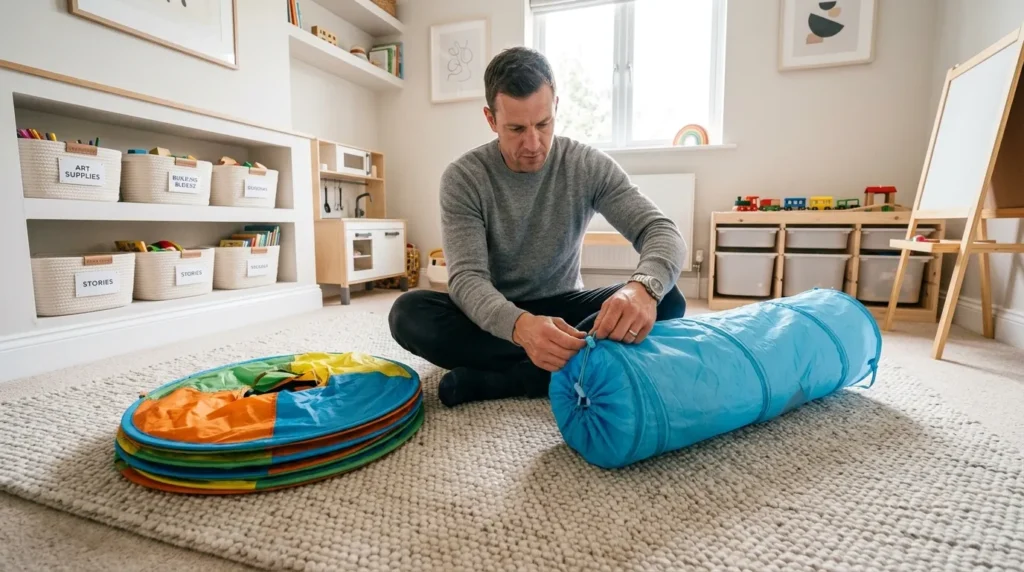
The way to manage a modular system is to disconnect each piece entirely and fold them as individual units rather than trying to compress the whole course at once. I have seen many people try to roll up a tunnel while it is still attached to the tent, and it always ends in a tangled mess of velcro and mesh. When I was testing the tunnel tent play setup, I realized that the UTEX set is much easier to store if you treat each of the 3 parts as a separate mission. You fold the square tent, then the ball pit, and finally the long tunnel.
I found that the tunnel is actually the easiest part to fold, but it requires a specific technical move. Most tunnels have a series of wire hoops connected by fabric. You just squash the hoops together like an accordion and use the integrated toggles or ties to lock them in place. I noticed during my field test that if you do not use those ties, the tunnel will spring open in your trunk like a jack-in-the-box, which is a major safety distraction while driving. In my guide to packing a motorcycle for camping, I talked about the danger of shifting loads, and the same logic applies to your SUV or playroom closet.
Keep all the balls from the ball pit in a separate mesh bag. Do not try to fold the balls inside the fabric layers. I noticed that many budget kits show the balls inside the bag, but this puts uneven pressure on the spring-steel frame, which can lead to permanent warping. According to technical storage reports, keeping your kids adventure play tents flat and separate is the best way to maintain their 1-second setup speed. Once each modular part is a flat disc, you can stack them all inside the large carry bag. It turns a massive 115-inch obstacle course into a thin 20-inch package that slides under a bed easily.
Why is the folding process different for roleplay playhouses?
Playhouses like the old post office or the farm play tent require more care because they often feature realistic, high-definition graphics and vertical walls that can become creased or damaged if you do not fold them along the factory seams. Unlike a simple dome where the fabric is just a shell, roleplay tents are designed to look like specific buildings. I’ve noticed that if you perform a sloppy twist on the Kid Trax USPS model, the mailbox pocket can get crushed or the window awnings can lose their shape. You have to be more surgical with your movements.
The best way to protect these graphics is to fold the tent so that the printed walls are facing inward. This protects the outer finish from getting scratched by the metal pole ends in your bag. In my old post office playhouse review, you can see how I tuck the roll-up dock door inside before starting the twist. It is a technical step that maintains the aesthetic value of your gear. I noticed during my farm play tent review that the roof window was a potential snag point, so I always make sure it is perfectly flat before the taco stage.
These themed playhouses often use a slightly heavier polyester than the basic domes. This means the spring frame has to be stronger to support the weight. I felt a significant difference in the tension when I was folding the Amplov barn compared to a standard pop up. As I mentioned in my guide for the best kids play tent, you are paying for that durability, but you have to handle it with the correct technique. According to technical reports on gear longevity, avoiding sharp creases in printed fabrics can extend the visual life of your tent by years. It is about treating your educational toys with the same respect you would give your own camping technical gear.
How do you identify structural damage during the folding process?
Identifying a failure is to pay close attention to the feel of the frame: looking for any uneven resistance, grinding sounds, or areas where the pole is no longer forming a smooth curve. I’ve spent a lot of time analyzing frame health for my best ultralight tents list, and the same technical vigilance is required for your playroom. If you are performing a fold and you notice that one side of the tent is leaning or that a pole is sticking out of a sleeve: stop immediately. You likely have a snapped fiberglass segment that could easily pierce the fabric and hurt a child.
The most common place for damage is at the bottom corners where the frame takes the most abuse from being dragged across the floor. In my guide on what to look for kids play tent safety, I mentioned that fully wrapped edges are a major safety win. I always suggest that you run your hands along the fabric-covered poles once a month. If you feel any splinters or sharp points, the tent is no longer safe for play. I found that during my large play tent review, the thicker 15.79mm poles were much easier to inspect because they were so substantial.
If you find a minor twist in the frame, you can often massage it back into place by letting the tent pop open and manually counter-twisting the affected pole. But if the pole is snapped, do not try to fix it with duct tape. The tension in a play tent is too high for a tape-only repair. Knowing when to retire an item is a sign of an expert. According to CPSC safety standards, any gear with exposed wires or splintered fiberglass should be removed from the playroom immediately. It is better to buy a new, safe shelter from my kids play tent hub than to risk an injury.
Frequently asked questions about how to fold pop up play tent
What should I do if the tent frame stays permanently twisted?
You may have already put too much stress on the metal or fiberglass by forcing a bad fold. I’ve noticed that many beginners try to reverse the twist when the tent is already in the bag, which creates a figure-8 knot. I suggest you let the tent pop open completely on a flat floor. Most modern frames, such as the ones in my dinosaur play tent review, are designed to return to their memory shape. If it still looks crooked, you can gently bend the poles in the opposite direction of the twist to reset the frame.
Is it easier for two people to fold a large play tent together?
Yes, especially for hexagonal models like the Zooawa extra large playpen. One person can hold the taco base steady while the other person performs the top-down twist. I’ve found that with the massive 81-inch Zooawa model, having a partner prevent the tent from sliding on the floor made the teardown much safer. Teamwork is the key to managing large basecamps without the stress.
Can I fold the tent while the internal padded mat is still inside?
No, you should always remove the mat, toys, and pillows before you begin the technical sequence. I noticed during my large play tent review that the BSHAPPLUS mat is quite thick and would prevent the frame from reaching the required taco shape. In my guide on how to clean kids play tents, I explained that fabric can tear if it is compressed against a hard or thick object. Folding the mat separately in its own roll is the best way to ensure everything fits back into the carry bag.
How do I fold the mesh windows without snagging the zippers?
Zippers fail during a fold because they are left partially open in a high-tension area. I always suggest that you either fully zip or fully unzip your windows before you start. I found that leaving them half-open can cause the slider to get caught in the mesh when you perform the figure-8 twist. I noticed this specifically during my princess castle tent review field tests.
Is there a specific way to fold the pop up playhouse tent by Diorssen?
Yes, you must collapse the front porch area first. Since that tent features a mini-canopy extension, it has a secondary spring loop. You should tuck that loop flat against the main tent body before you attempt the taco fold. I noticed during my pop up playhouse tent that skipping this step resulted in the canopy poking out of the side of the bag. As I mentioned in my foundational post on what is a pop up tent, understanding each mechanical part is the only way to master the teardown.
Why mastering the fold is the final step in expert gear ownership
At the end of the day, knowing how to fold pop up play tent setups is a mandatory technical skill for any parent who wants to provide a safe and organized adventure for their children. By following the figure-8 secret and being diligent about air purging, you are removing the frustration from gear management. It turns a potentially stressful Sunday morning cleanup into a thirty-second task that you can handle with confidence. Taking care of your frames is the best way to respect the investment you have made in your child’s development.
I’ve seen too many beautiful tents from my kids play tent guide ruined by a single forced fold. I have laid out all the best technical solutions in this guide to help you avoid the expensive mistakes I made as a beginner. I suggest you start by practicing the taco-fold in your backyard or living room today.
Camping is about freedom and family, and having an easy-to-manage teardown routine is what allows you to focus on the memories. I will see you at the next playroom trailhead.