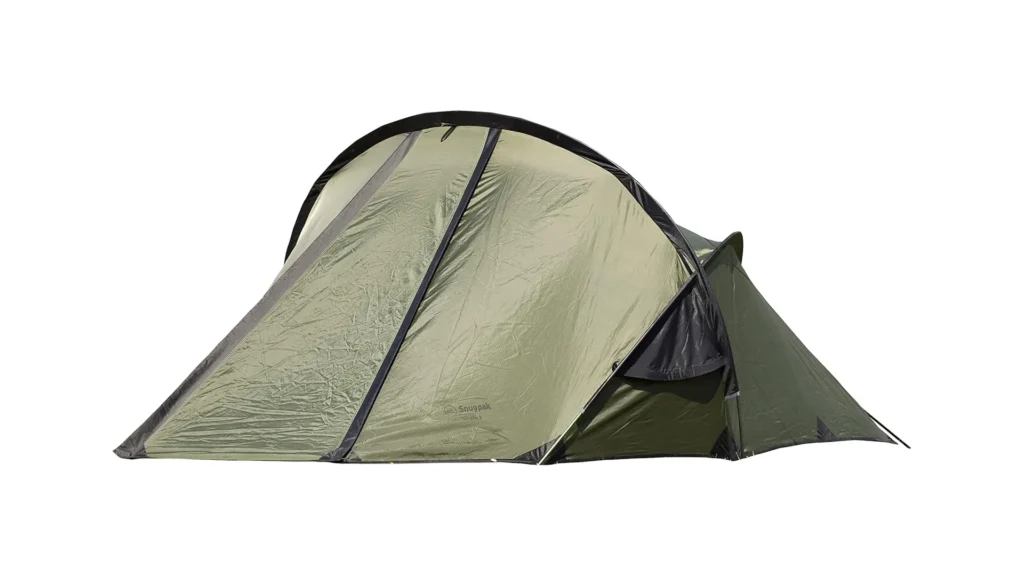
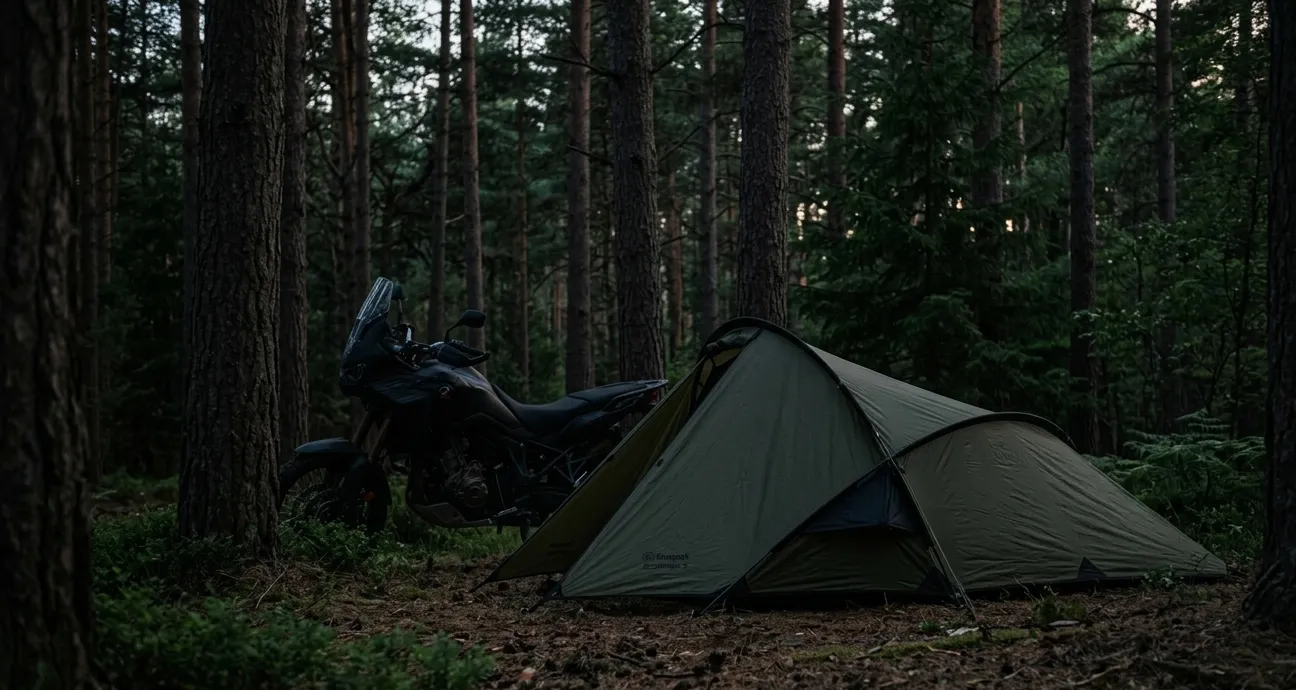

I’ll be honest, I love my Big Agnes Copper Spur, but there are some trips where that bright orange rainfly feels like a giant neon sign saying “Hey look at me, I’m camping here!” When I’m riding through the more remote parts of the country or I find myself needing to stealth camp on a patch of BLM land that isn’t exactly a designated site, I want to be invisible. That’s exactly why I picked up the Snugpak Scorpion 2. It’s a military-style, olive-drab bunker that looks more like a natural mound of dirt than a piece of camping gear once the sun starts to go down. If you’re a rider who values staying under the radar, this tent is in a league of its own.
As I mentioned in my best tent for motorcycle camping guide, the Scorpion 2 is the tactical choice. It’s built by a company that specializes in gear for the British Armed Forces, and you can feel that heritage the second you touch the fabric. It doesn’t feel like the delicate, thin material on my Nemo Dragonfly OSMO 2P. Instead, it’s a rugged 210t ripstop polyester that feels like it could survive a literal sandstorm. For me, that durability is a huge peace of mind when I’m riding solo in the middle of nowhere. I don’t have to baby this tent. I can toss it into a dry bag, strap it down tight, and know that it’s going to be ready for action when I hit camp.
The Scorpion 2 is perfect for stealth missions, but if you’re staying at a standard site and just want the easiest pitch possible, you’ve got to see my Kelty Late Start 2 review.
I use the Scorpion for stealth missions, but when I’m staying at a normal campsite and just want a spacious, reliable fortress, I always look at the gear I covered in my The North Face Stormbreak 2 review.
The Scorpion 2 isn’t about being the lightest or the most spacious. In fact, compared to the ALPS Mountaineering Lynx 2, it’s quite cramped. But what it lacks in elbow room, it makes up for in absolute bombproof reliability. According to the official Snugpak technical specs, this tent was designed as a fly-first pitch to keep the interior dry during the worst possible weather. When I’m touring in 2026, I find myself looking for gear that works when everything else fails. If the wind is howling and the rain is sideways, this is the tent I want to be inside. It’s a specialized tool for a specific type of rider, the one who cares more about being dry and hidden than they do about having a tall ceiling.
Can you actually set this up in a downpour without getting the inside wet?
Have you ever tried to set up a standard inner-first tent while it’s absolutely dumping rain? It’s a nightmare. By the time you get the poles snapped together and the rainfly tossed over the top, the mesh inner body is already soaked, and you’re basically sleeping in a swamp for the rest of the night. This was one of my biggest gripes when I was living out of the MSR Hubba Hubba NX 2, which is a great tent, but it definitely leaves you exposed during a wet setup. That’s where the Snugpak Scorpion 2 completely changes the game. It uses a fly-first design, meaning the waterproof outer shell goes up first, or better yet, the inner tent stays attached to the fly, so the place you actually sleep never sees a single drop of rain.
I remember rolling into a site in the mountains of North Carolina just as a massive cell was moving in. The wind was picking up, and the first heavy drops were starting to hit my visor. With the Scorpion 2, I didn’t have to fumble with a delicate mesh inner. I just slid the three DAC aluminum poles into the external sleeves on the flysheet, and the whole structure rose up as one solid unit. Because the poles are on the outside, you aren’t fighting to keep the tent body from blowing away while you work. It felt incredibly secure, and within about four minutes, I was inside, bone-dry, listening to the rain bounce off the heavy-duty 210t polyester.
According to the official Snugpak setup guide, this all-in-one pitch is a major reason why this tent is favored for four-season use in extreme climates. For me as a rider, it’s just one less thing to stress about when the weather turns sour. If you’re like me and you often find yourself pushing through the rain to hit your mileage goal for the day, you’ll appreciate not having to dry out your sleeping area with a pack towel at midnight. As I mentioned in my best tent for motorcycle camping guide, this pitch style is a pro-level feature for riders who don’t just stay in fair-weather campgrounds. It’s a bit different than the intuitive snap-on clips of the Big Agnes Copper Spur, but in a downpour, I’d take the Snugpak every single time.
Is the low-profile slope design a blessing for wind or a curse for headroom?
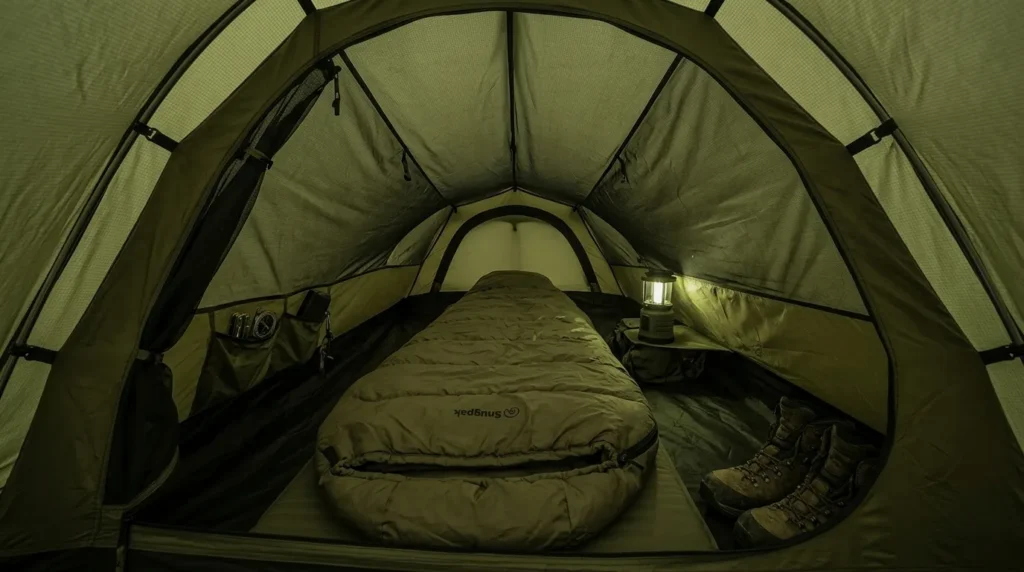
Let’s get real about the geometry of this tent, because it’s the first thing you’ll notice when you crawl inside. The Snugpak Scorpion 2 uses a distinct slope or wedge design that is very different from the boxy, high-ceiling tents I usually talk about. The direct answer to the headroom question is pretty simple: the design is a massive blessing for wind stability, but it’s a total curse for anyone who wants to sit up straight and hang out. I’m about average height, and I can only really sit upright at the very highest point near the front door. If I move six inches back, I’m basically doing a weird horizontal shimmy to keep my head from rubbing against the mesh.
If you’re coming from my MSR Hubba Hubba NX 2 review, where I raved about the vertical side walls, the Scorpion is going to feel a bit like a high-tech coffin. But there’s a reason for this. When you’re camping in a wide-open area like the plains of Wyoming or a high-altitude mountain pass, wind is your absolute enemy. I’ve been in situations where the gusts were so strong that standard dome tents were literally pancaking flat against the ground. Because the Scorpion 2 has such a low, aerodynamic profile, the wind just slides right over the top of it. I’ve slept through 35mph gusts in this thing and didn’t feel a single shudder in the frame. According to the official DAC pole technical specs, the aluminum poles used in this tent are specifically tuned for this kind of tension, making the whole structure feel more like a bunker than a tent.
Stealth camping is great, but when I want a spacious mid-range dome with tons of mesh for hot summer nights, I always look at the gear in my Marmot Crane Creek 2P review.
I’ve mentioned in my best tent for motorcycle camping guide that you have to choose between living space and survival space. The Scorpion 2 is definitely on the survival end of that spectrum. I wouldn’t want to spend a rainy afternoon in here trying to read a book or look at my paper maps, but I would 100% want to be in here when a storm is threatening to blow my bike over. It’s a specialized tool. If you’re the type of rider who only crawls into your tent when you’re ready to close your eyes, the low profile won’t bother you. But if you like to sit up and drink coffee inside while you wait for the sun to come up, you might find yourself wishing for the standing room found in my Wolf Walker Motorcycle Tent review. For me, the peace of mind knowing my tent won’t collapse in a gale is a trade-off I’m willing to make for a few inches of headroom.
Does a 5000mm waterproof rating actually matter for a motorcyclist?
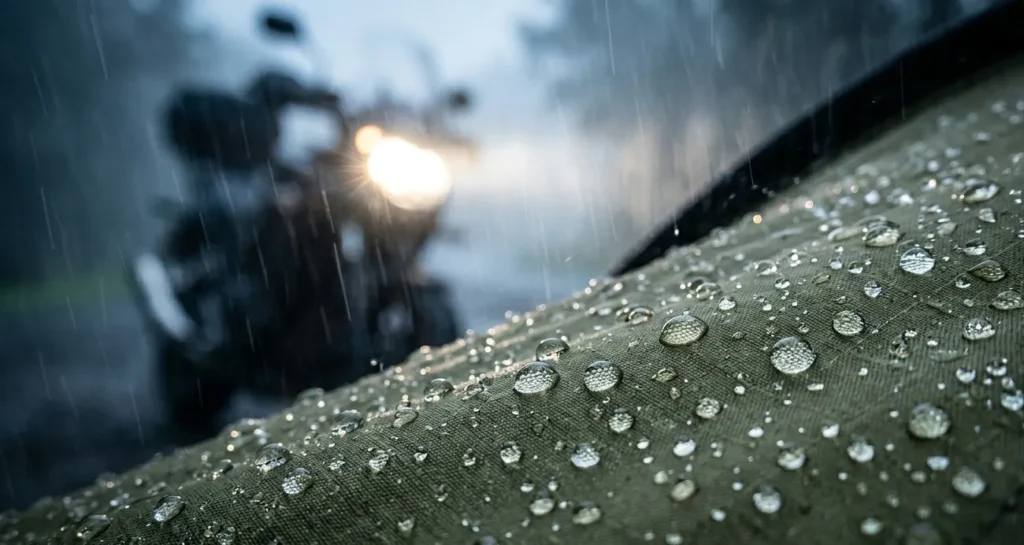
I used to think these high-waterproof numbers were just marketing tactics to sell gear to people who don’t know any better. But after getting caught in a literal deluge in the mountains, I realized that for us riders, a 5000mm rating is like having insurance you hope you never use. It’s the difference between a tent that is waterproof enough and a tent that is a legitimate bunker. Most of the ultralight tents I’ve reviewed, like the ones in my best tent for motorcycle camping guide, usually hover around the 1,200mm to 1,500mm mark. While that is perfectly fine for a typical weekend drizzle, it can struggle during a multi-day soaking.
The Snugpak Scorpion 2 is a different beast entirely. According to the technical data on Hydrostatic Head (HH) ratings, a 5,000mm rating means the fabric can withstand a five-meter column of water pressure before a single drop leaks through. For me, this translated to absolute peace of mind during a storm that would have had me worried in my other tents. In my MSR Hubba Hubba NX 2 review, I talked about the Durashield coating, which is great, but the Snugpak fabric feels like a heavy-duty shield. You don’t get that mist-through effect where high-pressure wind actually drives a fine spray through the flysheet.
There is another reason this high rating matters for riders: the morning pack-up. We often have to roll up a soaked tent at 7:00 AM to stay on schedule. Because the Snugpak fly has such a thick, high-quality PU coating, the water doesn’t really soak into the polyester fibers; it mostly sits on the surface. I can give the tent a violent shake before I pack it, and about 90% of the moisture flies off. This prevents that heavy, soggy mess from sitting in my dry bag all day, which helps keep my bike’s weight down and prevents my other gear from getting damp. It’s a level of over-engineering that makes a lot of sense when you’re touring through climates where unpredictable is the only word to describe the weather.
How does the 17-inch pack size fit into a tactical luggage setup?
One of the things I’ve realized after thousands of miles on the road is that tactical gear usually comes with a weight and size penalty. When I first looked at the 17-inch pack size of the Snugpak Scorpion 2, I knew I wasn’t getting a palm-sized ultralight setup. If you’re coming from my Big Agnes Copper Spur review, you might be a bit disappointed that these poles don’t have that tiny 12-inch shortstik design. However, at 17 inches, the Scorpion 2 actually fits perfectly into a middle-ground category that works surprisingly well for most adventure bike setups. I’ve found that it slides vertically into a standard 35-liter aluminum pannier with room to spare for my cooking kit on top, or it can lay flat across a rear luggage rack without sticking out like a wide load.
I’m a big fan of the compression stuff sack Snugpak includes. Unlike the thin, flimsy bags you get with most tents, this one is made of the same rugged material as the tent itself and features heavy-duty straps that actually let you crank down on the volume. I’ve managed to get the main bundle down to a very dense, manageable cylinder that doesn’t shift around under my Rok Straps. According to the official Snugpak weight specs, the whole kit weighs in at about 5.8 pounds. It’s definitely heavier than the Nemo Dragonfly OSMO 2P, but because the weight is so concentrated, it doesn’t feel like it’s throwing off the bike’s center of gravity when I’m standing on the pegs through a technical section.
In my guide on the best tent for motorcycle camping, I talk about the importance of luggage footprint, and the Scorpion 2 hits a sweet spot for those of us who prefer a narrow profile for lane splitting or tight trails. Because the olive-drab bag is so low-key, it doesn’t scream expensive camping gear to everyone at the gas station. One trick I’ve used is to strap it to the top of my crash bars or my front forks on my dual-sport bike; it’s rugged enough to handle the road spray and mud without me worrying about the bag tearing. For me, the 17-inch length is a fair trade for a tent that feels like it could survive being dropped off a cliff.
Should you actually buy the Snugpak Scorpion 2 for your next trip?
I’ve lived out of a lot of different tents on the road, but the Snugpak Scorpion 2 is one of the only ones that makes me feel like a total badass every time I pitch it. It’s not for everyone, and I want to be super clear about that. If you’re the kind of rider who loves the standing room in my Wolf Walker Motorcycle Tent review, you are probably going to hate how small this thing feels. But if you are like me and you find yourself pushing into the late hours of the night and needing a place to crash where nobody will bother you, this is the ultimate stealth machine. It’s rugged, it’s low-profile, and it has that military-grade reliability that gives me a lot of confidence when I’m alone in the woods.
I’ve mentioned in my best tent for motorcycle camping guide that I value different gear for different missions. For a casual weekend with friends, I’d take a big dome. For a cross-country speed run, I’d take the Big Agnes Copper Spur. But for a solo, wild-camping adventure through unpredictable weather, the Scorpion 2 is always my first choice. You just can’t beat the 5000mm waterproofing and that fly-first pitch when things get nasty. It’s a specialized tool that does exactly what it’s supposed to do: it keeps you dry, it keeps you hidden, and it survives the vibrations of being strapped to a bike for weeks on end.
In my view, the value here is incredible. You’re getting a professional-grade shelter for a fraction of what you’d pay for a boutique mountaineering tent. I’ve seen some riders complain about the weight, but at nearly six pounds, I think it’s a fair trade for a tent that won’t rip or leak when you’re miles away from the nearest town. If you’re a rider who prioritizes stealth and survival over luxury and headroom, I really think you’ll appreciate the bombproof nature of this setup. It’s built for the long haul, and it’s one of those rare pieces of gear that feels like it will outlast the bike you’re riding.
The Scorpion 2 is my go-to for stealth, but when I’m staying at a normal site and just want to see the stars and catch a breeze, I always look at the gear in my TETON Sports Mountain Ultra 2 review.
Frequently Asked Questions: What riders need to know about the Scorpion 2
It can be if you don’t use the vents properly. Because the Scorpion 2 is a low-profile, fly-first design with a very high waterproof rating, the air doesn’t naturally move through the fabric as well as it does in a mesh-heavy tent like the Nemo Dragonfly OSMO 2P. I’ve found that I have to be very diligent about propping open the rear and side vents to get a chimney effect going. If I’m camping in a humid valley, I’ll sometimes wake up with a little mist on the inside of the fly, but it’s never been enough to actually drip onto my sleeping bag.
Technically, yes, but you’d better be very close friends. It’s more of a 1.5-person tent in my opinion. If I’m solo, I have plenty of room to lay my riding suit along one side and sleep comfortably on the other. But with two people, you have almost no floor space left for gear. According to the official Snugpak floor plan, the interior width is about 43 inches at the head, which is pretty narrow. For most moto-campers, I recommend treating this as a solo palace where you can keep all your expensive riding gear safe and dry inside the tent with you.
The first few times I did it, it took me about ten minutes because the pole sleeves are a bit of a tight fit. But once you get the hang of it, you can easily have it pitched in under five minutes. The best part is that once you have the inner tent attached to the fly, you never have to take it off. You just roll the whole thing up together. This makes the next setup even faster because you’re essentially just sliding three poles in and staking it out. It’s much faster than the ALPS Mountaineering Lynx 2 when you’re trying to beat a rainstorm.
The Scorpion 2 doesn’t come with an official footprint, and honestly, the floor is so rugged that you might not even need one. The floor fabric is a 190t ripstop polyester with a 5000mm coating, which is much thicker and more durable than the floors on high-end backpacking tents. However, if I’m camping on a gravel lot or really abrasive volcanic rock, I’ll still toss down a piece of Tyvek just to be safe. It keeps the bottom of the tent clean, which makes the morning pack-up a lot less of a mess.
It’s surprisingly effective. I’ve had nights where I was camped only 50 yards off a trail and people walked right by without even noticing. The low profile means it doesn’t cast a tall shadow, and the matte color doesn’t reflect moonlight or headlamps. If you’re trying to be low-key on a long trip, this is a massive advantage over the bright look-at-me colors of most consumer tents. According to the community on ADVrider, color is the number one factor for a successful stealth camp, and the Scorpion 2 hits the mark perfectly.
Is the Snugpak Scorpion 2 the right choice for you?
If you are a rider who finds themselves on the road in late autumn or early spring, or if you simply prefer the peace and quiet of a stealth camp, the Snugpak Scorpion 2 is an incredible piece of kit. It’s a tank that fits on the back of your bike, and it gives you a level of weather protection that most other tents can’t touch. While it isn’t the roomiest tent on the market, the trade-off in durability and invisibility makes it a winner for the hardcore adventure crowd. It’s the kind of gear that doesn’t just hold up; it excels when the conditions get tough.
If you’re ready to stop worrying about the wind and start enjoying the stealth life, I really think this tent belongs in your luggage. It has changed the way I approach my remote trips, and I think it’ll do the same for you.