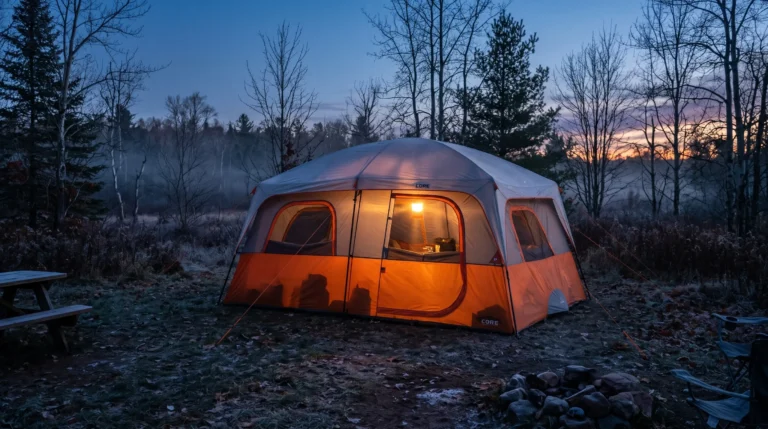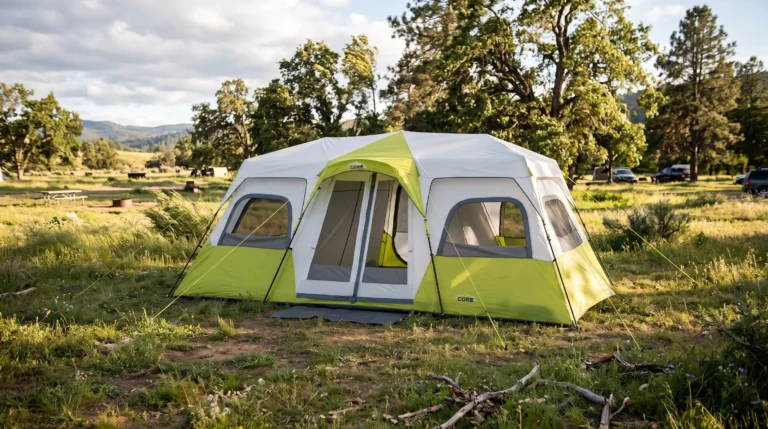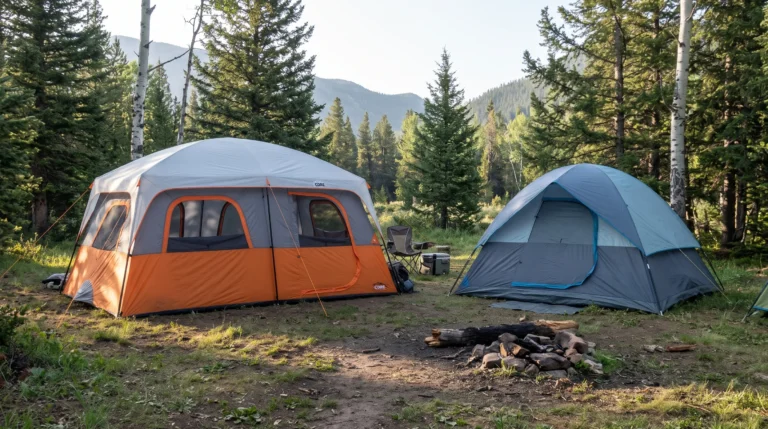

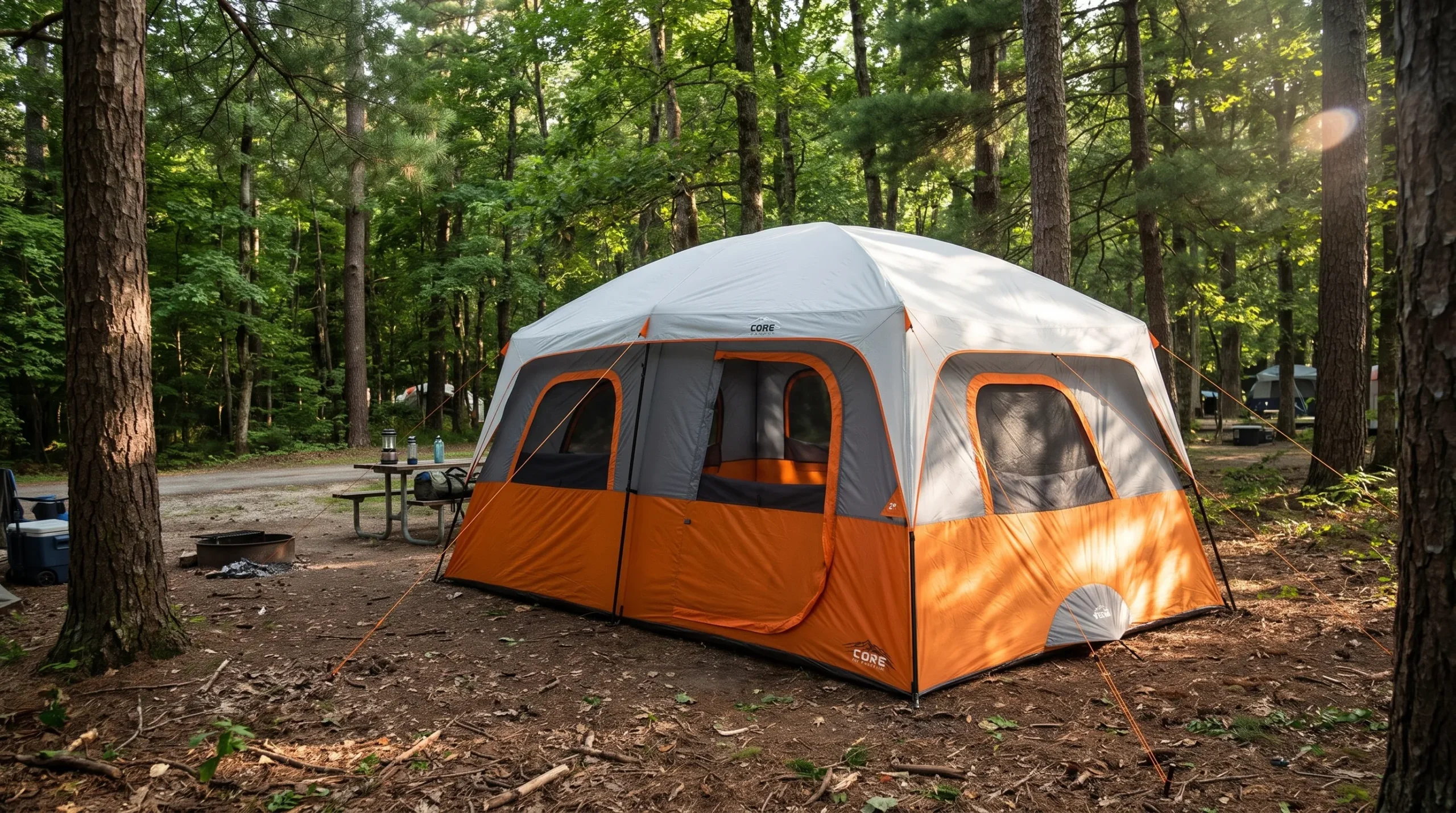
What is a cabin tent? It is a family camping tent with walls that rise almost straight up and a tall, flat-topped roof, so the whole floor feels like a small room instead of a cave you crawl into. The first time I stood up inside one after years of hunching in domes, I put my coffee on a folding table, pulled on my jacket standing straight and wondered why I had waited so long. That feeling is the whole point of the design, but it comes with trade-offs that nobody mentions on the box.
This post contains affiliate links. As an Amazon Associate, I may earn commission from qualifying purchases at no extra cost to you.
I spent the last few months testing ten of them for my guide to the best cabin tents, from one-minute instant cabins to a 12 person three-room tent. This explainer pulls together what I learned about the shape itself, so you can decide whether a cabin is right for your family before you look at specific models.
What makes a tent a cabin tent?
A tent counts as a cabin tent when its walls are close to vertical and its roof is high and relatively flat, which gives you standing room across most of the floor rather than only in the center. Most cabins are rectangular, with one or more doors on the long side and windows on every wall.
The easiest way to picture the difference is to compare cross sections. A dome tent is shaped like half an orange, so the walls start curving inward right from the floor. A cabin tent is shaped like a shoebox with a slightly peaked lid. On a dome, maybe a third of the floor has full standing height. On a cabin, most of it does.
Cabin tents are almost always built for car camping. They are heavy, tall and big, which is fine when the tent goes from your trunk to a campsite pad but not when you carry it on your back. That is why you will not find a cabin in my ultralight or backpacking guides.
Here is a quick summary of the defining features:
| Feature | Cabin tent | Typical dome tent |
|---|---|---|
| Wall angle | Near vertical | Curves in from the floor |
| Standing room | Most of the floor | Center only |
| Typical height | 68 to 86 in (1.7 to 2.2 m) | 48 to 72 in (1.2 to 1.8 m) |
| Typical capacity | 4 to 12 people | 2 to 8 people |
| Weight | Heavier | Lighter |
| Wind handling | Needs more guying | Sheds wind better |
| Best use | Car and family camping | Everything from backpacking to car camping |
What are the main types of cabin tents?
There are three main types: instant cabin tents with pre-attached frames, traditional pole cabins that use separate poles and sleeves or clips, and hybrid designs such as magnetic-frame or porch-equipped cabins. Each type changes how fast setup is, how much the tent weighs and how it behaves in weather.
Instant cabins are the most popular today. The poles are permanently attached, so you unfold the bundle, extend the legs and lock the roof. The Coleman 6 person instant cabin tent goes up in about 60 seconds, the EVER ADVANCED tent adds blackout fabric to the same idea, the 6 person cabin tent from Amazon Basics is the lightest version I tested, and the CORE 12 person instant cabin tent scales the concept up to three rooms.
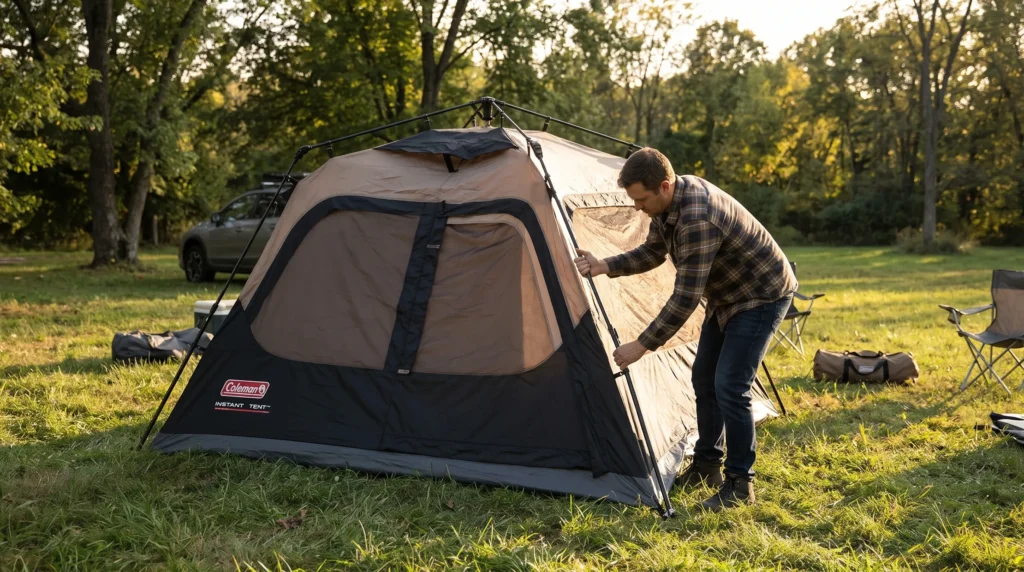
Traditional pole cabins take longer to pitch but usually pack smaller and offer more headroom for the weight. The CORE 10 person straight wall cabin tent reaches 86 in (2.2 m) and still packs into a 29 in bag, while the KTT tent gives you two rooms, three doors and a door-panel awning for a low price.
Hybrids blend features. The PORTAL tent adds a 110 x 110 in porch to a pole cabin, the 8 person instant tent from DMH Outdoors pairs an instant frame with its own porch, the CORE lighted tent builds LED lights into an instant frame and the Naturehike Village tent uses magnetic poles and an outer fly that turns into a vestibule.
Canvas cabins are a separate category. They use heavy cotton canvas instead of polyester, which makes them breathable and durable but much heavier. I covered those in my canvas tents hub, including the canvas cabin tent from Kodiak.
What are the pros of a cabin tent?
The main pros are standing headroom, a fully usable floor, easy room dividers and a home-like feel that makes longer trips more comfortable, especially for families with kids. Here are the advantages I noticed most across my testing:
- Standing room. You can change clothes, make beds and move around without crouching.
- Usable floor edges. Straight walls let air mattresses and cots sit right against the wall.
- Room dividers. Most cabins over 8 person include a curtain or zippered divider for privacy.
- Multiple doors. Larger cabins usually have two or three doors, so nobody climbs over anyone.
- Easy furnishing. A folding table, chairs and cots fit naturally in a rectangular room.
- Good ventilation. Tall walls allow big windows and mesh ceilings that vent warm air.
Every one of the ten tents in my cabin tents roundup delivered at least some of these benefits, though how much depends on the height and layout. For a family, the comfort difference is real. On a rainy day in a dome, everyone ends up lying down. In a cabin, the kids can sit at a table and play cards while you make lunch at the door.
What are the cons of a cabin tent?
The main cons are weight, bulk, wind sensitivity and a larger footprint that does not fit every campsite. These are the trade-offs I would want a friend to know before buying:
- Weight. Most cabins weigh 18 to 54 lb (8 to 24.5 kg), so they are strictly car camping tents.
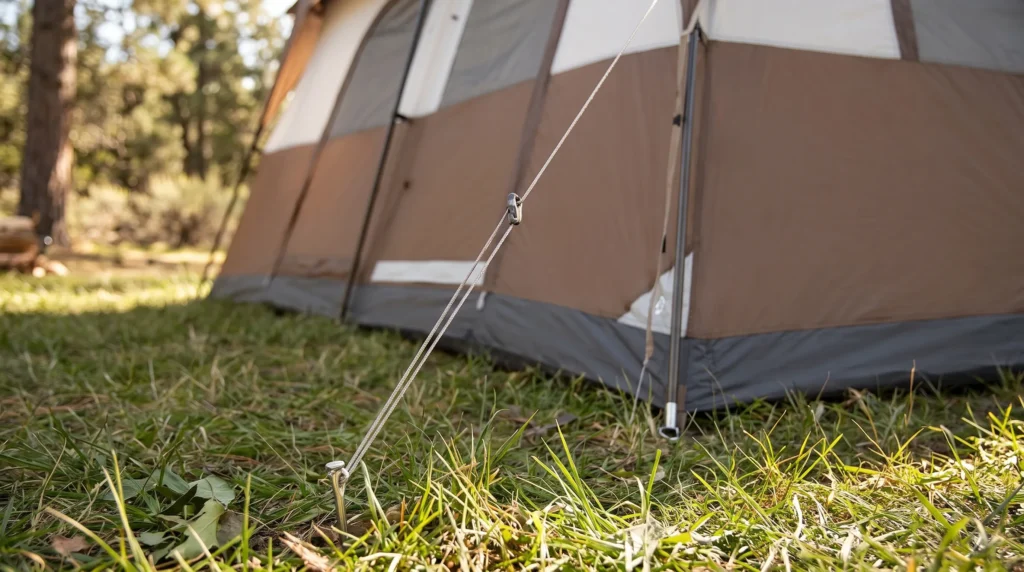
- Wind. Tall flat walls catch wind like a sail and need more guylines and stakes than domes.
- Footprint. A 14 x 10 ft or 18 x 10 ft floor needs a big flat pad.
- Heat loss. Tall roofs hold a lot of air, which is harder to keep warm on cold nights.
- Packed size. Instant cabins especially pack into long, heavy bundles.
The wind point matters most. A dome’s curved shape lets wind flow around it, while a cabin’s flat walls take the full force of a gust. I explain the details in my cabin tent wind guide, listed in Helpful Guides below, and the National Weather Service wind safety page is a good reference for how strong winds become dangerous.
Cold weather is the other weak spot. All that headroom means more air to heat, and many cabins use mesh ceilings for summer airflow, which lets warmth escape. If you camp in shoulder season, you will want the layering tactics in my cabin tent warmth guide and a warm sleep system. For true winter trips, my best tent for winter camping guide is a better starting point.
How do you choose the right cabin tent size?
Choose a cabin tent by taking the rated capacity and cutting it roughly in half for a comfortable trip with gear, then checking that the floor fits the beds you actually use. Brand capacity numbers assume people packed shoulder to shoulder in sleeping bags, not families with air mattresses and luggage.
Here is how I think about sizes based on what I tested:
- Count your group and add one or two people for gear space. A family of four should look at 6 to 8 person tents.
- Measure your beds. A queen air mattress is about 5 x 6.7 ft (1.5 x 2.0 m). Check how many fit on the floor with a walkway.
- Check the center height. If anyone is over six feet, look for at least 80 in (2.0 m).
- Decide on rooms and doors. If you want privacy, choose a tent with a divider and a door for each room.
- Check your campsite. Make sure the pad can fit the floor plus guylines.
- Match setup to your crew. If one adult usually pitches alone, choose an instant frame.
If you want to see how these rules play out across real models, my roundup of the best cabin tents sorts all ten picks by group size, setup style and budget. Campground rules also matter. Many established sites list pad sizes on Recreation.gov, and the National Park Service camping pages explain how to read site details. A 14 x 10 ft cabin with its guylines needs more room than the floor size suggests.
Is a cabin tent right for you?
A cabin tent is right for you if you car camp with family or friends, value standing room and comfort and mostly camp in three-season weather at established campgrounds. It is the wrong choice if you hike to your campsite, camp in exposed windy spots or want the lightest possible gear.
For most families, a cabin makes camping feel easier and more like a weekend away. The kids get space, the adults can stand and the rainy afternoons become manageable. If you already own a dome and wonder whether the upgrade is worth it, my cabin vs dome comparison in the Helpful Guides list goes into the head-to-head detail. I also reviewed a dome-style family option, the Coleman Skydome 6 person tent, if you want to see the alternative.
If you decide a cabin fits your family, start with the comparison table in my best cabin tents guide, which lines up height, floor size, weight and setup time for every model I tested. Whichever shape you choose, a few safety basics apply to every tent. Never cook or run a fuel heater inside, because carbon monoxide builds up quickly in an enclosed space, as the CDC carbon monoxide guidance explains. And remember that no tent protects you from lightning, according to the NWS lightning safety guidance. For a broader look at staying safe at camp, my guide on whether is tent camping safe covers the essentials.
Frequently asked questions about cabin tents
What is the difference between a cabin tent and a regular tent?
A cabin tent has near-vertical walls and a tall flat roof, so you can stand up across most of the floor. A regular dome tent has curved walls that slope in from the floor, so standing room is limited to the center. Cabins are roomier but heavier and more sensitive to wind.
Can you stand up in a cabin tent?
Yes, in most cabin tents adults can stand up across most of the floor. Center heights in my testing ranged from 68 in (1.73 m) to 86 in (2.2 m). Check the center height before buying if anyone in your group is over six feet tall.
Are cabin tents good for camping in the rain?
They can be, as long as the tent has sealed seams, a good rainfly and a solid floor. Many cabins use a rainfly that covers only the roof, which leaves the walls more exposed to sideways rain. If you camp in wet places, look for a full rainfly version and stake every guyline.
Are cabin tents hard to set up?
Instant cabin tents are very easy, often setting up in one to two minutes because the poles are pre-attached. Traditional pole cabins take longer, usually around 10 to 15 minutes with two people. Practice once at home before your first trip.
Why are cabin tents so heavy?
Cabin tents are large, with tall walls, steel poles and big floors, so they use more fabric and frame material than domes. In my testing, cabins weighed between about 18 and 54 lb (8 and 24.5 kg). That is fine for car camping but too heavy for backpacking.