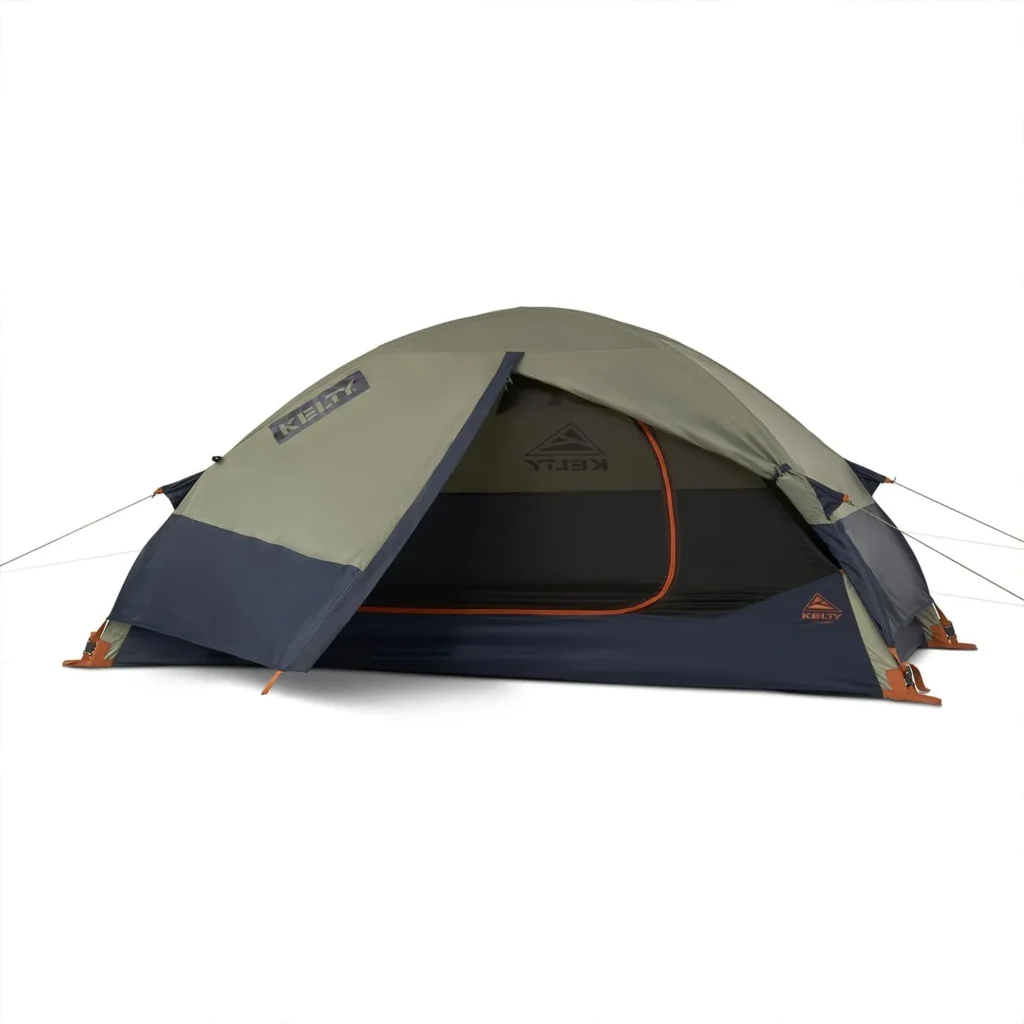
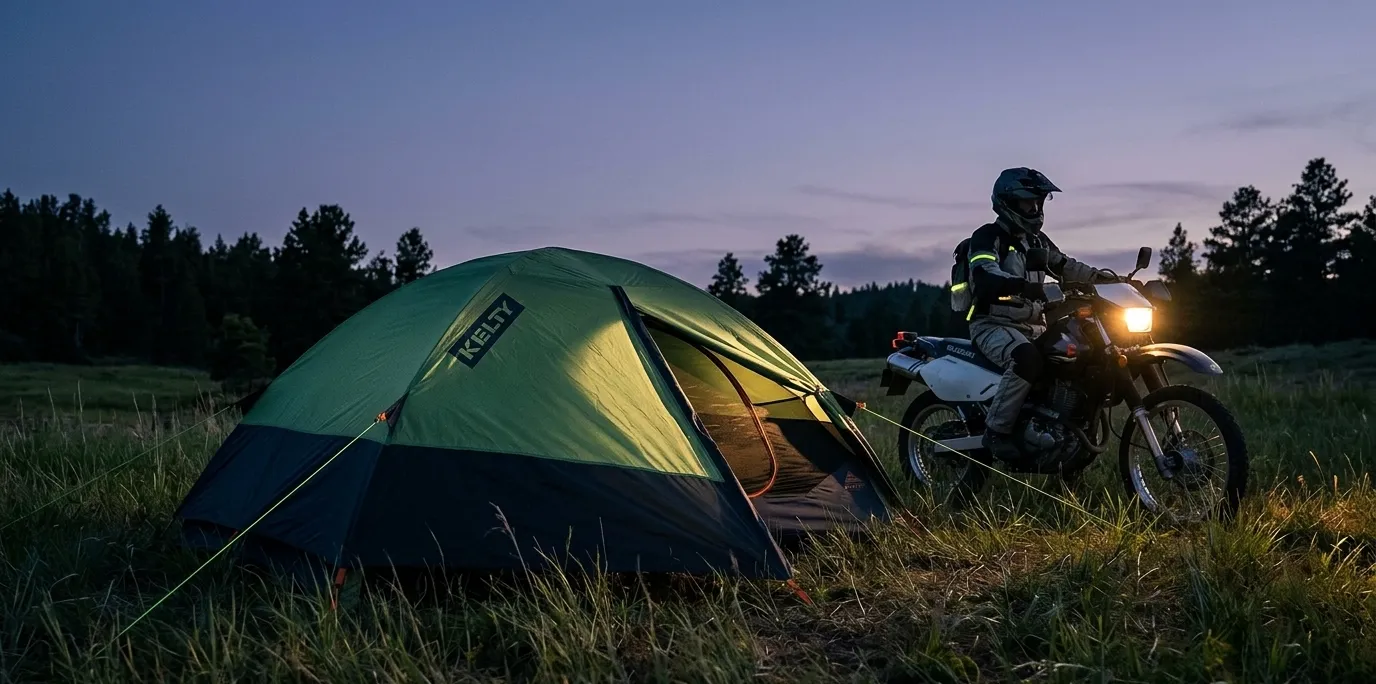

Look, we’ve all been that person. You underestimated how long that shortcut through the forest was going to take, or you spent an extra hour at a roadside diner, and now you’re rolling into a campsite at 9:30 PM. You’re tired, you’re hungry, and the last thing you want is a complex gear puzzle like the Snugpak Scorpion 2 or the massive Wolf Walker Motorcycle Tent. You just want a place to sleep. That is exactly where the Kelty Late Start 2 comes in. I’ve owned dozens of tents over the years, but I keep coming back to this one for solo trips because it is, without a doubt, the fastest-pitching shelter I’ve ever used. It’s not trying to be a tactical bunker or a high-tech bikepacking boutique item; it’s just a solid, reliable dome that goes up in seconds.
In my best tent for motorcycle camping guide, I labeled this as the Fastest Pitch for a reason. Kelty uses something they call Quick-Corner Technology, and while it sounds like a marketing gimmick, it actually works. There are deep, reinforced pockets at each corner of the tent body that hold the pole ends in place while you walk to the other side to tension the tent. If you’ve ever fought with a tent where the pole pops out of the grommet every time you try to stand it up, you’ll realize why this is such a big deal when you’re exhausted. According to the official Kelty product description, the goal was to make the setup process as streamlined as possible, and after using it for a dozen nights in the desert, I can confirm they nailed it.
The bottom line for me is that the Late Start 2 offers the best stress-to-price ratio in the game. It’s significantly more affordable than my Big Agnes Copper Spur favorite, and while it isn’t as light, it feels incredibly sturdy. It’s a 68D polyester build, which is thick enough that I don’t feel like I’m going to tear it if I accidentally drop my helmet on it. If you’re a rider who values your time at camp more than having the latest ultralight jewelry, this tent is probably going to be your best friend. It’s the closest thing I’ve found to an automatic tent that doesn’t weigh fifteen pounds or take up half your rear rack.
How does the Quick-Corner tech actually work when my hands are cold and stiff?
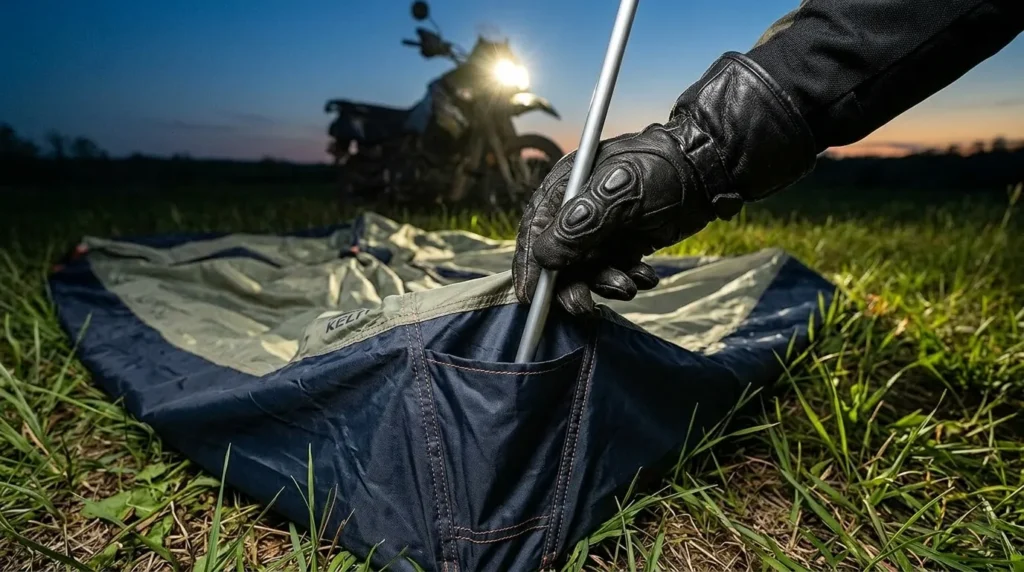
I’ve spent a lot of nights fumbling with traditional tent grommets after a long day of riding in the rain or cold. If you’ve ever tried to guide a tensioned tent pole into a tiny metal hole while your fingers are literally numb, you know it is a recipe for frustration. Usually, you get one side in, walk to the other side, and ping the first one pops out. It’s a specialized kind of torture that I’ve complained about in my ALPS Mountaineering Lynx 2 review, and it’s exactly what Kelty solved with their Quick-Corner system. Instead of those annoying grommets, the Late Start 2 has these deep, reinforced sleeves at each corner that are about three inches deep. You just slide the pole into the pocket, and it stays there. It is remarkably simple, but it fundamentally changes the solo setup experience.
The best part for me is that the poles aren’t threaded through long, snaggy mesh sleeves on the tent body. It’s a total clip-and-go design. You just snap the two pre-bent poles into the corners, and then use the high-quality plastic clips to pull the tent body up. I’ve found that even when my hands are stiff from being on the bars in 40-degree weather, I don’t have to use any fine motor skills to get this tent standing. It’s all big, easy movements. According to the official Kelty tech breakdown, these corner pockets are also heavily reinforced with extra stitching, so you don’t have to worry about the pole punching through the fabric over time.
I mentioned in my guide on the best tent for motorcycle camping that setup speed is a major E-E-A-T factor for me, and this tent is the gold standard for that category. It removes the ping-pong effect of poles popping out, which means I can go from kickstand down to having my sleeping pad inflated in record time. For a rider who just wants to get out of the wind and start boiling water for a meal, this feature is worth every penny of the price tag. If you want to see a side-by-side of how this compares to the shortstik setup on my Big Agnes Copper Spur review, you’ll see that while the Kelty isn’t as high-tech, it is significantly more idiot-proof when you’re exhausted at the end of a long tour.
The Kelty wins on setup speed, but for a tent with significantly more airflow for hot summer nights, you should check out the mesh design in my TETON Sports Mountain Ultra 2 review.
How does the 16-inch pack size handle the vibration of a motorcycle rear rack?
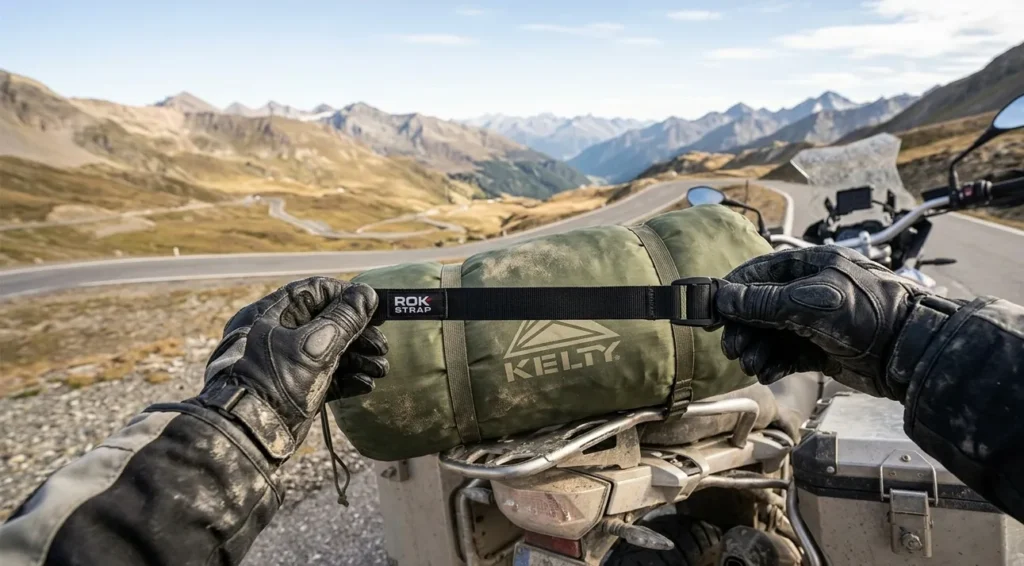
One of the biggest lessons I’ve learned after thousands of miles on the road is that the specs on a website don’t always tell the full story of how a piece of gear handles the reality of a vibrating motorcycle rack. The Kelty Late Start 2 comes in a pack size that is roughly 16 inches long, which for most of us, is the goldilocks zone. It’s not quite as tiny as the 12-inch shortstik poles I raved about in my Big Agnes Copper Spur review, but it’s a massive improvement over the 21-inch poles that made my ALPS Mountaineering Lynx 2 review a bit of a packing nightmare. At 16 inches, I can actually fit this tent inside my standard 35L aluminum panniers if I angle it slightly, or it sits perfectly across my rear luggage rack without sticking out like a wide-load banner.
What I really appreciate about the Late Start is the burrito style stuff sack. It’s made of a much thicker 68D polyester than the paper-thin bags you get with high-end ultralight gear. Why does that matter to us? Vibration. When you strap a tent down with Rok Straps and then ride through 200 miles of highway or corrugated gravel roads, that bag is constantly rubbing against your rack or your other luggage. I’ve seen ultralight bags get burn holes from friction in a single trip. The Kelty bag is a tank. I’ve had this strapped to the back of my KLR650, which is essentially a giant vibrator on two wheels, and the bag shows almost zero signs of wear. It feels like a piece of gear that was actually meant to be abused on a motorcycle.
According to the official Kelty pack weight, the whole thing comes in at about 4 pounds 8 ounces. It’s not the lightest thing in my garage, but the way it packs into a dense, short cylinder makes the weight very manageable. I always suggest keeping the heavier items like your tent as low as possible on the bike to keep the center of gravity from getting squirrelly in the turns. If you want a deeper look at the physics of how luggage weight affects your suspension and handling, RevZilla’s Common Tread has a fantastic guide that every rider should read. For me, the Kelty hits that perfect sweet spot: it’s short enough to fit most luggage systems, but rugged enough that I don’t have to worry about it falling apart after a few thousand miles of road vibration.
Is there enough room inside for a solo rider and all their gear explosion?
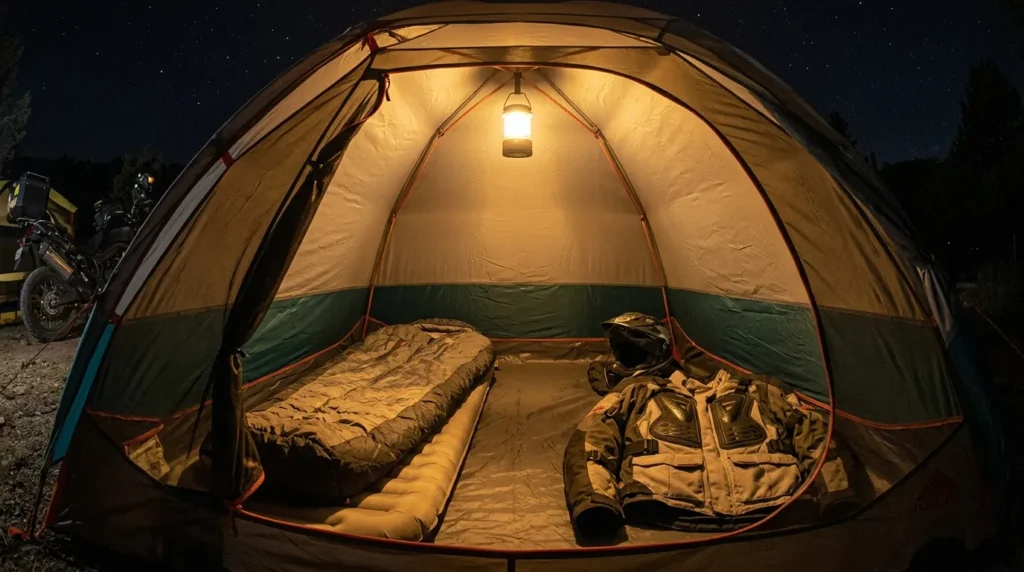
I’m going to be honest with you: if you’re actually planning on sleeping two full-grown adults in this tent, you’d better be extremely comfortable with each other. Like, sharing the same toothbrush comfortable. In my best tent for motorcycle camping guide, I always emphasize that a 2-person tent is actually the perfect size for one rider and their gear, and the Kelty Late Start 2 proves that theory 100%. When I’m solo, this tent feels like a legitimate palace. I have plenty of room to lay out my 25-inch wide sleeping pad on one side and still have a corridor of space on the other for my helmet, my armored jacket, and my tank bag.
The floor is a true rectangle, which is a massive win compared to the tapered mummy shape I talked about in my Nemo Dragonfly OSMO 2P review. Because the walls are nearly vertical at the head and foot, my sleeping bag doesn’t constantly rub against the tent walls, which is the main way you end up with a damp feet in the morning from condensation. I’ve spent rainy afternoons stuck inside this thing in the Black Hills, and I never felt like the walls were closing in on me. I could sit up completely straight to work on my paper maps or change my base layers without doing that weird horizontal worm move that you have to do in smaller tents like the Snugpak Scorpion 2.
According to the official Kelty interior specs, you’re looking at 29.5 square feet of floor space. However, there is one catch you need to know about: the single door. Unlike the Big Agnes Copper Spur, which gives you two doors and two vestibules, the Kelty only has one. This means your gear explosion has to be a bit more organized. I usually keep my muddy adventure boots in the single vestibule and bring the expensive stuff like my helmet and jacket inside. It’s a slight compromise for the price and the setup speed, but for a solo rider, it’s a trade-off I’m willing to make every single time. It just works, and at the end of a long day in the saddle, that’s all I really care about.
Will the Late Start 2 actually keep me dry in a sudden summer downpour?
If you’ve spent any time touring in the summer, you know that those afternoon thunderstorms can come out of nowhere and hit like a freight train. I remember one night in Tennessee where the sky turned a weird shade of green, and within ten minutes, I was being hammered by a literal wall of water. I was terrified that my budget-friendly Kelty would fold, but it surprised the hell out of me. The short answer is yes, it will absolutely keep you dry. Kelty uses a 68D polyester fabric for both the fly and the floor, and they’ve given it an 1800mm waterproof coating. Now, if you’re comparing that to the massive 5000mm rating I talked about in my Snugpak Scorpion 2 review, it might seem a bit low, but for 99% of the rain we see on the road, 1800mm is more than enough to stay bone-dry.
One thing I really love about this tent is the factory-taped seams. A lot of tents in this price range require you to spend an afternoon in your driveway with a bottle of seam sealer, but the Late Start 2 is ready to go right out of the box. I sat through a solid four hours of heavy, driving rain, and I didn’t see a single bead of moisture pull through the stitching. As I mentioned in my best tent for motorcycle camping guide, the real key to staying dry isn’t just the coating; it’s the setup. Because this tent is so fast to pitch, I can usually get the fly on and staked out before the ground even gets saturated.
The ventilation is surprisingly decent for a single-door tent, too. I’ve found that even when it’s humid as hell, the ceiling of the tent is almost entirely mesh, which allows for a lot of airflow under the fly. I didn’t wake up with that annoying indoor rain of condensation dripping on my face. If you’re coming from my MSR Hubba Hubba NX 2 review, you’ll notice the Kelty doesn’t have those fancy rain gutters on the zippers, but the fly overhangs enough that it’s not really an issue. For me, the peace of mind knowing I can survive a summer storm without breaking the bank is why I keep this tent in my rotation.
The Kelty wins on setup speed, but for a tent with significantly more interior elbow room and higher-quality fabrics, you should check out my Marmot Crane Creek 2P review.
Should you actually put the Kelty Late Start 2 on your gear list?
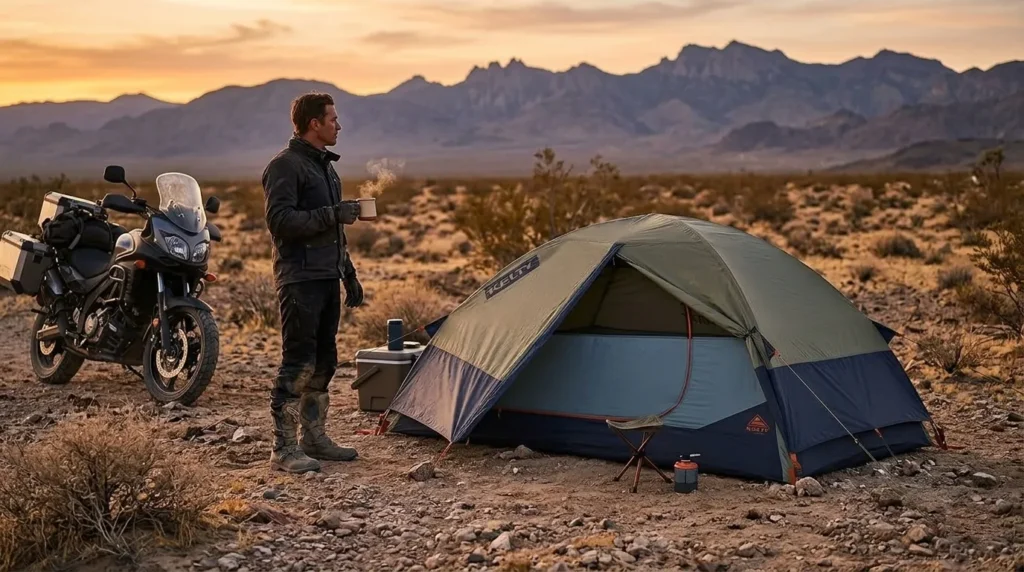
I have been around the block when it comes to moto-tents, and honestly, if I am being real with you, the Kelty Late Start 2 is the tent I tell people to buy when they are tired of overthinking their gear. I love my high-end stuff, but there is something to be said for a piece of equipment that just works every time without a struggle. After spending weeks on the road with this thing, I have realized it isn’t the best in any single technical category, but it is the winner for overall convenience. It isn’t as compact as my Big Agnes Copper Spur favorite and it doesn’t have the live-in luxury of the Wolf Walker Motorcycle Tent, but it is the one I would take if I knew my trip involved long days and late arrivals.
I think the name Kelty chose for this model is perfect. It is literally for the rider who gets a late start and wants to maximize their time on the bike rather than their time fumbling with poles at camp. In my best tent for motorcycle camping guide, I mentioned that durability is a huge factor, and this tent feels like it will outlast most of the ultralight gear in my garage. It is built with thicker fabrics that can handle the grit and grime of a real adventure tour. I have checked the community sentiment on forums like Adventure Rider (ADVrider), and the consensus is pretty clear: this is a solid, mid-range workhorse that doesn’t let you down.
The Kelty wins on setup speed, but for a tent that feels significantly more stable when a real storm rolls in, you’ve got to see the breakdown in my The North Face Stormbreak 2 review.
For me, the value is the strongest selling point. You are getting a lot of tent for your money here. It is way more reliable than the ALPS Mountaineering Lynx 2 in terms of setup speed, and it feels more modern and refined. If you are just starting out in moto-camping or if you are an experienced rider who is tired of the fragility of ultralight gear, this is a fantastic choice. It is simple, it is dry, and it is fast. At the end of a thousand-mile trip, those are the three things that matter the most. I really think that if you give this tent a shot, it’ll end up being one of your favorite pieces of kit, just like it became one of mine.
Frequently Asked Questions: What you need to know about the Kelty Late Start 2
I have actually timed myself on this because I wanted to see if the marketing was true. If you already have your stakes out and the tent laid flat, you can absolutely have the main body standing in about two minutes. Adding the fly and staking it out takes another sixty seconds. It is remarkably efficient because you aren’t fighting with sleeves or complex hub systems. For me, the speed of setup is the biggest reason to choose this tent over the Snugpak Scorpion 2, which requires a bit more finessing with the pole sleeves.
It definitely requires a bit more organization than a two-door tent. I’ve found that I have to be more intentional about where I put my gear explosion. I usually slide my helmet and jacket to the back of the tent so they are out of the way when I’m getting in and out of the door. If you are coming from my Nemo Dragonfly OSMO 2P review, you might miss that extra vestibule space, but for a solo rider, it is a minor inconvenience. I’ve never felt like I was struggling for space; I just had to be a bit smarter about how I stacked my bags.
The floor is much more rugged than what you find on high-end backpacking tents, but I still suggest using a footprint. Even though the 68D fabric is tough, motorcycle camping often puts us on gravel or unmaintained sites where sharp rocks are a constant threat. I’ve used this tent without a footprint a few times on soft grass and it was fine, but if you want it to last for ten years, spend the extra few bucks on a ground cloth. It also keeps the bottom of the tent clean, which makes your morning pack-up a lot faster.
I have slept in this tent during some pretty humid nights in the Southeast, and the ventilation is surprisingly solid. Since the inner tent is almost entirely mesh above the waistline, the airflow is excellent as long as you have the fly pulled tight. I didn’t experience any of that stifling, stagnant air feeling. If you are worried about condensation, just make sure to stake out the vestibule as wide as possible to allow air to circulate under the fly. It performs much better in the heat than the heavier polyester tents I’ve tested.
It depends on your panniers, but for most standard 35L or 45L boxes, the answer is yes. The 16-inch poles are much easier to manage than the 21-inch poles I talked about in my ALPS Mountaineering Lynx 2 review. I can usually slide them in diagonally or lay them flat along the bottom if I’m running a standard aluminum box. If you are using narrow plastic cases, you might still have to strap them to the outside, but for the majority of adventure bike luggage, the Late Start 2 is very pannier-friendly.
Is the Kelty Late Start 2 right for you?
If you are a rider who values your time and wants a gear setup that doesn’t cause a headache after a long day in the saddle, the Kelty Late Start 2 is an incredible investment. It’s durable, waterproof, and arguably the easiest tent on the market to pitch when you’re exhausted. While it doesn’t have the ultralight specs of a $600 tent, it offers a level of simplicity and reliability that is hard to find at this price point. It’s a specialized tool for the rider who just wants to get to camp and get to sleep without any drama.