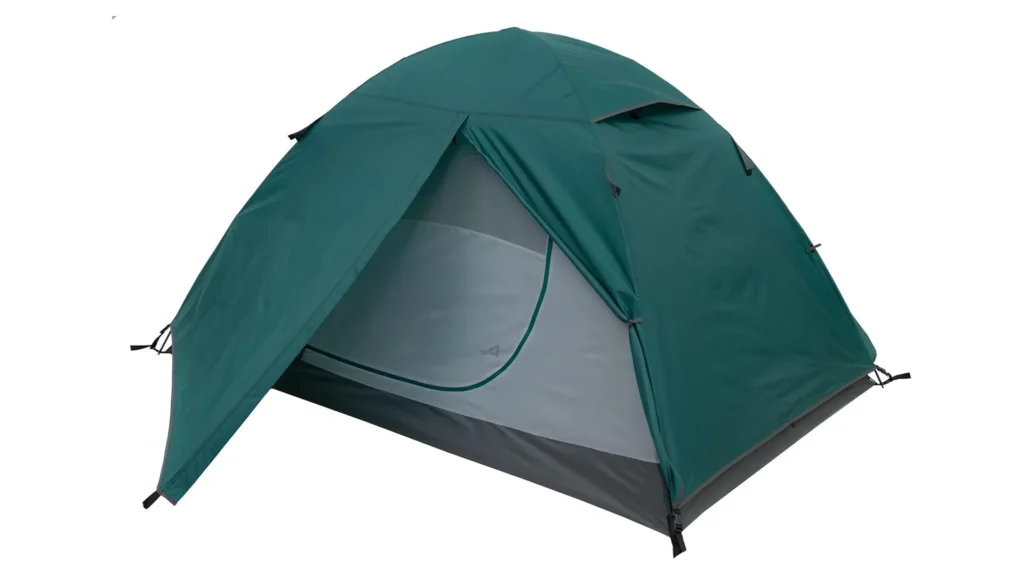
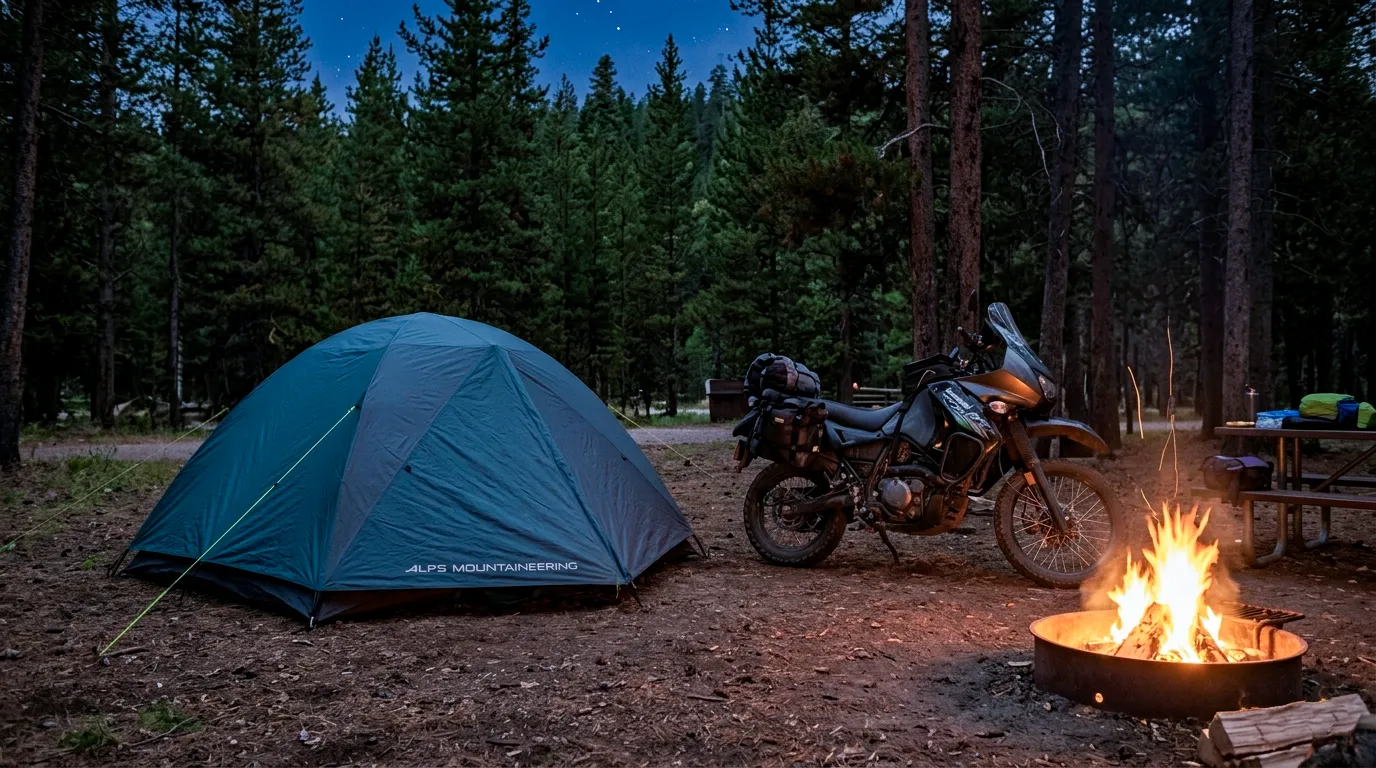

Look, I get it. We all see those glossy photos of $600 Nemo Dragonfly setups perched on a mountain ridge and we think that’s what we need to go touring. But I’m going to let you in on a secret: the dirt doesn’t care how much you spent on your tent. I’ve spent more nights in the ALPS Mountaineering Lynx 2 than I care to admit, and honestly, it’s the tent I recommend to about 70% of the people who ask me for advice. It isn’t sexy gear. It doesn’t have proprietary fancy fabrics or 12-inch poles like my Big Agnes Copper Spur favorite. But what it does have is a reputation for being absolutely “bombproof” and incredibly affordable.
When I first started moto-camping, I was terrified of breaking expensive gear. I wanted something I could throw in a dry bag, beat up on a gravel road, and not have a heart attack if a stray ember from the campfire landed near it. The Lynx 2 is exactly that. It’s built like a tank. While those high-end tents use 15D or 20D fabrics that feel like a luxury silk scarf, the Lynx 2 uses a heavy-duty 75D polyester. It’s thicker, it’s heavier, and it’s way more abrasion-resistant. For me, that’s a huge plus when I’m pitching on unmaintained sites where there might be a few sharp sticks I missed.
The Lynx 2 is a great budget pick for established campgrounds, but it’s not something I’d use for wild camping. If you’re ready to move into the hardcore territory of stealth touring and extreme waterproofing, you should definitely read my Snugpak Scorpion 2 review. It’s a specialized tool for riders who want to disappear into the woods.
The Lynx 2 is the king of budget picks, but if you can spend a little more for a major jump in brand reliability and storm protection, check out my The North Face Stormbreak 2 review.
According to the official ALPS Mountaineering specs, this tent is designed to be a versatile, durable companion, and I think that’s an understatement. It’s the kind of gear you buy when you’re starting out, and even after you upgrade to the fancy stuff, you still keep this in your garage as a backup or for loaner gear when a buddy wants to come along. As I mentioned in my best tent for motorcycle camping guide, the Lynx 2 is the king of the budget category. It isn’t trying to be the lightest; it’s trying to be the one that’s still standing when the $100 Amazon Special tents have already had their zippers fail.
Is the simple two-pole setup a blessing when you’re exhausted?
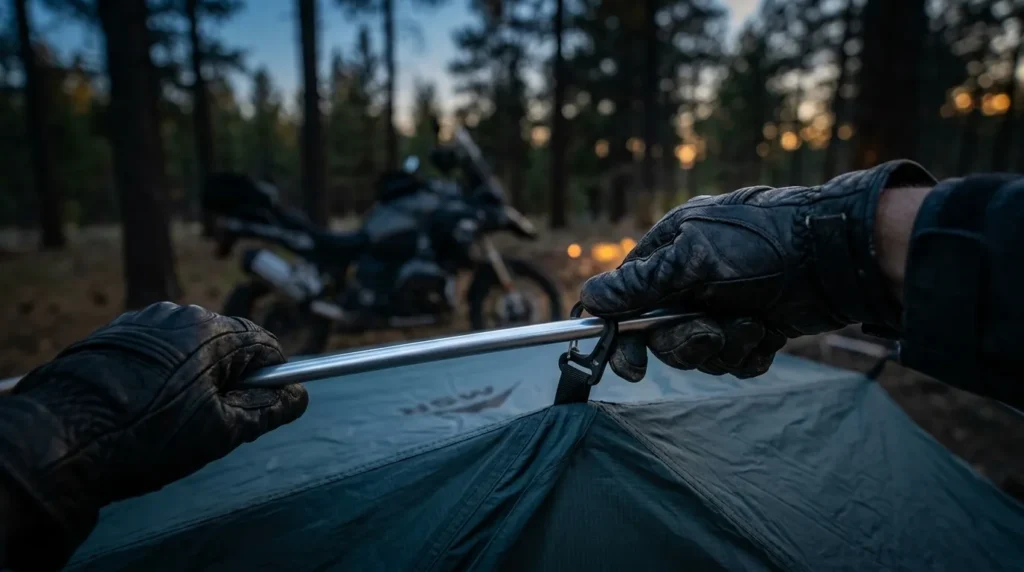
I’ve had days where I roll into a campsite so drained that even the thought of boiling water for a dehydrated meal feels like an absolute chore. That’s exactly why I appreciate the straightforward, no-brainer design of the ALPS Mountaineering Lynx 2. It uses a classic two-pole X-frame setup that is practically foolproof. While I’ve definitely had my struggles with more complex designs, like I mentioned in my Wolf Walker Motorcycle Tent review, where the tunnel shape can be a total nightmare to pitch solo in the wind, the Lynx 2 just works. You lay the tent flat, cross the two aluminum poles, and clip the tent body to them. There are no annoying sleeves to thread the poles through, which is a massive win in my book because those sleeves always seem to snag right when you’re in a hurry.
I’ve timed myself doing this in the dark, and I can usually get the main body up in about two or three minutes. Because it’s a fully freestanding tent, I can pick the whole thing up and move it around the campsite until I find a spot that doesn’t have a hidden root or a rock digging into my kidney. For a budget-friendly option, I was actually surprised to see they used 7000-series aluminum poles instead of the heavy, fragile fiberglass stuff you usually see at this price point. According to the official ALPS Mountaineering technical specs, these poles are designed to handle significant stress, and from what I’ve seen on the trail, they don’t develop that permanent bend that cheap poles do.
The clips on this tent are oversized, which is a small detail I didn’t realize I loved until I tried setting it up with cold, stiff fingers. I don’t even have to take off my riding gloves to snap them into place. As I noted in my best tent for motorcycle camping guide, sometimes simplicity is the greatest luxury you can have when you’re touring. You aren’t wrestling with complex hub systems or specialized bikepack poles; you’re just setting up a tent that you know will be ready for you to crawl into before your headlamp dies. It’s the kind of reliable, no-nonsense setup that makes me keep this tent in my rotation even when I have much more expensive options sitting on my gear shelf.
The Lynx 2 is a solid budget buy, but the ‘Quick-Corner’ design I covered in my Kelty Late Start 2 review makes it a much better choice for riders who hate fumbling with poles in the dark.
Does the 21-inch pack size make it a nightmare to fit in my panniers?
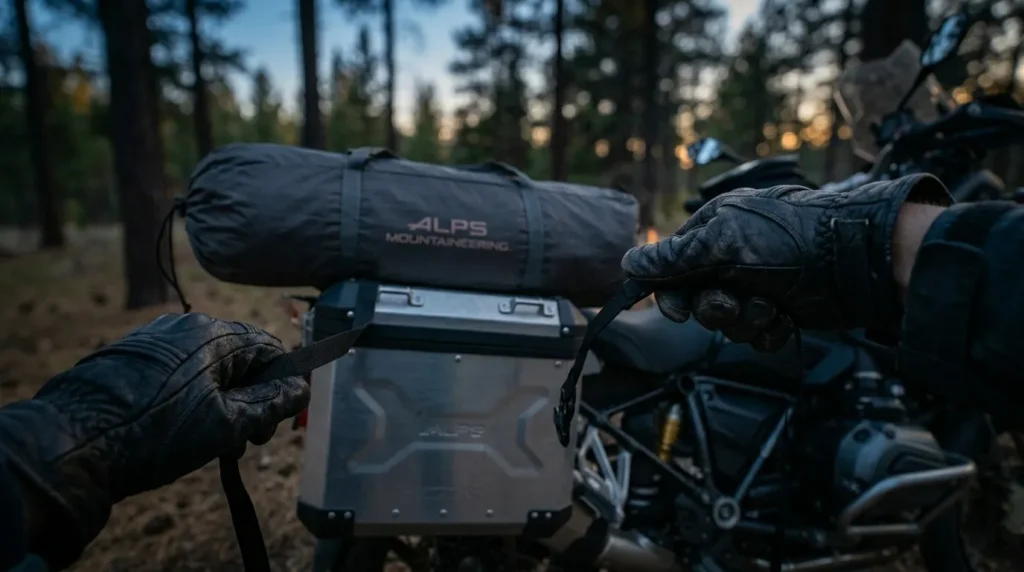
Let’s talk about the elephant in the room, or rather, the giant orange bag on your rear rack. If you’ve been following my other reviews, you know I’m obsessed with packability. I absolutely raved about the 12-inch shortstik poles in my Big Agnes Copper Spur review because they fit inside almost any pannier. The ALPS Mountaineering Lynx 2 is a completely different story. The poles on this tent are a solid 21 inches long. In the world of motorcycle camping, that is a massive length. Unless you are riding a bike with oversized custom boxes, there is almost no way you are fitting this tent inside your hard luggage. I’ve tried every angle in my 45-liter aluminum cases, and it’s just not happening.
So, how do I actually carry this thing? I’ve found that the only way to make it work is to commit to the rear rack lifestyle. I usually strap the Lynx 2 horizontally across my pillion seat or my tail rack using a pair of Rok Straps. Because the fabric bag it comes in is pretty thick and durable, I don’t worry as much about it getting shredded by the wind or vibration as I do with my ultralight gear. However, this means your tent is exposed to the elements. If I’m riding through a mud-caked trail or a rainstorm, the outer bag is going to get nasty. As I pointed out in my best tent for motorcycle camping guide, having your tent on the outside of your bike is a compromise you have to accept when you’re shopping in the budget category.
One trick I’ve used to slim things down is to pull the aluminum poles out of the main bag and store them separately. I’ll slide the poles into a narrow dry bag and strap them along the frame or the top of my side pannier. This lets me shove the actual tent fabric and rainfly into a much smaller compression sack that does fit inside my luggage. It’s a bit more work during the morning pack-up, but it helps keep the bike’s profile narrower. According to the official ALPS Mountaineering product details, the packed weight is about five and a half pounds, so while it’s bulky, it’s not going to make your bike feel like it’s about to tip over. If you’re touring on a large cruiser or a full-sized adventure bike, the 21-inch length is just a minor annoyance. But if you’re on a small dual-sport bike, you might find yourself wishing you’d spent the extra cash on a more compact setup like the MSR Hubba Hubba NX 2.
Can I actually fit myself and all my riding gear inside this tent comfortably?
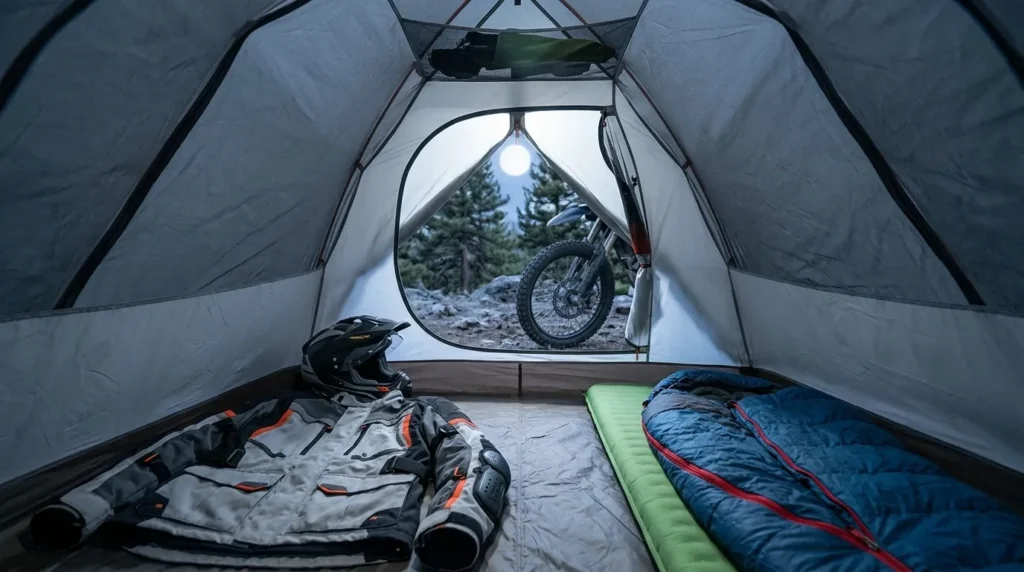
If there’s one thing I can’t stand, it’s waking up with a face full of wet mesh because I tried to cram my bulky riding jacket into a tent that was clearly designed for a hobbit. I’ve mentioned this before in my guide on the best tent for motorcycle camping, but a 2-person tent is really just a 1-person tent once you factor in all our gear. The Lynx 2 is one of the few tents in this price bracket where I actually feel like I have room to breathe. Unlike my Nemo Dragonfly OSMO 2P review, where I noted that the floor tapers at the feet to save weight, the Lynx 2 stays a wide rectangle all the way down. It measures about five feet by seven and a half feet, which gives you roughly 37 square feet of floor space. For me, that’s plenty of room to have my sleeping pad on one side and my entire gear explosion of a helmet, riding suit, and tank bag laid out on the other.
The vertical space is where this tent really wins for me. The center height is 46 inches, which is actually taller than most of the premium ultralight tents I’ve tested. I can sit up completely straight to change out of my base layers or look at my GPS routes for the next day without my head constantly brushing against the ceiling. It makes the tent feel more like a small room than a temporary shelter. I also really appreciate that you get two doors and two vestibules. Each vestibule gives you an extra 10 square feet of covered storage outside. I usually keep my muddy adventure boots and my panniers out there so I don’t drag the dirt inside.
I’ve found that the mesh storage pockets on the walls and the included gear loft are lifesavers for staying organized. I use the loft to hang my headlamp so it illuminates the whole tent while I’m winding down for the night, and it’s a great spot to toss my damp riding gloves so they aren’t sitting in a pile on the floor. While it’s definitely snug if you’re trying to fit two actual humans inside, for a solo rider, this thing is a total palace. I’ve spent rainy afternoons stuck inside this tent just waiting for a storm to pass, and I never got that claustrophobic feeling that usually drives me crazy in smaller setups. For me, the extra interior volume is a massive fair trade for the heavier polyester fabric.
The Lynx 2 is a solid budget buy, but for a major jump in ventilation and a much more compact 16-inch pack size, you’ve got to read my TETON Sports Mountain Ultra 2 review.
Will the Lynx 2 actually keep me dry during a heavy downpour?
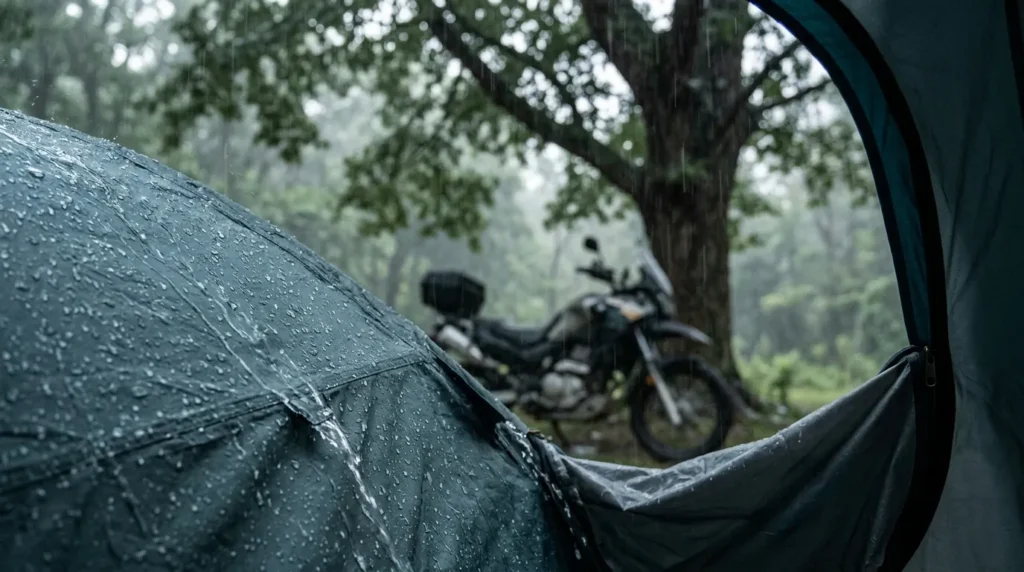
I’ve had my fair share of cheap tents that turned into backyard swimming pools the second a cloud looked at them funny, so I was naturally pretty skeptical about the Lynx 2 when I first saw the price tag. I’ve lived through a few washout nights where I ended up sleeping in my riding gear just to stay dry because the seams on my old budget tent decided to give up. However, after a particularly nasty spring storm in the Ozarks where it rained for eight hours straight, I can honestly say I was impressed with how this thing held up. The 75D polyester fly has a 1500mm coating that might not sound like much compared to the massive ratings on the Wolf Walker Motorcycle Tent, but it’s more than enough for 99% of the rain a three-season rider will ever see.
The real secret to its waterproofing isn’t just the coating; it’s the fact that ALPS actually takes the time to factory-seal all the seams on the fly and the floor. In most budget tents, you have to buy a bottle of seam sealer and spend an afternoon in your driveway doing it yourself, but this one is ready to roll right out of the box. I’ve noticed that even in high-wind rain, where the water is being shoved sideways against the zippers, the protective flaps over the doors do a great job of shedding the moisture. I’ve talked about the importance of these technical ratings in my best tent for motorcycle camping guide, and the Lynx 2 definitely punches above its weight class in this department.
One thing I have to mention is the condensation. Because the Lynx 2 uses a heavier polyester fabric, it doesn’t breathe as naturally as the high-end nylon on my Nemo Dragonfly OSMO 2P review. I’ve woken up a few times with some mist on the inside of the fly on humid mornings. It isn’t a leak, but it can feel like one if the fly is touching the inner mesh. The key I’ve found is to use the guy lines to pull the fly as tight and far away from the tent body as possible. This creates enough of a chimney effect that the moisture escapes through the roof vents. For me, as long as I set it up correctly, I’ve never had a drop of actual rain make it through to my sleeping bag.
Frequently Asked Questions: What riders want to know about the Lynx 2
Honestly, you can probably get away without one if you are pitching on soft grass, but I still recommend it. While the 75D polyester floor is way tougher than the 20D floors on my Nemo Dragonfly OSMO 2P review, ground moisture is still a factor. Using a footprint prevents the bottom of your tent from getting caked in mud, which makes your morning pack-up a lot less gross. It also adds a second layer of defense against those hidden sharp rocks that can eventually wear through even the toughest fabric. I’ve found that even a cheap piece of Tyvek cut to size works great for the Lynx 2 if you don’t want to buy the official one.
In my experience, no. Unless you are running massive custom boxes or a giant top case, those poles are going to be too long. I’ve tried every angle in my Touratech boxes and it’s just a no-go. As I mentioned in my best tent for motorcycle camping guide, the best pro move is to take the poles out of the tent bag and strap them separately along your frame or on top of your luggage. This allows the tent fabric itself to be squashed down into a much smaller space, but the poles are always going to be the limiting factor for this specific model.
It’s a bit of a mixed bag. Because it’s made of heavier polyester, it doesn’t breathe quite as well as the high-end technical nylon. On cold, humid mornings, you will likely see some mist on the inside of the fly. However, the Lynx 2 has two massive mesh doors and two roof vents, so as long as you aren’t completely battened down for a blizzard, the airflow is decent. I’ve found that if I leave the top of the vestibule zippers open just an inch or two, it creates enough of a draft to keep the interior pretty dry.
If you are planning on touring two-up, you’re going to be very cozy. For one person and a gear explosion, it’s perfect. But with two people, your helmets and riding suits will definitely have to live in the vestibules. Because it is a true rectangular floor, you do get more usable space than mummy-style tents, but it is still a backpacking-sized tent. I’ve spent a few nights in here with a riding buddy when we were stuck in a storm, and while we were safe and dry, we were definitely bumping elbows all night.
This is the biggest reason to buy the Lynx 2 over other budget tents. Most tents in this price range use fiberglass poles that can splinter and snap under pressure. The aluminum poles on the Lynx 2 are much more resilient. I’ve had this tent out in 25mph winds, and while it moved around, the poles flexed and returned to their original shape without any permanent damage. According to the community over at ADVrider, the reliability of these aluminum poles is why this tent is such a cult favorite among long-distance riders who can’t afford a gear failure in the middle of nowhere.
Should you actually spend your hard-earned money on the Lynx 2?
If you have stayed with me this far, you probably already know my answer. For a rider who wants to get out on the road without taking out a second mortgage for a gear setup, the ALPS Mountaineering Lynx 2 is the absolute winner. It is the Toyota Corolla of tents; it isn’t fancy, it doesn’t have a 12-inch pack size, and it certainly won’t win any awards for being the lightest in the pack. But it will be there for you night after night, keeping the bugs out and the rain off your face. I honestly think it is the best entry-level investment you can make. When I compare it to the high-end stuff I featured in my best tent for motorcycle camping guide, the Lynx 2 holds its own because of its sheer simplicity and ruggedness.
I’ll admit that as I’ve progressed in my touring, I find myself reaching for my Big Agnes Copper Spur more often simply because those short poles make packing my panniers so much easier. But I still keep my Lynx 2 on the shelf for those weekend trips where I know I’m going to be camping in rougher terrain or when I just want a tent I don’t have to baby. The fact that you can often find this tent for around $100 to $130 on Amazon makes it a no-brainer. You are getting a lot of utility and real aluminum poles for the price of a few tanks of gas and a decent steak dinner.
If you’re ready to upgrade from a budget setup to something with much better vertical walls and premium aluminum poles, you’ve got to read my Marmot Crane Creek 2P review.
If you are a minimalist riding a small dual-sport bike, the 21-inch pole length might eventually drive you crazy. But if you have a rear rack and a pair of Rok Straps, you can make this work for years. It’s durable, it’s spacious, and it’s predictable. In a world where ultralight gear is becoming more fragile and more expensive, there is something deeply satisfying about a piece of gear that is built to take a beating. For me, the Lynx 2 isn’t just a budget tent; it’s the gateway to adventure for anyone who has been sitting on the fence about trying moto-camping for the first time.