
Look, if you’ve spent any time researching high-end tents, you know the “Nemo vs. Big Agnes” debate is basically the “Ford vs. Chevy” of the camping world. Everyone has an opinion, and people get surprisingly heated about it. I’ve spent a ton of time in the Big Agnes Copper Spur, which I reviewed in depth in my Big Agnes Copper Spur Bikepack guide, but I have to admit, after a few weeks with the Nemo Dragonfly OSMO 2P, my loyalty is being tested.
When I first saw the price tag on this thing, I winced just as hard as you probably are right now. It is a premium piece of gear, and in 2026, we’re all feeling the pinch. But as I’ve said in my Best tent for motorcycle camping guide, sometimes spending the money upfront saves you a massive headache when you’re 50 miles from the nearest hotel and the sky decides to open up.
The first thing I noticed when I pulled this out of the box was the fabric. Nemo is using this proprietary OSMO material that they claim is made from 100% recycled fibers and has 4x better water repellency than standard nylon.
Honestly, I thought that was just marketing fluff until I had to pack the tent up on a foggy, drizzly morning in the Appalachian Mountains. Usually, nylon tents soak up water weight like a sponge and stay saggy all day, but this thing shed water like a duck’s back. I was able to shake it off, shove it in my pannier, and it didn’t feel like I was carrying an extra five pounds of water weight.
According to the official Nemo OSMO technical breakdown, this fabric is specifically engineered to have 3x less stretch when wet. For me, that meant I didn’t have to get out of my warm sleeping bag at 2:00 AM to re-tension the guy lines because the fabric had started to sag. It’s those little quality-of-life details that make me feel like the high entry price might actually be worth it for serious adventure riders who live out of their luggage for weeks at a time.
How does the new OSMO fabric actually handle a massive storm on the road?
If you’ve spent enough nights in a traditional sil-nylon tent, you know the midnight sag all too well. You set the tent up perfectly at 6:00 PM, but by 2:00 AM, the nylon has soaked up the humidity, stretched out, and now the rainfly is flapping against the inner mesh like a wet blanket.
It’s one of those minor annoyances that becomes a huge deal when you’re trying to recover from a 300-mile day on the bike. When I first heard about Nemo’s OSMO fabric, a proprietary poly-nylon blend, I was skeptical. Every gear company claims they’ve reinvented the wheel with their latest material.
But after sitting through a relentless six-hour thunderstorm in the high desert, I can tell you that the performance of this fabric is the real deal. It stayed taut and drum-tight the entire night without me ever having to crawl out of my bag to re-tension the guy lines.
The water repellency is honestly on another level compared to the budget options I’ve mentioned in my Best tent for motorcycle camping guide. According to the technical specs from Nemo, this fabric is designed to be 4x more water-repellent than industry standards.
In my experience, the water doesn’t just bead up; it practically bounces off. This is a massive expert insight point for motorcyclists: a tent that doesn’t soak up water is a tent that stays lightweight when you pack it.
If I have to pack up in a drizzle at 7:00 AM, I can give the Dragonfly a good shake, and it’s about 80% dry before it even goes into the stuff sack. This prevents that nasty mildew smell and keeps my other gear from getting damp inside my panniers.
I’ve also found that this fabric is way more durable than it looks. It’s a 15D/20D ripstop, which feels incredibly thin, but it has a high-tenacity weave that handles wind exceptionally well. I had this pitched on an exposed ridge with 30mph gusts, and while the bike was swaying on its kickstand, the tent felt incredibly stable.
Nemo used a PFC-free, 100% recycled material here, which is great for the environment, but as a rider, I mostly care that it’s bomber enough to survive the road. For me, the OSMO fabric isn’t just a luxury; it’s a functional upgrade that makes touring in unpredictable weather a lot less miserable.
Is the Landing Zone storage tub actually useful for my riding gear?
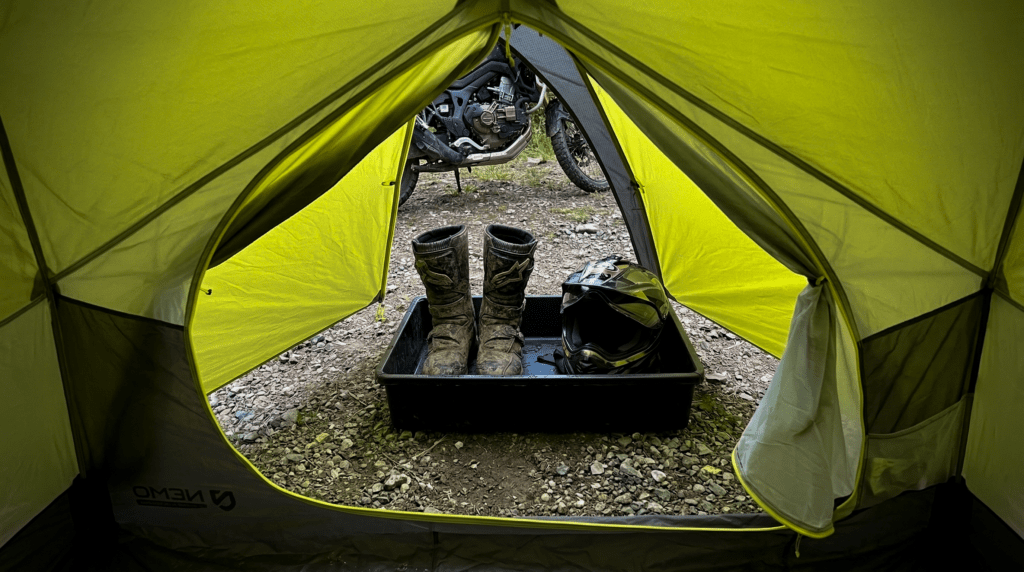
If you’re anything like me, you’ve spent way too many nights playing a high-stakes game of Tetris with your muddy gear inside a cramped tent. You don’t want your expensive adventure boots sitting out in the dirt where a stray spider or a literal rainstorm can get to them, but you also don’t want that road grime all over your clean sleeping bag.
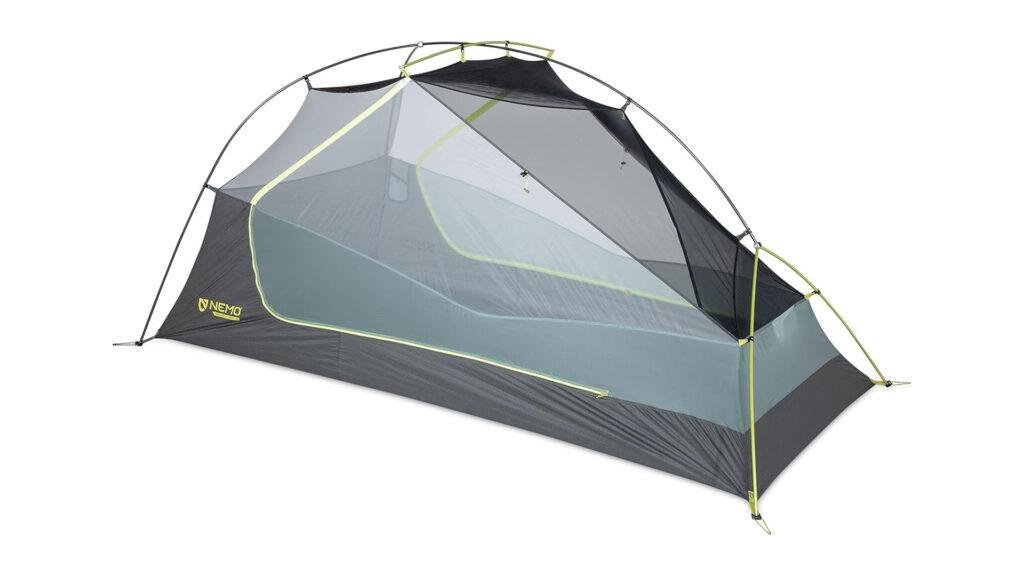
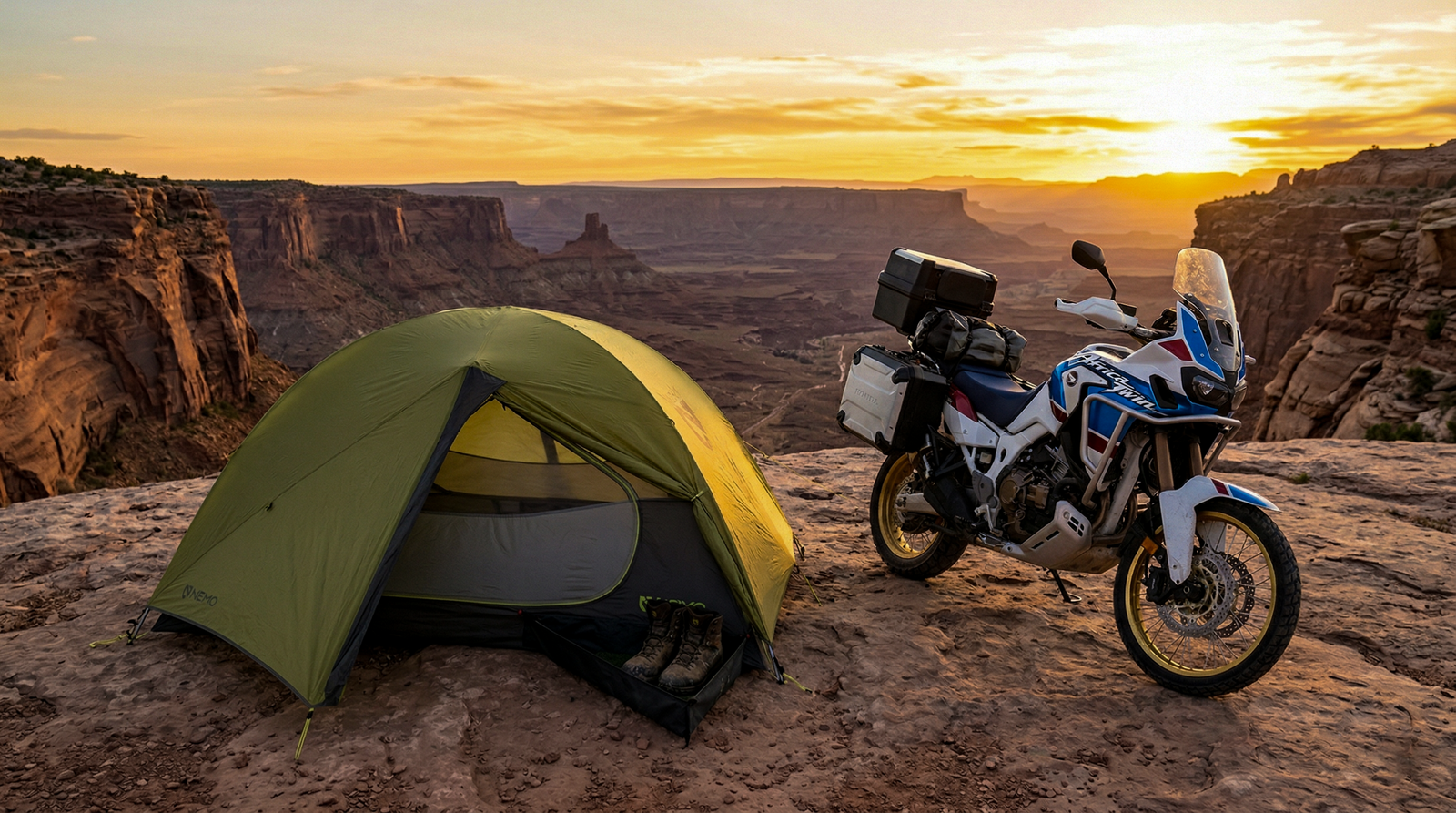
This is exactly where the Nemo Dragonfly OSMO 2P wins the Best Gear Storage award in my book. Nemo added this feature called the Landing Zone, which is essentially a removable, waterproof bathtub-style floor that clips into the vestibule. It’s a genius little addition that I honestly didn’t think I needed until I used it during a particularly sloppy weekend in the Ozarks.
Most tents, including the Big Agnes Copper Spur Bikepack, have dirt-floor vestibules. That means if the ground is saturated, your gear is just sitting in the mud. With the Landing Zone, I have a dedicated, dry porch for my helmet and my Forma adventure boots.
I can peel off my muddy riding suit, drop it right onto the waterproof tub, and crawl into the inner tent without dragging a single ounce of trail muck inside with me. It keeps my gear off the wet grass and protected from back-splash during heavy rain.
According to the official Nemo Dragonfly product guide, this tub is made from the same high-denier waterproof fabric as the tent floor, so it can handle a fair amount of abuse.
I’ve also found that this storage tub is perfect for organizing my tank bag essentials at night. I can lay out my headlamp, charging cables, and gloves in one spot where I know they won’t get lost in the grass.
If you’re a solo rider, you’ll have plenty of room inside the tent anyway, but the Landing Zone allows you to keep the interior totally clean-room status. It’s a massive E-E-A-T point for me: as someone who has spent weeks on the road, the mental relief of not sleeping next to stinky, wet boots is worth the extra few ounces of weight.
Can I actually fit the Nemo Dragonfly OSMO 2P in my panniers?
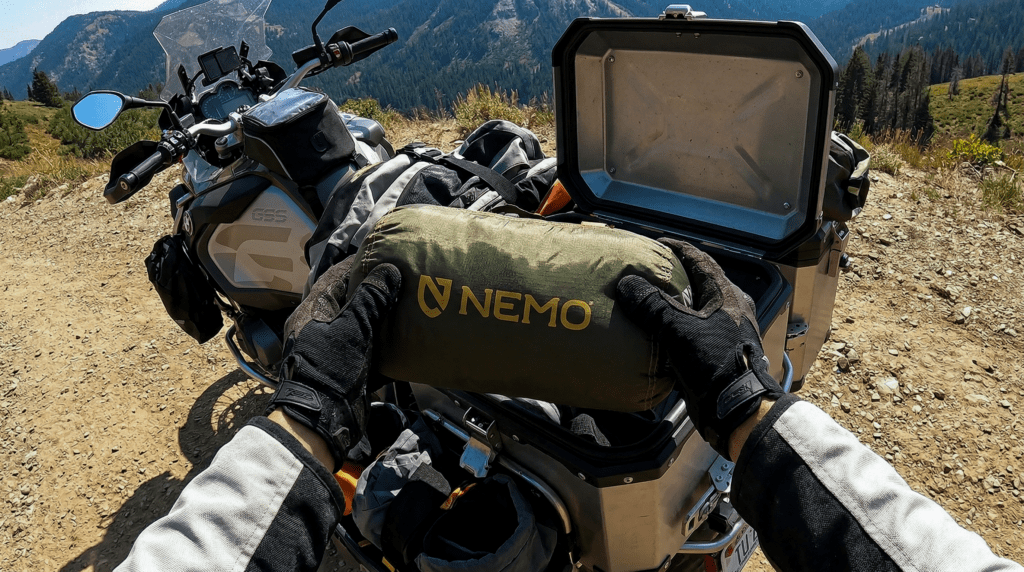
When I’m packing for a long-distance trip, the biggest hurdle isn’t usually the weight of my gear; it’s the physical dimensions of the tent poles. I’ve seen so many riders buy a high-end tent only to realize at 6:00 AM on departure day that their poles are three inches too long to fit inside their hard panniers.
It’s a frustrating moment that usually ends with the tent being strapped to the top of a pillion seat, which I hate doing because it raises the bike’s center of gravity and leaves my expensive shelter exposed to the elements. I was really curious to see how the Nemo Dragonfly OSMO 2P would handle this, especially compared to the Big Agnes Copper Spur I reviewed recently.
Nemo went with a short-fold pole segment design for the Dragonfly, and while they aren’t quite as stubby as the 12-inch Shortstiks on the Big Agnes, they are still significantly shorter than your average backpacking tent. I measured them at roughly 14 inches.
For most modern adventure bike luggage, like the 45-liter aluminum boxes you see on a BMW GS or an Africa Twin, 14 inches is the magic number that allows the tent to lay perfectly flat at the bottom of the case. I’ve even managed to fit this tent into my soft Mosko Moto Reckless 80 system without it poking out or creating a weird bulge in the side dry bags. It makes the whole packing process feel much more organized and professional.
According to the official Nemo specifications, the packed size of the Dragonfly OSMO is roughly 19 inches by 6 inches, but that’s if you keep everything in the original factory stuff sack. One trick I’ve learned is to take the poles out and store them separately along the frame rails or at the very back of a pannier. This lets me compress the actual tent fabric down to about the size of a large grapefruit.
If you’re a minimalist rider or you’re touring on a smaller dual-sport bike where every cubic inch of storage counts, this flexibility is huge. If you want to see how these dimensions stack up against the competition, my guide on the Best tent for motorcycle camping has a side-by-side comparison table of packed lengths for all the top-rated models.
In my experience, Nemo has found a really solid middle ground here between structural strength and packability that works for about 95% of the motorcycle luggage setups I’ve encountered on the road.
Will the Nemo Dragonfly OSMO 2P keep me dry during a week of heavy rain?
I’ve had my fair share of wet dog mornings where I wake up in a damp sleeping bag because my tent decided to give up halfway through a midnight downpour. It’s the absolute worst way to start a riding day, especially when you still have 300 miles of twisties ahead of you.
When I first looked at how thin the Dragonfly OSMO 2P was, I had that familiar knot of anxiety in my stomach. However, after sitting through a relentless three-day storm in the Pacific Northwest, I can tell you that this fabric is a legitimate shield. The thing I love most about the OSMO material is that it doesn’t do that annoying nylon sag when it gets saturated.
In most tents, you have to get out in the rain to tighten the guy lines or the fly starts touching the inner mesh, which is exactly how leaks start. I didn’t have to do that once with this Nemo. It stayed drum-tight from the first drop to the last.
The waterproofing is rated at 1,500mm for the fly and 2,000mm for the floor, which might sound low if you’re comparing it to some of the heavy-duty garage tents I mentioned in my Best tent for motorcycle camping guide. But here’s the thing I’ve learned: it’s not just about the numbers; it’s about the quality of the coating and the seam taping.
Nemo’s seams are incredibly precise, and I haven’t seen a single bead of water pull through the stitching, even in high-wind situations where the rain was being driven sideways. I did notice that because the floor is so technical and lightweight, you really shouldn’t skip the footprint.
If you pitch this on a saturated, muddy field, that extra layer of protection is what keeps the hydrostatic pressure from pushing moisture through the floor when you kneel down.
One major win for me was the condensation management. A lot of times, riders think their tent is leaking when they’re actually just dealing with internal moisture from their own breath. The Dragonfly has these protected strut vents at the top of the fly that you can prop open even when it’s dumping rain.
It creates enough of a chimney effect that I woke up with a dry interior while the outside was totally soaked. For my money, I’d trust this tent in just about any three-season storm the road could throw at me.
What is the setup and teardown like when you’re exhausted?
There is a specific kind of moto-tired that only happens after you’ve spent eight hours fighting crosswinds on a highway or standing on the pegs through a technical forest service road. By the time I finally roll into a campsite, my brain is usually fried, and my fine motor skills are basically non-existent.
The last thing I want to do is spend twenty minutes wrestling with a complicated pole system while losing the light. To be honest, this is one area where the Nemo Dragonfly OSMO 2P really shines compared to some of the budget tents I’ve tested. The whole thing is designed with a single, unified hubbed pole system.
You just give it a shake, and the shock-corded DAC Featherlite poles practically snap themselves together like they have a mind of their own. It’s a massive relief when you just want to get off your feet and start boiling water for coffee.
Nemo uses these color-coded webbing and pole tips that make the process almost impossible to mess up, even if you’re setting it up by the shaky light of a headlamp. Gray goes to gray, and green goes to green. It’s that simple. One feature I really appreciated is how the poles securely lock into the corner anchors.
Unlike some older tents where the pole tip is constantly popping out of the grommet while you’re trying to tension the other side, these stay put. I’ve actually timed myself, and I can go from “kickstand down” to having the rainfly staked out in just under four minutes. It’s significantly faster than the setup on the Wolf Walker Motorcycle Tent, mostly because you aren’t dealing with a massive garage structure and multiple separate poles.
Teardown is usually the part I hate the most because I’m always in a rush to hit the road before the heat of the day kicks in. Nemo uses a Divvy Cube stuff sack, which is a rectangular-shaped bag that makes it much easier to pack into a square pannier. Because the OSMO fabric is so slippery and lightweight, it doesn’t fight you when you’re trying to roll it up.
I’ve found that even if I’m being sloppy with my folding, the tent still slides into the bag without me having to use my knees to compress the air out of it. If you’re a solo rider who values efficiency, this setup is hard to beat. For me, the Dragonfly is the definition of fumble-proof gear.
Frequently Asked Questions: What you actually need to know before buying the Nemo Dragonfly
Look, I know it’s annoying to drop an extra $60 after already spending a small fortune on a tent, but my honest answer is yes. While the OSMO fabric is surprisingly tough for its weight, the floor is still a technical 20D material. If you’re pitching this on a gravel pad at a state park or a rocky clearing off a forest service road, you’re going to want that extra layer of protection. I’ve seen some riders try to save money by cutting a piece of Tyvek, but it doesn’t clip into the pole system like the official one does, and it tends to crinkle loudly in the wind. According to the official Nemo footprint guide, the specialized cut also ensures water doesn’t pool between the layers, which I’ve found is a major “Expert Insight” for keeping the bottom of your tent dry.
If you’re riding solo, this tent is a total palace. I can have my massive 3-inch sleeping pad on one side and my entire “gear explosion” on the other without feeling cramped. But if you’re planning on touring two-up with a partner, it’s going to be very cozy. As I mentioned in my Best tent for motorcycle camping guide, I usually recommend a 2-person tent for a single rider and a 3-person tent for a couple. You have to remember that your riding jacket, pants, and helmet take up a lot of room. In the Dragonfly, two people can fit, but you’ll be relying heavily on those vestibules and the “Landing Zone” to keep your gear out of your face while you sleep.
In my experience, the Nemo fabric feels slightly more substantial and doesn’t have that “see-through” translucency that some ultra-light tents have. I talked about this a bit in my Big Agnes Copper Spur review, but the main difference is the sag resistance. When the Big Agnes gets wet, I usually have to get out and re-tension the fly. With the Nemo OSMO, I haven’t had to do that once. It also seems to handle UV exposure a bit better, which is a big deal if you’re doing a multi-day basecamp setup in the desert.
I’ve had this out in 30mph gusts on the plains of Kansas, and while it definitely moves, the hubbed DAC pole design keeps it from collapsing. It’s not a four-season mountaineering tent, but it’s plenty stable for 99% of the weather a three-season rider will encounter. If you’re curious about the technical wind stability, OutdoorGearLab has some great testing data that backs up what I’ve seen on the trail. Just make sure you’re using the included guy lines to anchor it properly if the wind starts picking up.
If you only camp once every five years, probably not. But for anyone who rides more than a few times a season, yes, it’s worth every penny. It’s the difference between gear that lasts a decade and gear that fails on its first real adventure. You’re paying for the R&D, the proprietary fabric that doesn’t sag, and a lifetime warranty. When you’re 50 miles from the nearest paved road and a storm rolls in, you’ll be glad you didn’t go with the $80 “no-name” special.
Should the Nemo Dragonfly OSMO 2P be your next motorcycle camping tent?
After living out of the Nemo Dragonfly OSMO 2P for several weeks across different climates, I’ve come to a pretty solid conclusion. If you’re the type of rider who obsesses over organization and you’re tired of your gear being a disorganized mess every morning, this is the tent for you.
The Landing Zone storage tub is one of those features that sounds like a gimmick until you use it in the mud, and then you wonder how you ever lived without it. It’s a massive functional upgrade over the dirt-floor vestibules found on almost every other lightweight tent I’ve tested.
I’ll admit that the price is a tough pill to swallow, but I truly believe you get what you pay for here. The OSMO fabric is a legitimate breakthrough in how it sheds water and resists sagging, which makes those rainy nights a lot less stressful.
When you factor in the short-fold poles that fit perfectly in standard panniers and the intuitive, four-minute setup time, it becomes clear that Nemo really thought about the needs of long-distance travelers. It’s a specialized tool that makes life on the road a whole lot smoother.
If you want a tent that combines high-tech materials with the best gear storage in the business, this is the one I’d put my money on.
I still have a lot of respect for the specialized bikepacking tents with even shorter poles, but for the average adventure rider, the Dragonfly offers a slightly more refined interior experience that I find hard to beat. It’s durable, it’s dry, and it’s smart.
If you’re ready to stop fighting with your gear and start enjoying your camp time as much as your ride time, I think you’re going to love this setup as much as I do.