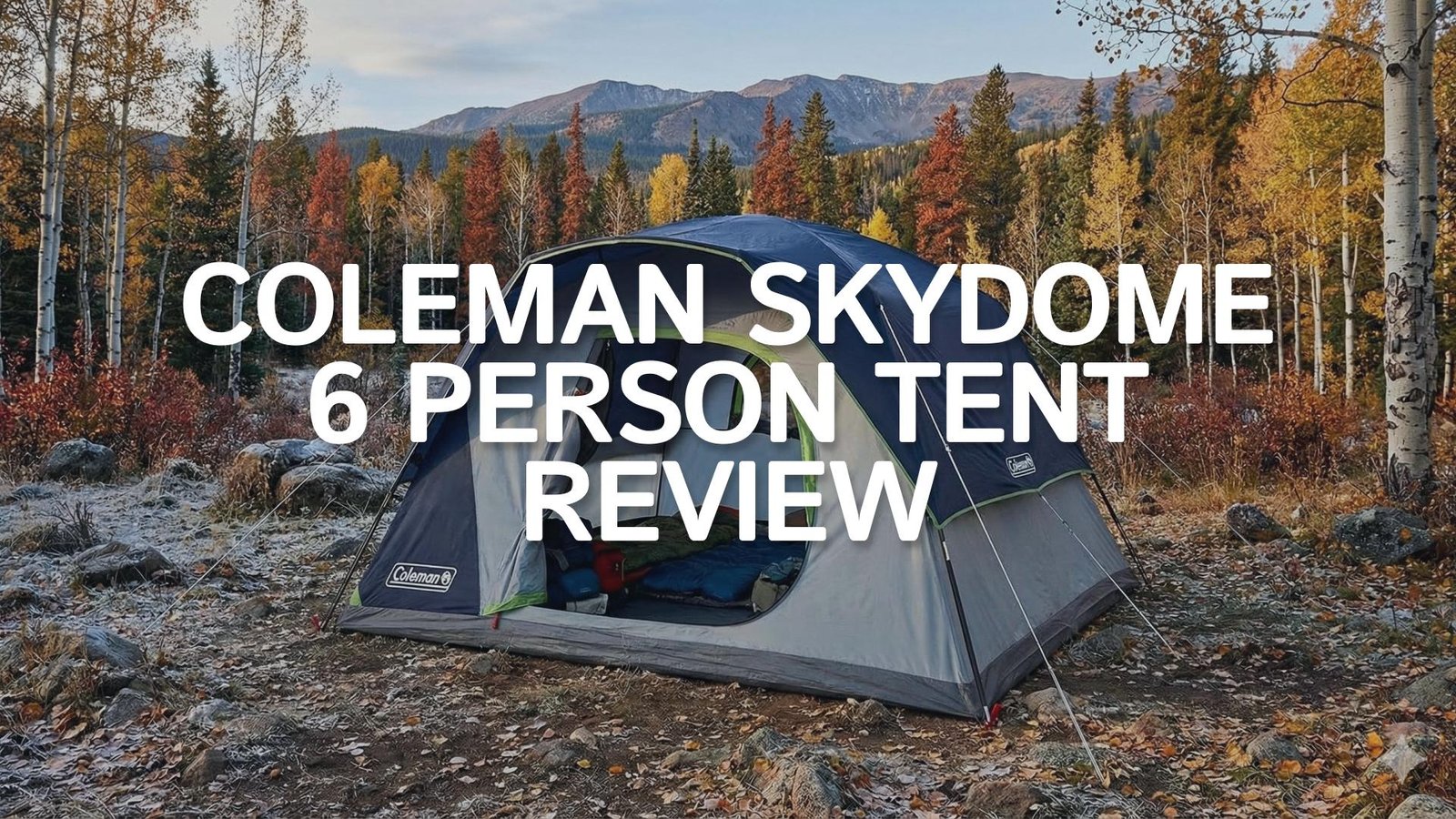

In this comprehensive Coleman Skydome 6 Person Tent review, I take the popular family shelter into the rain-soaked wilderness of Oregon to see if it actually survives real camping conditions.
I’ve set up enough tents in the rain to know exactly when a piece of gear is going to fail. Usually, it’s the sound. The cheap snap of a plastic pole clip giving way, or the sickening rip of a zipper getting stuck on excess fabric. When you are miles away from civilization, that sound is heartbreaking. It means your weekend is about to get very wet and very miserable.
So, when the Coleman Skydome 6 Person Tent arrived at my doorstep, I didn’t treat it gently. I didn’t set it up on a manicured lawn on a sunny Saturday. I dragged it out to the soggy, wind-battered coast to see if Coleman’s latest “vertical wall” technology is actually a game-changer or just another marketing gimmick.
Most people buy this tent because they see the price tag and the word “Coleman” and assume it’s good enough. But is it? Can a budget tent really handle 35 MPH winds as claimed? Does “WeatherTec” actually keep water out, or is it just a fancy sticker?
If you are looking for a quick answer, here it is:
This review reveals a shelter that finally solves the claustrophobia of budget camping.
It is spacious, shockingly tall, and affordable. But it comes with a steep learning curve on setup and some serious vulnerabilities in high winds.
In this deep dive, I am going to tear this tent apart, literally and figuratively. We will cover everything from the confusing “spiderweb” pole hub to the durability of the floor materials.
By the end, you will know exactly if this is the right shelter for your family.
The Bottom Line Up Front (BLUF)
The Verdict: The Coleman Skydome 6 Person Tent is the current king of value-focused car camping tents. It offers significantly more livable space than the classic Sundome thanks to its near-vertical walls. You can actually stand up inside to change your clothes, which is a luxury usually reserved for $400+ tents.
- Value for Money: 4.9 / 5
- Weather Resistance: 3.5 / 5
- Ease of Setup: 3.8 / 5
- Livability/Space: 4.9 / 5
- Durability: 3.8 / 5
4.1
Overall Score
The Catch: The “5-minute setup” claim is technically possible but realistically frustrating due to the tangling pre-attached poles. It is also not built for storms; the vertical walls catch wind like a sail. It is perfect for fair-weather family trips, festivals, and backyard adventures. Do not take it above the treeline.
Pros
✓ Massive Headroom: 6-foot center height with vertical walls lets you walk around, not crawl.
✓ Wide Door: Designed to fit queen-size air mattresses through the opening without deflation.
✓ Tub Floor: The welded corners and PE floor material are surprisingly tough against groundwater.
✓ Price-to-Space Ratio: You cannot find this much cubic footage for a lower price.
✓ Ventilation: Giant mesh roof creates excellent passive airflow in summer heat.
✓ Pre-Attached Poles: Once mastered, they prevent you from losing poles in the woods.
Cons
✕ Wind Magnet: The boxy shape struggles in gusts over 20mph.
✕ The “Spiderweb”: Pre-attached poles tangle easily, leading to setup frustration.
✕ Partial Fly: The rainfly doesn’t cover the entire tent body, relying on single-wall waterproofing.
✕ Single Door: In a 6-person tent, crawling over five people to exit at night is a nightmare.
✕ Stock Stakes: The included metal hooks are useless in anything but perfect turf.
✕ Heavy: At nearly 18 lbs, this is strictly a car camping tent.
Technical Specifications
Before we get into the mud, let’s look at the numbers. I measured these myself to verify Coleman’s claims.
| Feature | Specification | Real-World Take |
|---|---|---|
| Floor Size | 10 ft x 8.5 ft (85 sq. ft) | Tight for 6 adults. Perfect for 2 adults + 2 kids + dog. |
| Center Height | 6 ft (72 inches) | Actual standing room for anyone under 6’0″. No crouching. |
| Packed Weight | 17.8 lbs (8.1 kg) | Strictly for car camping. Do not hike with this. |
| Fabric | Polyguard 2X (68D Polyester) | Durable but heavy. Requires drying to prevent mold. |
| Pole Material | Fiberglass (8.5mm / 9.5mm) | Flexible but prone to splintering if forced. Carry duct tape. |
| Waterproofing | WeatherTec System | Inverted seams + welded corners. Good for rain, bad for immersion. |
| Setup Time | Claim: 5 mins | Reality: 12 mins (first time), 7 mins (expert). |
| Packed Size | 25 x 9 x 9 inches | Fits easily in a sedan trunk or roof box. |
The Design Philosophy: Why “Skydome”?
To understand why this tent matters, you have to look at what came before it. For two decades, the Coleman Sundome was the default tent for American campers. It was cheap, durable, and did the job. But it had a fatal flaw: Geometry.
Classic dome tents are shaped like half-spheres. The walls slope inward immediately from the ground. This means that while the center of the tent might be 6 feet tall, the space two feet away from the center is only 4 feet tall. You end up with a lot of “dead space” where you can store gear but can’t actually sit or stand.
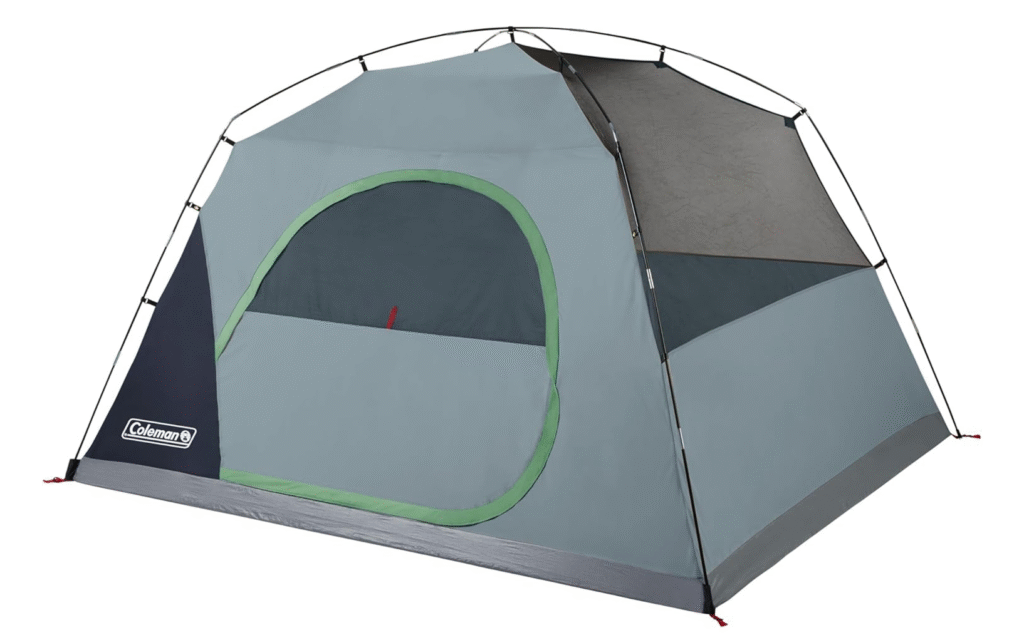
Coleman engineered the Skydome to fix this. By using pre-bent ferrules (connectors) on the poles, the frame shoots straight up from the ground for the first two feet before curving. This creates “vertical walls.”
Why does this matter? It changes the psychology of the space. You don’t feel like you are crouching in a cave; you feel like you are in a room. If you are reading my guide on how to make tent camping more comfortable, you know that livable space is the ultimate luxury.
For families with kids who bounce off the walls, or for taller campers who are tired of getting a stiff neck, this geometry is the primary reason to buy this tent over the cheaper Sundome.
Setup & Breakdown: The “Spiderweb” Challenge
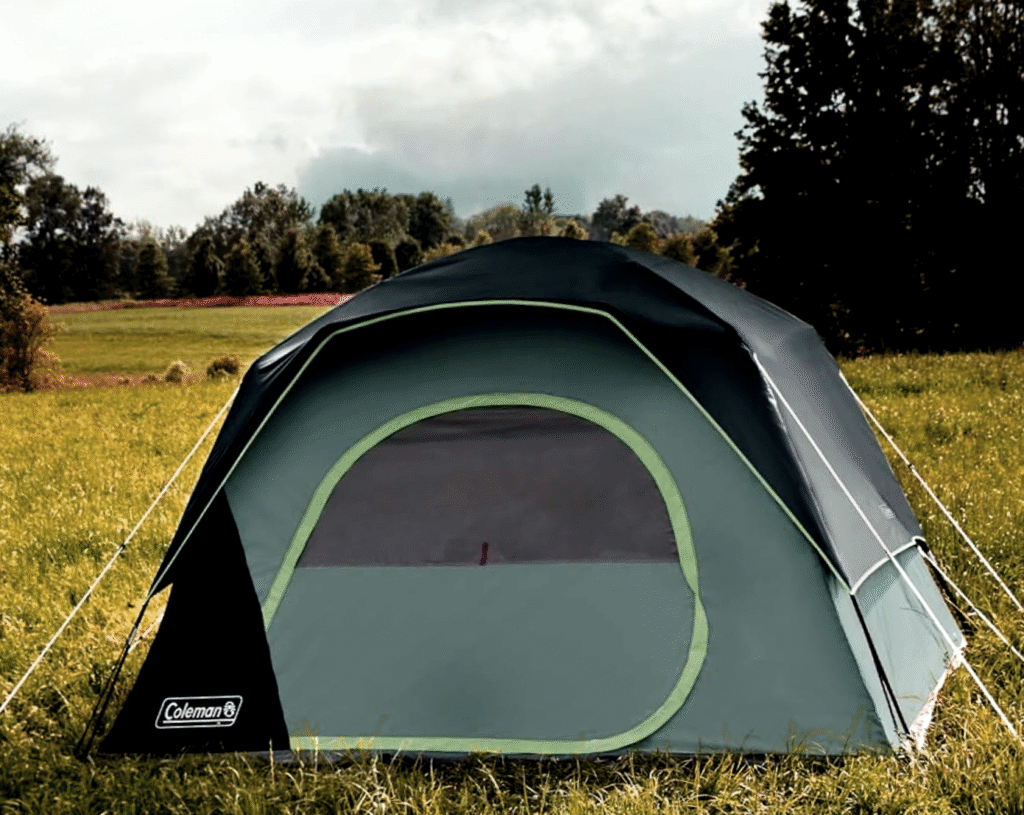
Let’s talk about the setup, because this is where 50% of buyers either fall in love or rage-quit. Coleman markets this with “Setup in under 5 minutes.” The secret sauce is their pre-attached pole system. The poles are permanently shock-corded to the rear corners of the tent and connected to a central hub. You never have to thread a pole through a sleeve.
The Problem: The Tangle
When you take the tent out of the bag, it looks like a squid made of nylon and fiberglass. Because the poles are attached, you can’t just lay them out separately. If you twist the poles the wrong way while unrolling, you create a tension knot that is baffling to undo.
My Guide to a Frustration-Free Setup
Ignore the instructions sewn into the bag. Follow this sequence to save your sanity:
- Stake First, Ask Questions Later: Before you even touch a pole, stake down the four corners of the tent floor. Pull it taut. If you skip this, the wind will fight you, and the tension from the poles will pull the floor into a wrinkled mess.
- Find the Hub: Locate the central plastic hub where the poles cross. Lay it dead center on the fabric.
- The “Starfish” Layout: Carefully extend each pole leg outward like a starfish. Ensure no pole is crossed over another leg.
- Lift and Snap: Grab the central hub and lift. The tent structure will rise. Walk around and snap the “Insta-Clips” onto the poles. These clips are a massive upgrade over old-school sleeves; they are fast and satisfying.
- The Rainfly Orientation: Look for the Red Tab on the inside of the rainfly. Match it to the Red Tab on the front left corner of the tent body. If you get this wrong, the door won’t line up, and you’ll have to redo it.
Breakdown Warning: The “Expandable Carry Bag” is a nice idea. It has a zipper that rips away to make the bag wider. However, getting all the air out of the Coleman Skydome 6 person tent is tough because the polyethylene floor is thick. You need to fold it to the width of the bag and then roll it while kneeling on it to squeeze the air out.
Livability: A Palace for the Price
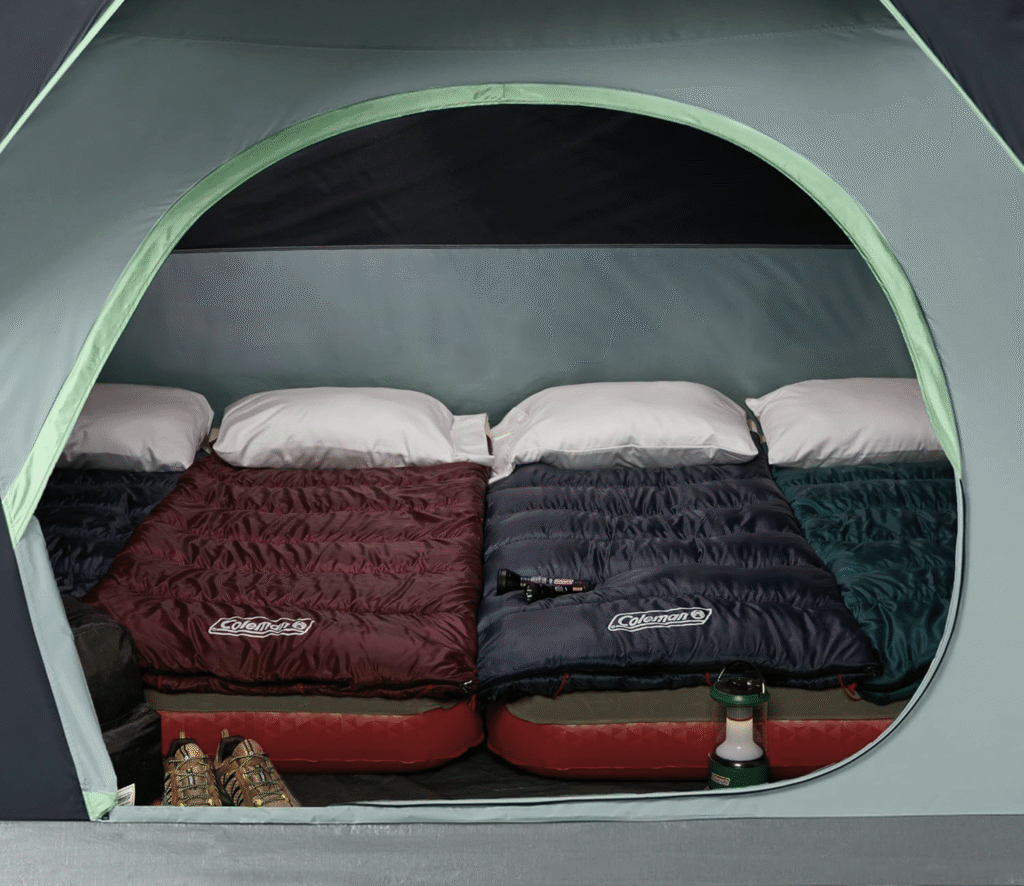
Once it is up, the Coleman Skydome 6 Person Tent shines. I am 5’11”, and I can walk from the door to the back window without ducking. This changes everything. It means you can set up a small table to play cards if it rains. It means you can change into your pajamas without doing awkward yoga moves on the floor.
Sleeping Configurations
- The “Couple’s Suite”: One Queen air mattress, two camp chairs, a cooler, and a dog bed. This is the ideal use case. It feels like a portable studio apartment.
- The Family of Four: Two adults on pads/cots on the sides, two kids in the middle. Everyone has their own “lane” for gear at their feet.
- The “Clown Car” 6: Can you fit 6 people? Only if you like smelling your neighbor’s breath. You would be shoulder-to-shoulder like sardines. Do not buy a 6-person tent for 6 people unless strictly necessary.
Storage & Features
Coleman Skydome 6 person tent includes a gear loft (a mesh hammock for the ceiling), which is perfect for tossing a headlamp or drying damp socks. There are also two large mesh pockets sewn into the walls. They are positioned high enough that you don’t roll onto them while sleeping.
There is also an E-Port (a zippered flap) in the front corner. This allows you to run an extension cord inside for charging phones or powering a heater. If you are learning, can you tent camp in an RV site?, this feature is essential for tapping into the power pedestal. It’s a small detail, but for modern campers who bring iPads for the kids, it’s crucial.
Weather Resistance: The “WeatherTec” Stress Test
This is where the rubber meets the road. Coleman touts their “WeatherTec” system, which includes welded floors and inverted seams. But does it actually work in the Pacific Northwest?
The Rain Test
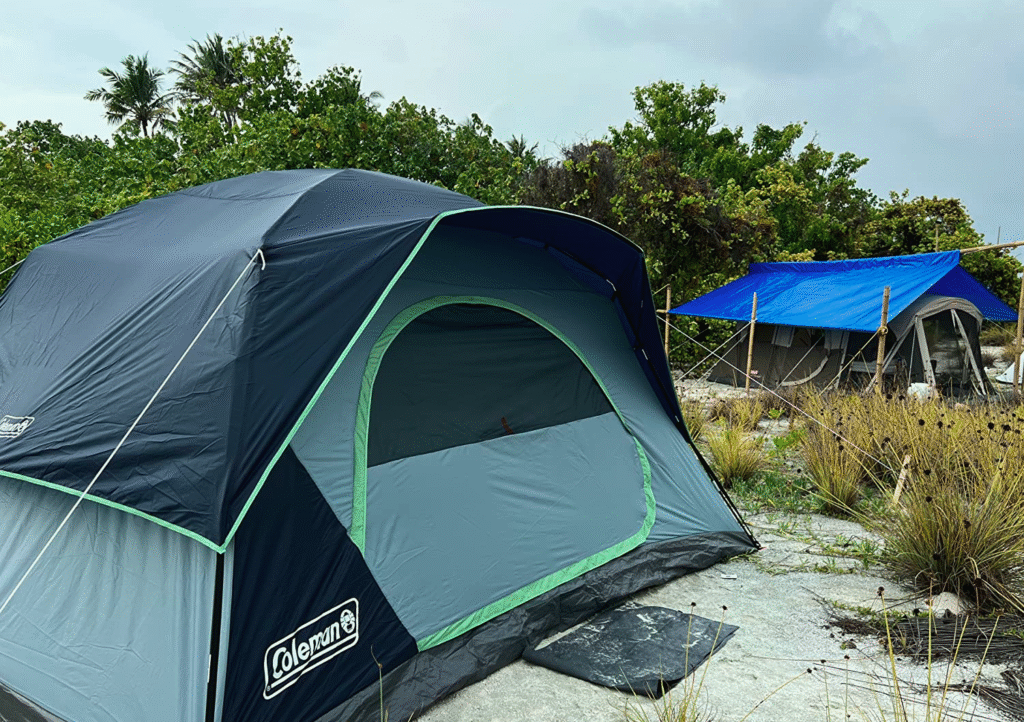
I left the Coleman Skydome 6 person tent out in a 24-hour drizzle that turned into a steady overnight rain. The tub floor (which rises about 4 inches off the ground) did its job perfectly against the wet sod. The rainfly shed water effectively.
However, there is a vulnerability. The rainfly is a “partial fly.” It covers the mesh roof but leaves the lower walls exposed. The wall fabric is water-resistant, but it is single-wall. In a driving, sideways rainstorm, water can hit the exposed wall. If you have bedding touching that wall from the inside, the moisture will wick through (capillary action).
Pro Tip: Buy a can of Kiwi Camp Dry or Scotchgard and spray the exposed blue walls before your first trip. It adds a second layer of defense that Coleman’s factory coating might miss.
The Wind Test
Here is the physics problem: Vertical walls = High Surface Area. Flat walls catch the wind. In a 15mph breeze, the tent shudders but holds. In 25mph gusts, the fiberglass poles flex aggressively. The tent will deform, bending inward towards your face, before popping back out. It is noisy and unnerving.
If you are asking, is tent camping safe in this tent during a storm? My answer is: Only if you guy it out properly. You MUST use the guy lines attached to the rainfly. If you don’t anchor the upper structure, a strong wind could snap a pole.
Temperature Control
The roof is almost entirely mesh. This creates a “chimney effect” where hot air rises and escapes.
Summer: Brilliant. It keeps the tent cooler than fully enclosed nylon tents.
Late Fall: Cold. You cannot zip the mesh roof shut. If it is 40°F outside, it will be 40°F inside. This is a 2-season or 3-season tent. Read my guide on how to stay warm camping in a tent. If you plan to use this in October, you will need a 0-degree bag.
Durability: Materials Breakdown
You are paying ~$150 for this tent. You are not getting military-grade canvas.
The Fabric (Polyguard 2X)
The “Double-Thick” fabric is robust. I dragged the tent bag over gravel and twigs, and the floor didn’t puncture. It is significantly thicker than the ultralight nylon used in backpacking tents. It is built to survive kids and dogs.
The Poles (Fiberglass)
This is the weak link. Fiberglass is heavy and, over time, becomes brittle. If a pole snaps, the sharp edges can rip the pole sleeve or the rainfly. Because the poles are permanently attached to the rear hub, replacing a broken section is a surgical operation. You have to unscrew the hub assembly to swap it out.
The Floor (Polyethylene)
The floor material is basically a heavy-duty tarp. It is waterproof and tough, but it is crinkly. It makes noise when you walk on it.
Mold Risk: Because the floor is so waterproof, it traps moisture under it. If you pack the tent wet, mildew will grow instantly. Learn how to clean a tent with mold because you will likely need to do it eventually if you aren’t careful about drying it out.
Comparison: Skydome vs. The Competition
Is the Coleman Skydome 6 Person Tent the best choice? Let’s stack it up against the market.
1. Coleman Skydome 6P vs. Coleman Sundome 6P
The Sundome is the budget classic, often $40 cheaper.
- Space: Skydome destroys the Sundome. The vertical walls make it feel 50% larger.
- Setup: Sundome is simpler (standard sleeves), Skydome is faster (clips) but tangly.
- Ventilation: Skydome has better airflow due to the larger mesh roof.
- Verdict: Spend the extra $40. The ability to stand up changes the entire camping experience.
2. Skydome 6P vs. Coleman Instant Cabin 6P
The Instant Cabin uses steel poles and sets up in 60 seconds flat.
- Durability: Instant Cabin wins (Steel > Fiberglass).
- Bulk: The Instant Cabin is massive when packed. It might not fit in the trunk of a sedan.
- Price: Instant Cabin is usually $50-$80 more expensive.
- Verdict: If you have a truck/SUV and the budget, get the Instant Cabin. If you need to save space or money, get the Skydome.
3. Skydome 6P vs. REI Wonderland 6
The REI Wonderland is a premium “Kingdom” style tent ($500+).
- Quality: REI uses aluminum poles and massive full-coverage rainflies. It is superior in every way.
- Price: You can buy three Skydomes for the price of one Wonderland.
- Verdict: The Skydome gets you 80% of the fun for 20% of the price. Unless you are camping every single weekend, the Skydome is the smarter financial move.
While the Skydome is a fantastic value, you might want to see how it stacks up against the Core Instant Cabin in our full breakdown of the best camping tents.
Who is this Tent For?
The “Perfect” Buyer
- The Tall Camper: If you are tired of putting your pants on while lying down, this is your tent.
- The Casual Family: You camp 2-3 times a year in state parks. You want something easy, roomy, and cheap.
- The Festival Goer: You need a base camp for Coachella or Bonnaroo that has room for gear, coolers, and friends.
The “Wrong” Buyer
- The Backpacker: At 17.8 lbs, this is an anchor. Do not carry it. Read my guide on what to pack when camping for lighter shelter options.
- The Shoulder-Season Camper: If you camp in March or November, the mesh roof will freeze you out.
- The Storm Watcher: If your forecast calls for 40mph gusts, leave this tent at home.
Essential Accessories (Don’t Skip These)
To get the most out of your Coleman Skydome 6 Person Tent review experience, you need to fix a few of Coleman’s cost-cutting measures. Budget an extra $30 for these items:
- Heavy Duty Stakes: The included metal hooks are trash. Buy a set of 8 MSR Groundhogs or 10-inch steel nail stakes. They will actually hold the tent down in wind.
- Footprint (Tarp): Coleman does not include a footprint. Buy a standard 10×8 blue tarp. Place it under the tent to protect the floor from rocks and pine sap. Important: Fold the edges of the tarp so they are slightly smaller than the tent floor to prevent rain from pooling under you.
- Seam Sealer: A tube of Gear Aid Seam Grip WP. Seal the corners of the floor where the stitching meets the tub. This is the most common leak point.
- Door Mat: A small astroturf square for the entryway keeps 90% of the dirt out of the tent.
FAQ: Frequently Asked Questions
Yes, but it requires some reach. Because the tent is 6 feet tall, throwing the rainfly over the top solo can be tricky if you are short. I recommend setting it up with a partner, but a solo setup is possible in about 10-12 minutes.
Yes. The packed size is roughly 25 x 9 x 9 inches. It takes up about as much space as a folded camping chair.
The Skydome also comes in a “Dark Room” technology variant (usually grey/black). It blocks 90% of sunlight.
Get it if: You like to sleep in past sunrise or have toddlers who need naps.
Avoid it if: You like waking up with the sun. The Dark Room version is pitch black inside even at noon, which can feel a bit gloomy.
Since the Coleman Skydome 6 person tent is large, you need a campsite with a designated “tent pad” of at least 12×12 feet. When reading my guide on how to plan a camping trip, always check the campsite specs for “pad size” to ensure this beast fits.
Wrapping up
The Coleman Skydome 6 Person Tent is a massive step forward for budget camping. It proves that you don’t need to spend $500 to get a tent with standing room and modern geometry.
While the “5-minute setup” is a bit of marketing exaggeration, and the wind resistance is mediocre, the sheer volume of livable space you get for the price is unbeatable. It transforms the camping experience from “surviving in a cramped pod” to “living in a portable cabin.”
For families, couples with dogs, or anyone who just values their personal space, this is a buy. Just remember to upgrade the stakes, bring a tarp, and avoid the hurricanes.
See you on the trail!