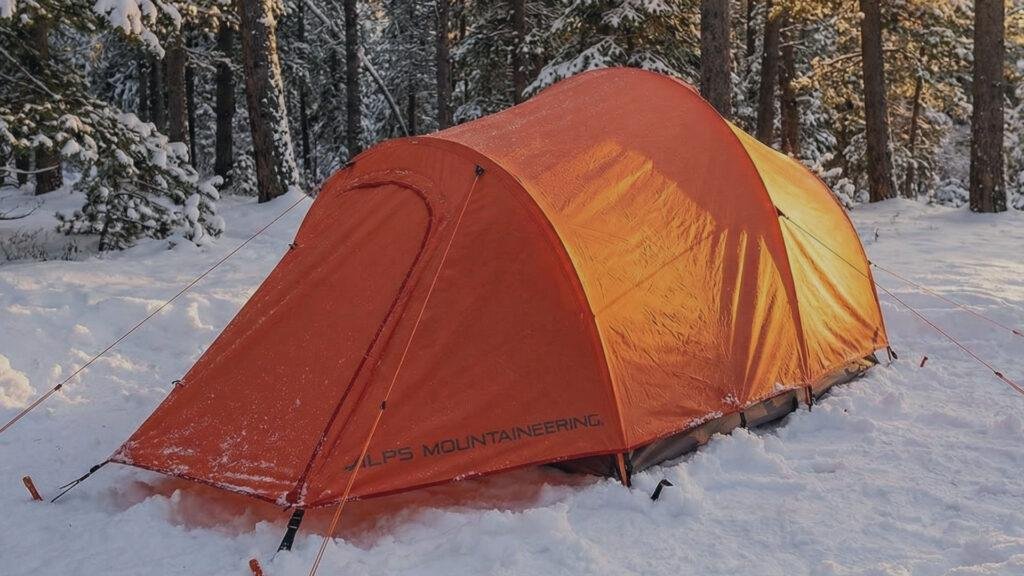
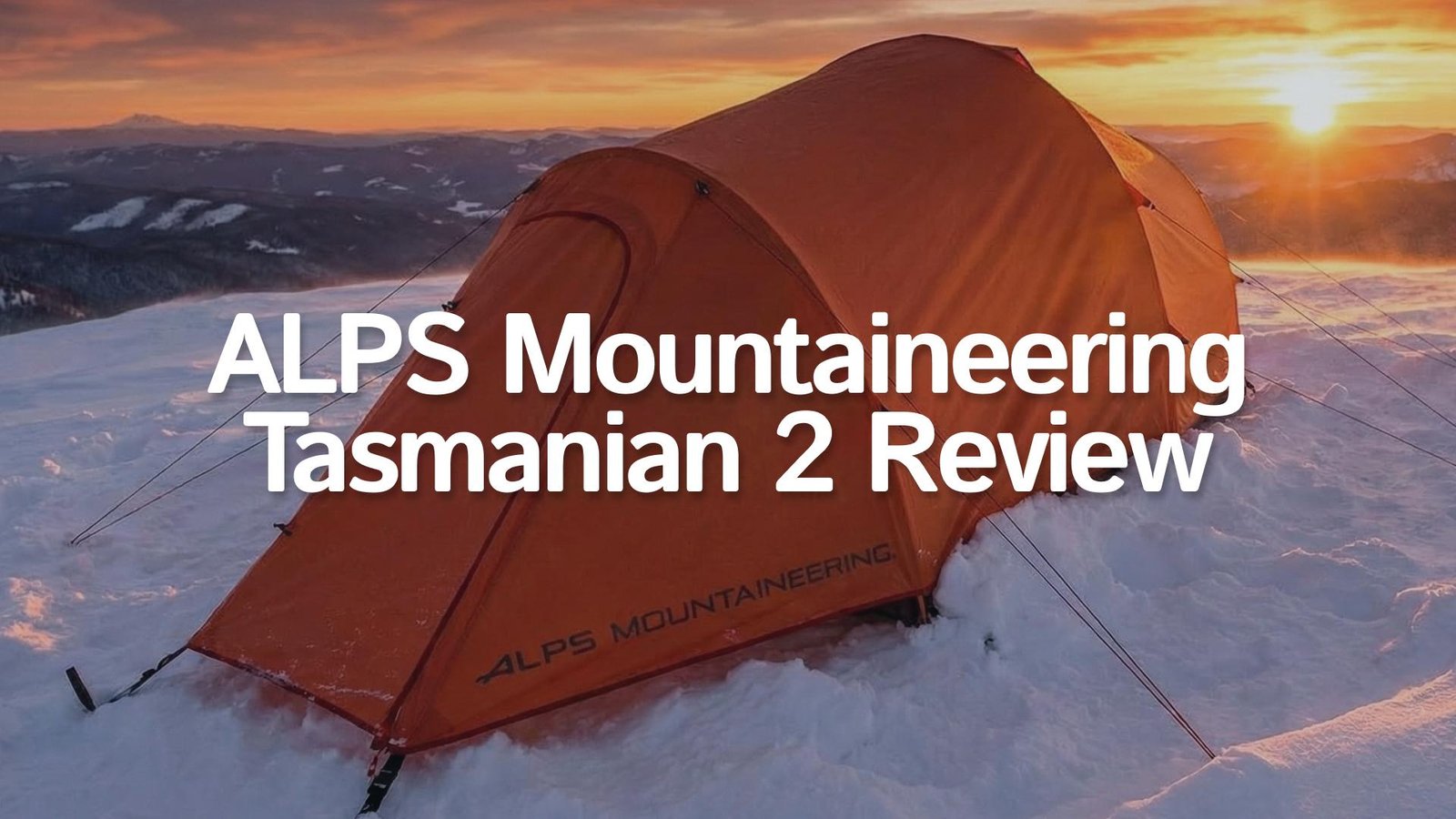

If you are considering the ALPS Mountaineering Tasmanian 2 for your next winter trip, you are likely trying to solve the biggest problem in 4-season camping: the cost. If you have read our guide on 3 season vs 4 season tent differences, you know that stepping up to a winter-ready shelter usually involves a painful price hike. Most mountaineering tents cost as much as a used car. This financial barrier to entry keeps many capable campers trapped in the summer months, missing out on the silence, beauty, and solitude of a snowy landscape.
This tent claims to offer true 4-season protection, 7000-series aluminum poles, full-coverage fly, and snow-shedding geodesic geometry, at a price point that rivals standard summer domes like the Coleman Skydome 6 person tent. It promises to be the bridge that allows budget-conscious backpackers to cross into the world of winter camping.
But is it too good to be true? Can a budget-friendly tent actually survive a blizzard, or will it leave you freezing on a ridgeline with snapped poles? Is the low price a result of smart engineering or cut corners?
In this comprehensive ALPS Mountaineering Tasmanian 2 tent review, we are tearing down every specification. We will analyze its pole structure physics, test its ventilation against the dreaded winter condensation, and compare it to both high-end expedition tents and budget backpackers like the Naturehike Cloud Up 2. We are going beyond the spec sheet to discuss field repairs, glove-friendly setups, and long-term durability.
If you are looking for one of the best camping tents for winter on a budget, this might be your only viable option. Let us find out if it is worth the weight.
Quick Verdict
Ideally Suited For: Winter campers on a budget, snowshoers pulling pulks (sleds), boy scouts venturing into shoulder seasons, and car campers looking for a bombproof winter basecamp.
The Bottom Line: The ALPS Mountaineering Tasmanian 2 is the heavy tank of the budget world. It is not an ultralight alpinist tent; at nearly 8 pounds, it is a beast to carry on your back. However, its structural integrity is undeniable. The continuous pole sleeves and crossing geometry handle heavy snow loads and high winds far better than any 3-season tent. It trades weight for durability and cost savings. If you can split the weight with a partner or are not hiking far, it is, without a doubt, the best budget 4 season tent on the market today.
- Weather Resistance: 4.8/5
- Durability: 4.5/5
- Ease of Setup: 3.0/5
- Space & Comfort: 4.2/5
- Value for Money: 5.0/5
4.3
Overall Score
Pros and Cons
Before we dive into the nitty-gritty details, here is a quick snapshot of what makes this tent shine and where it might fall short for your specific needs.
✓ True 4-Season Geometry: The pole structure creates steep walls that shed snow effectively and resist wind deformation.
✓ Incredible Price: It costs a fraction of what brands like North Face or Mountain Hardwear charge for similar specs.
✓ Two Doors & Vestibules: Rare for a 4-season tent, this allows for easy exit and ample gear storage for two people.
✓ Continuous Pole Sleeves: Adds significant strength to the frame compared to plastic clips, distributing stress evenly.
✓ Great Ventilation: The large roof vent helps manage the condensation issues typical of winter tents.
✓ Durability: Heavy 75D polyester fabrics withstand abrasion and dog claws better than ultralight silnylon.
✕ Heavy: Weighing close to 8 lbs, it is very heavy for a 2-person backpacking tent.
✕ Plastic Clips: While the sleeves are great, the few plastic clips used can be brittle in sub-zero temperatures.
✕ Bulk: It does not pack down small; it takes up a significant portion of a backpack (roughly 6.5″ x 19″).
✕ Tight for Two: Like most 2-person tents, it is a tight squeeze for two broad-shouldered adults in winter gear.
Product Specifications
| Feature | Specification |
|---|---|
| Product Name | ALPS Mountaineering Tasmanian 2 |
| Seasonality | 4-Season |
| Capacity | 2 Person |
| Minimum Weight | 7 lbs. 0 oz. |
| Packed Weight | 7 lbs. 15 oz. |
| Floor Area | 34.5 sq. ft. |
| Vestibule Area | 13 sq. ft. (Total) |
| Peak Height | 46 inches |
| Pole Material | 7000 Series Aluminum (Shock Corded) |
| Pole Diameter | 8.5 mm |
| Fly Fabric | 75D 185T Polyester Ripstop (1500mm coating) |
| Floor Fabric | 75D 185T Poly Taffeta (5000mm coating) |
| Doors | 2 |
| Ventilation | 1 Large Top Vent, Mesh Windows on Doors |
| Warranty | Limited Lifetime |
Who is ALPS Mountaineering?
Before assessing the tent, it helps to understand the manufacturer. ALPS Mountaineering is not a “hype” brand. You won’t see them sponsoring Everest expeditions or running Super Bowl ads. They are a volume manufacturer focused on the entry-to-mid-level market.
Their philosophy is simple: use heavier, standard materials (like polyester instead of silnylon) to keep costs down, while maintaining high build quality. They save money on marketing and material innovation, passing those savings to you. With the ALPS Mountaineering Tasmanian 2, you aren’t paying for the “North Face” logo; you are paying for aluminum and polyester. This context is crucial because it explains why the tent is heavy but tough.
The Pole System: Why It Matters
The defining feature of any 4-season tent is how it handles a static load (snow) and a dynamic load (wind). In our best camping tents roundup, we explained that 3-season tents use simple X-frames that collapse under snow. The Alps Mountaineering Tasmanian 2 tent uses a modified geodesic design that is vastly superior.
7000-Series Aluminum
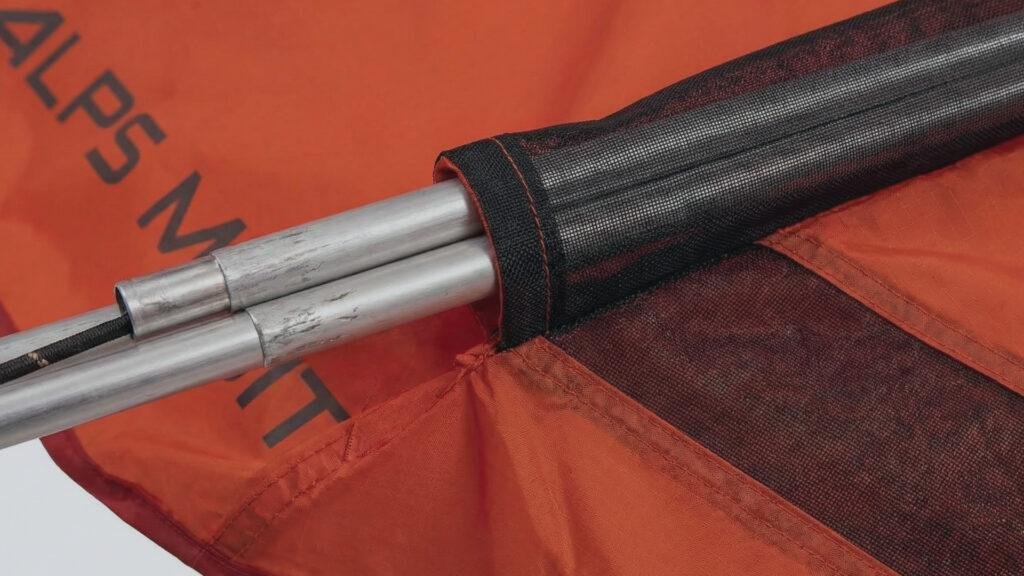
The tent utilizes 7000-series aluminum poles with a diameter of 8.5mm. This distinction is vital. Cheap tents use fiberglass, which shatters in extreme cold. Mid-range tents use 6000-series aluminum, which is soft and bends easily. 7000-series is the industry standard for aircraft and climbing gear; it has a high yield strength, meaning it can flex significantly under wind pressure and spring back to its original shape without snapping.
Continuous Pole Sleeves
What sets this tent apart is the use of continuous pole sleeves. Most modern tents use plastic clips to attach the tent body to the poles. While fast clips create stress points. If a heavy wind hits, all the force is concentrated on those tiny plastic hooks, which can rip the fabric or snap.
The ALPS Mountaineering Tasmanian 2 uses mesh sleeves that run the entire length of the tent. You slide the poles through these sleeves. This distributes wind and snow stress evenly across the entire fabric panel. It makes the tent incredibly rigid. In high winds, where a clip-based tent might shudder and flap, the Tasmanian stands firm. The brow pole across the top creates vertical walls, maximizing headroom and shedding snow away from the doors.
Interior Space and Livability
Winter camping requires more gear. You have puffy jackets, zero-degree sleeping bags, and thick insulated pads (often 25 inches wide). Does the Alps Mountaineering Tasmanian 2 person tent actually fit two people and their gear?
The Floor Plan
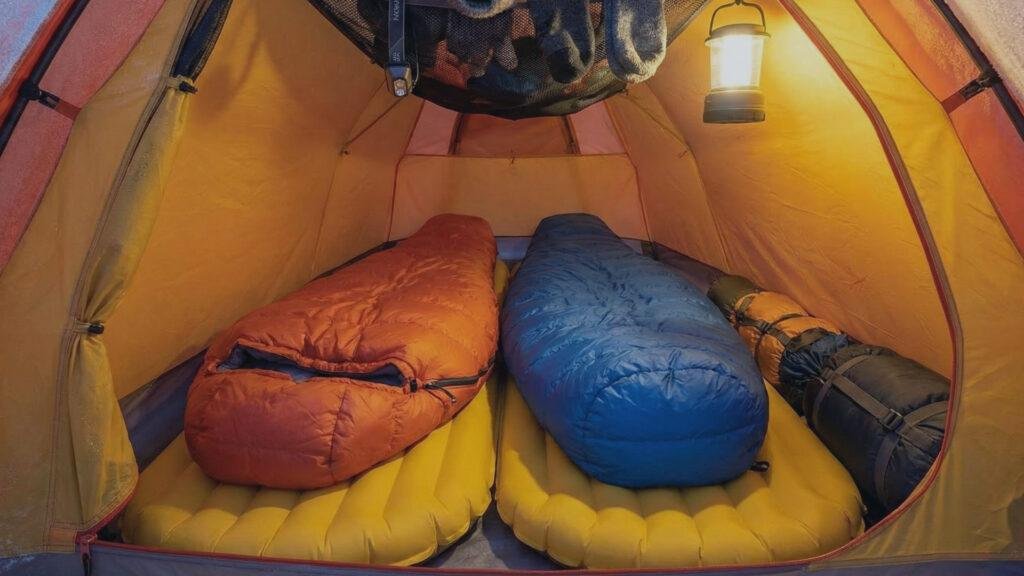
The floor measures 5 feet 2 inches by 7 feet 8 inches. On paper, this is spacious. In reality, the 4-season geometry means the walls taper inward relatively quickly. Two people can sleep side-by-side, but you will be shoulder-to-shoulder. If you are both over 6 feet tall, your feet might brush the end of the tent. In winter, this is risky because touching the tent wall can transfer moisture from condensation onto your sleeping bag footbox.
For a solo camper, this tent is a palace. You have room for a wide X-Therm pad, all your winter gear laid out, and space to sit up and change clothes without your head hitting the ceiling. If you are wondering what to pack when camping for a solo winter trip, this tent should be high on your list for its livability-to-price ratio.
Double Doors and Vestibules
Most mountaineering tents have one small door to save weight. The ALPS Mountaineering Tasmanian 2 has two doors and two vestibules. This is a massive luxury in winter. It means you do not have to crawl over your partner to go to the bathroom in the middle of the night.
The vestibules are crucial. They provide a total of 13 square feet of covered storage. You can dig out a “cold well” in the vestibule snow (as described in our guide on 3 season vs 4 season tent living) to make putting on boots easier. You can store your wet boots, crampons, and shovel outside the sleeping area but still under cover, keeping the inner tent dry.
The Gear Loft
The tent comes with an included gear loft and a mesh hammock that clips to the ceiling. In winter, this is essential for drying gloves and socks. Heat rises, so storing damp items near the roof helps them dry out faster than leaving them on the cold floor. There are also mesh storage pockets on the sides for headlamps and phones.
Weather Resistance: Handling the Storm
This is the main reason you are buying this tent. How does it handle the elements compared to a 3-season tent?
Wind Resistance
We found that when fully guyed out, the ALPS Mountaineering Tasmanian 2 is a bunker. The full-coverage rainfly reaches all the way to the ground, sealing out drafts. This is a stark contrast to the Ozark Trail 6 person tent, which lets wind blow right underneath. The Tasmanian creates a dead air space between the inner tent and the fly, which provides a noticeable boost in warmth (about 5-10 degrees warmer than outside). The aerodynamic shape allows wind to flow over the tent rather than hitting it like a wall.
Waterproofing
The floor has a massive 5000mm hydrostatic head rating. This is expedition-grade waterproofing. In winter, you are often kneeling on the floor, pressing your knees into the snow beneath. The heat from your knees melts the snow, creating a puddle. A lower rating (like 1200mm) would allow water to seep through under this pressure (“pressure leaking”). The Tasmanian floor keeps you dry even in slushy spring conditions.
The fly is 1500mm polyester. This is standard and sufficient for snow, which is drier than rain. All seams are factory sealed with polyurethane tape.
Ventilation and Condensation Management
Condensation is the enemy of winter camping. When it is 10°F outside and 40°F inside (from body heat), moisture from your breath freezes on the tent walls. When the sun hits the tent in the morning, it melts and “rains” on you.
The ALPS Mountaineering Tasmanian 2 handles this surprisingly well for its price. It features a large roof vent that can be propped open with a velcro kickstand. Since heat rises, your warm, moist breath escapes through this vent rather than freezing on the walls. Additionally, the two doors have mesh windows that can be unzipped for cross-ventilation.
Unlike single-wall tents which are notorious for raining inside, the Tasmanian is a double-wall tent. Moisture passes through the breathable inner canopy and condenses on the rainfly, keeping your sleeping bag dry.
Setup Guide: The Sleeve Struggle
Every tent has a weakness, and for the ALPS Mountaineering Tasmanian 2, it is the setup process. It is not difficult, but it is specific.
Because it uses continuous sleeves, you have to push the poles through long channels of fabric. In the summer, this is annoying. In the winter, wearing thick gloves, with wind whipping the fabric around, it can be a wrestling match.
Step-by-Step Winter Pitch
- Stomp the Pad: Use your snowshoes to pack down a flat area. Let it set for 30 minutes.
- Assemble Poles: Snap the shock-corded aluminum poles together. Ensure the ferrules (joints) are fully seated to prevent breakage.
- Thread the Sleeves: Push (do not pull) the two main poles through the mesh sleeves on the tent body. They will cross in the middle.
- Insert Tips: Insert the pole tips into the grommets at the corners. The tent will pop up.
- Add the Brow Pole: Thread the shorter pole across the top to create the roof structure.
- Clip: Attach the few plastic clips to the poles.
- Fly On: Throw the rainfly over the structure. Buckle it at the corners.
- Guy Out: This is critical. Use snow stakes or deadman anchors to pull the guy lines tight. This gives the tent its strength.
Pro Tip: If the pole separates inside the sleeve (pulls apart), it is a nightmare to fix. Always push the poles through; never pull them.
Takedown and Packing
Packing a frozen tent is hard. The Tasmanian comes with a zippered carry bag that is decently sized, but you will likely struggle to fit it back in if you don’t fold it perfectly.
- Shake it Off: Before dropping the poles, shake the tent violently to remove snow and ice from the fly.
- Push Poles Out: Push the poles out of the sleeves the same way you put them in.
- The “Burrito” Method: Fold the tent body to the width of the pole bag. Place the pole bag at one end and roll the tent around it tightly, squeezing air out as you go. This prevents the “ballooning” effect.
Durability and Component Analysis
Fabric: The 75D polyester fly is robust. It is heavier than the 20D nylon found on ultralight tents, but it is also more resistant to UV damage and tears. This is a tent you can be rough with. It doesn’t feel delicate.
Zippers: It uses #8 zippers. These are large and chunky, which is good for winter. Small zippers freeze shut easily. These are large enough to operate with gloves on.
Clips & Buckles: The plastic clips that attach the fly to the corners are the potential weak point. In extreme sub-zero cold, plastic becomes brittle. We recommend carrying a few zip ties or spare cord in your repair kit just in case one snaps. Always ensure you dry the tent completely after a trip to prevent mold, as discussed in our how to clean a tent with mold guide.
Comparison: Tasmanian 2 vs. The Competition
To understand the value of the Alps Mountaineering Tasmanian 2 tent, we need to stack it up against the other tents we have reviewed.
ALPS Tasmanian 2 vs. Naturehike Cloud Up 2
The Naturehike Cloud Up 2 is our top pick for budget backpacking. It is significantly lighter (around 4 lbs vs 8 lbs).
- Choose Naturehike if: You are hiking long distances in 3-season conditions or mild winter weather. You count every ounce.
- Choose ALPS if: You are expecting heavy snow loads, high winds, or are camping near your car. The ALPS is a true 4-season shelter; the Naturehike is a 3-season tent that can handle a light frost but not a dump of snow.
ALPS Tasmanian 2 vs. ALPS Lynx 1
We previously reviewed the ALPS Mountaineering Lynx 1. The Lynx is a 3-season solo tent.
- Choose Lynx if: You are solo and camping in summer/fall.
- Choose Tasmanian if: You need winter protection or room for two. The Tasmanian uses stronger poles and a full-coverage fly design that the Lynx lacks.
Real World Usage Scenarios
The Winter Backpacking Trip (with Sled)
If you are pulling a pulk sled, the 8lb weight of this tent doesn’t matter. It provides a spacious, warm basecamp. You can sleep securely knowing a sudden squall won’t flatten your shelter. The vestibules allow you to keep your sled gear accessible.
The Shoulder Season Scout Trip
For Boy Scouts or beginners camping in March or November, the weather is unpredictable. Rain can turn to snow in an hour. The ALPS Mountaineering Tasmanian 2 is perfect here. It handles rain as well as snow, and the durability means it can survive inexperienced handling better than a delicate silnylon tent.
The Solo Car Camper
If you are driving to a trailhead to camp in the snow (ski touring or snowshoeing), this is the perfect tent. It fits in the trunk easily, and the setup difficulty is mitigated by having a warm car nearby if things go wrong. It serves as a reliable bunker for basecamp operations.
Important Considerations Before Buying
Weight vs. Wallet
You are paying with pounds to save dollars. There is no way around this physics equation. If you absolutely need a lightweight 4-season tent (under 4 lbs), you need to spend $500+ on a single-wall tent. If you only have $200, you must accept the weight of the Tasmanian. Split the weight with a partner: one takes the poles and stakes, the other takes the tent body and fly.
Footprint
We recommend purchasing a separate footprint or making one from Tyvek. While the floor is tough, winter ground often hides sharp ice and rocks. Protecting the floor ensures the 5000mm coating stays intact for years.
Field Repair Guide
Even the best tents fail. Here is how to fix the ALPS Mountaineering Tasmanian 2 in the field:
- Pole Splint: The tent comes with a repair sleeve (a small metal tube). If a pole snaps, slide this tube over the break and tape it in place.
- Tear Repair: Carry Tenacious Tape. If you snag the fly with a crampon, clean the area and apply the tape on both sides.
- Zipper Failure: If the zipper separates, use pliers to gently squeeze the slider body to tighten it.
Maintenance and Care
To ensure your ALPS Mountaineering Tasmanian 2 lasts:
- Dry It Out: Never store it wet. The PU coating will delaminate and smell like vomit. Hang it in your garage for 24 hours after a trip.
- Lubricate Zippers: Winter grime and ice can jam zippers. Keep them clean. Use a zipper lubricant or candle wax.
- Check Poles: Before every trip, check the aluminum poles for hairline cracks, especially near the ferrules (joints).
Is Tent Camping Safe with the Tasmanian 2?
Yes. In our article is tent camping safe, we discuss weather hazards. The Tasmanian 2 mitigates these hazards significantly better than a 3-season tent. Its bright color (often orange or copper) makes it visible in snow for rescue situations, and its structure protects you from hypothermia-inducing wind chill. It creates a safe haven in conditions where a lesser tent would fail.
Frequently Asked Questions (FAQs)
Yes. With a 5000mm floor rating and 1500mm fly rating, plus factory-taped seams, it is highly waterproof against rain and snow. We have tested it in wet snow conditions with zero leakage.
Yes, but it takes practice. Threading the long poles through the sleeves can be tricky solo, especially in the wind. Expect it to take 10-15 minutes on your own.
Yes. While it has vents, the solid wall construction blocks the breeze. It is designed to retain heat. Using this in 80-degree weather will be uncomfortable. It is a 4-season tent, but practically speaking, it is a “1-season” (Winter) or “3-season” (Fall/Winter/Spring) tent.
Usually, no. You should purchase a separate footprint or make one from Tyvek to protect the high-value floor coating.
There is no stove jack, so you cannot use a wood stove (for that, see what is a hot tent). You can use a small propane heater, but be extremely careful about carbon monoxide and condensation. The tent floor is not fireproof.
Wrapping Up
The ALPS Mountaineering Tasmanian 2 is the undisputed champion of entry-level winter camping. It breaks the rule that you have to spend a fortune to stay safe in the snow.
It is heavy. It is bulky. It is annoying to set up. But once it is pitched, it is a fortress. It will shrug off snow loads that would crush a lesser tent. It offers the vestibule space needed for winter boots and packs.
If you are looking to extend your camping season into the fourth season without emptying your bank account, this is the tent to buy. It is rugged, reliable, and warm. Just make sure you have a strong back or a sled to carry it.