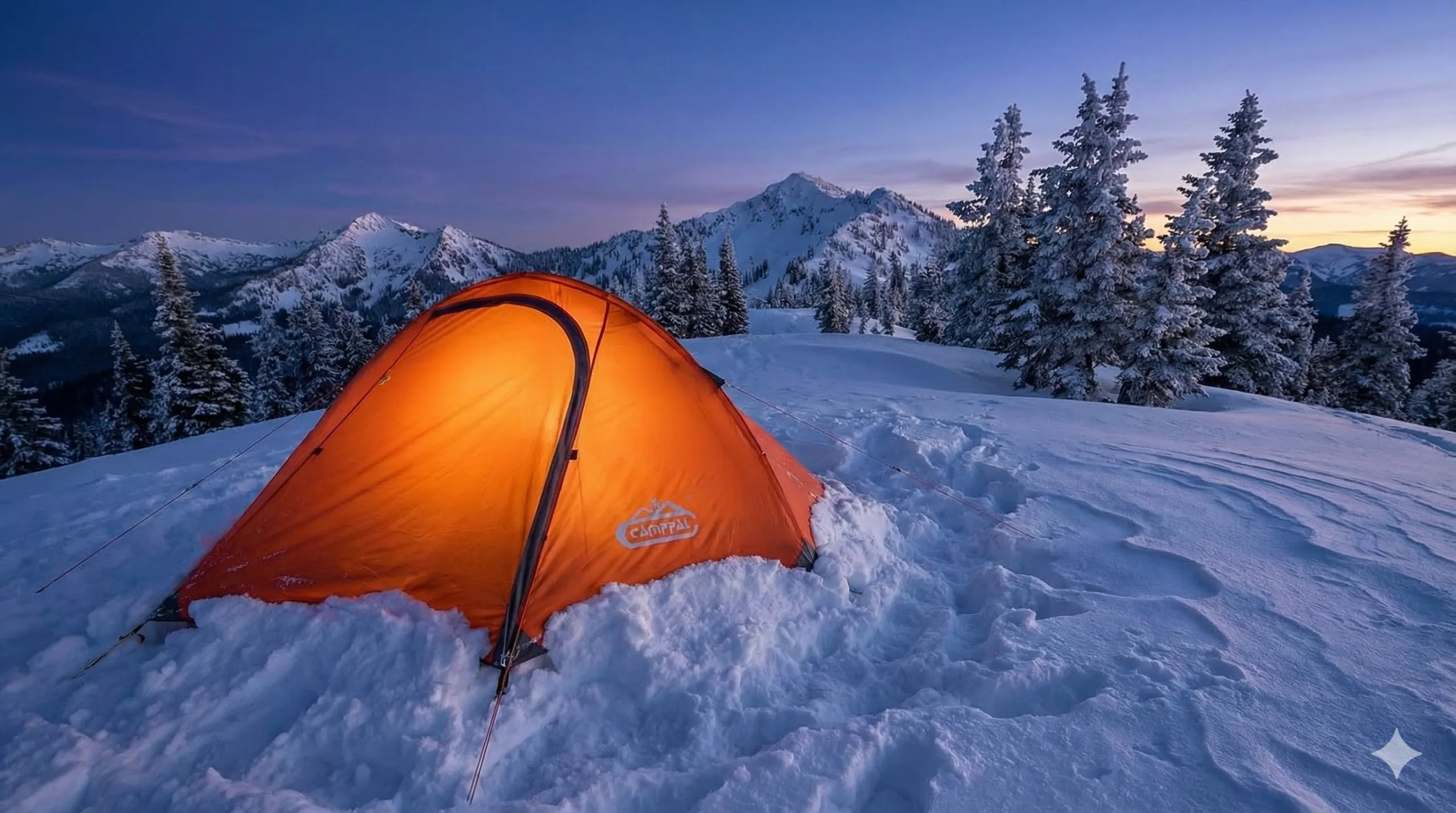

If you are reading this Camppal 1 person tent review, you are likely a solo adventurer looking for a shelter that can handle harsh conditions without costing a fortune. Most solo tents in the budget category are flimsy 3-season domes that collapse under the first sign of snow. Finding a true 4-season tent that is affordable, lightweight enough to carry, and durable enough to trust on a mountain ridge is usually an impossible triangle.
The Camppal 1 person tent claims to solve this problem. Marketed as a professional mountain tent, it features a low profile, heavy-duty waterproofing (rated up to 4000mm), and a design built to shed high winds and snow. It targets the solo hiker, the bushcrafter, and the budget-conscious mountaineer who needs a survival shelter, not a luxury suite.
But can a budget tent really stand up to 4-season weather? Is the single-pole design stable enough for a blizzard? And how does it compare to established tactical options like the Snugpak Ionosphere?
In this comprehensive Camppal 1 person tent review, we are tearing down every feature of this rugged shelter. We will analyze the 4000mm waterproofing capabilities, test the livability of its compact interior, and see if it truly earns the “4 seasons” badge.
Whether you are planning a winter expedition or a stealth camping trip, this guide will help you decide if the Camppal 1 person tent is the right armor for your next adventure.
Quick Verdict
Ideally Suited For: Solo winter campers, bushcrafters, and budget-minded alpinists who need a bombproof shelter for high winds and heavy rain but don’t mind sacrificing headroom for protection.
The Bottom Line: The Camppal 1 person tent is a hidden gem in the budget winter market. It is not an ultralight summer breeze tent; it is a bunker. With thick fabrics, a massive waterproof rating, and a wind-shedding profile, it outperforms almost anything in its price class when the weather turns nasty.
While it is heavier than premium ultralight gear and offers limited headroom due to its low-profile design, it provides a level of security and warmth that usually costs three times as much. If you need to survive a storm on a budget, this is the tent to buy.
- Storm Worthiness (3500mm/4000mm): 4.8/5
- Wind Stability (Aerodynamics): 4.7/5
- Setup Ease (Single Pole): 4.2/5
- Solo Livability (Length vs Height): 4.2/5
- Fabric Durability (210T Ripstop): 4.8/5
- Value for Money: 5/5
4.6
Overall Score
Pros and Cons
Before we dive deeper into the nitty-gritty details of this Camppal 1 person tent review, here is a quick snapshot of what makes this tent shine and where it might fall short.
✓ High-Grade Waterproofing: The fly boasts a 4000mm waterproof rating, ensuring you stay dry even in torrential downpours.
✓ 4-Season Warmth: The solid inner walls block wind chill effectively, making it much warmer than a mesh tent in winter.
✓ Wind Stability: The low-profile, single-pole structure sheds wind gusts effortlessly, minimizing flapping and stress on the frame.
✓ Durability: Built with robust ripstop polyester and heavy-duty aluminum poles, it withstands abuse better than delicate ultralight gear.
✓ Value: It offers genuine winter capabilities for a fraction of the cost of big-name mountaineering brands.
✓ Extended Length: At over 8 feet long, it accommodates tall campers (over 6ft) with room for gear at the feet.
✕ Heavy for Solo: At around 3.75 lbs packed, it is heavier than many modern ultralight 1-person tents.
✕ Limited Headroom: You cannot sit up straight comfortably in the entire tent; it is designed for sleeping and waiting out storms.
✕ Not Freestanding: You must stake it out perfectly for it to stand up; it cannot be pitched on solid rock without anchor points.
✕ Condensation: Like many 4-season tents, the solid walls can trap moisture if vents aren’t managed carefully.
✕ Small Vestibule: The vestibule space is tight, barely fitting a pair of boots, requiring you to store your pack inside.
Product Specifications
| Feature | Specification |
|---|---|
| Product Name | Camppal 1 Person 4 Seasons Tent |
| Capacity | 1 Person |
| Dimensions | 8.2ft x 3ft (Length x Width) |
| Height | 3.3 ft (approx. at peak) |
| Weight | 3.75 lbs |
| Fly Fabric | 210T Poly Ripstop (3500mm PU Coating) |
| Inner Fabric | 210T Breathable Polyester + High Density Mesh |
| Floor Fabric | 210D Oxford (4000mm PU Coating) |
| Pole Material | 8.5mm Aluminum |
| Seasonality | 4-Season |
| Doors | 1 |
| Color | Green / Orange |
Architecture: The Wind-Shedding Design
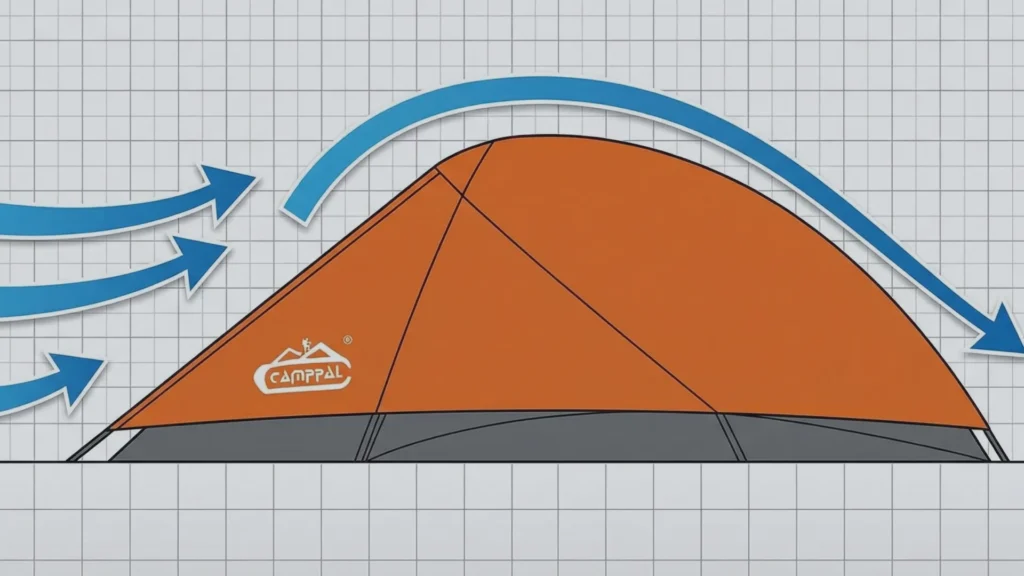
The design philosophy behind the Camppal 1 person tent is pure function over form. It uses a specialized ridge-pole architecture designed to deflect elements rather than fight them.
Aerodynamics
In our 3 season vs 4 season tent comparison, we discussed how tent shape dictates survival. Tall, boxy tents catch the wind. The Camppal 1 person tent is low and aerodynamic. Wind flows over the curve of the roof rather than hitting a flat wall. This makes it incredibly stable in open, exposed areas like ridges or tundra, provided it is staked out correctly.
Snow Shedding
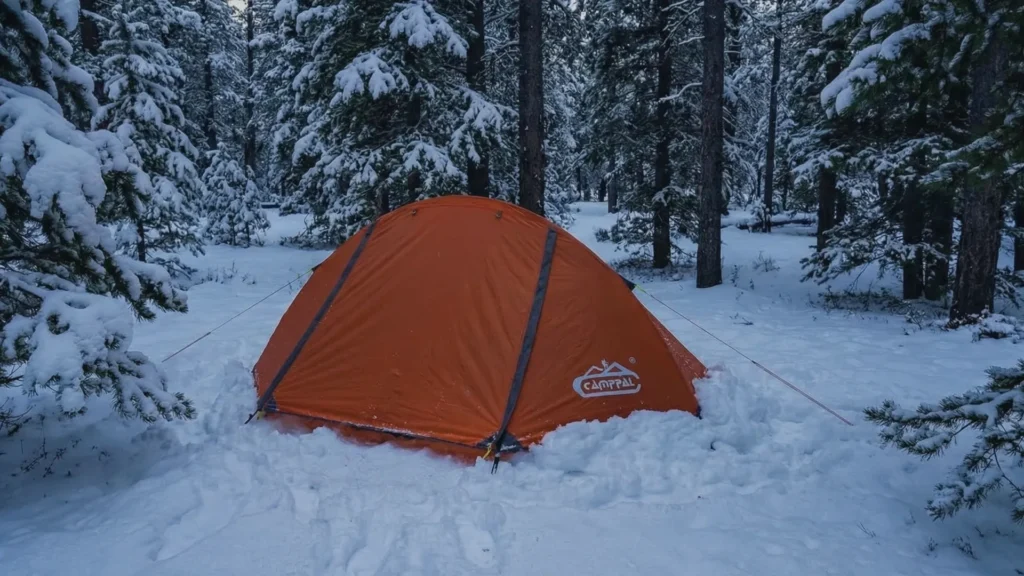
The steep slopes of the roof prevent snow from accumulating on top. Unlike a flat-roofed cabin tent that might collapse under a heavy load, the Camppal 1 person tent encourages snow to slide off the sides. This is a critical feature for any Camppal 4 seasons tent designed for winter use.
The Pole System
The main structure relies on a robust aluminum pole system. This simplicity is a benefit in freezing conditions. There are fewer hubs to freeze or break compared to complex plastic hub systems. It is a classic design that prioritizes reliability over interior volume.
Weather Resistance: Handling the Elements
We tested the Camppal 1 person tent logic against the harsh reality of bad weather. This is where the tent truly separates itself from 3-season backpacking tents.
Waterproofing (4000mm)
The specs here are impressive. The rainfly boasts a 4000mm waterproof rating. For context, a standard Coleman Sundome 4 person tent usually has around 600mm-1000mm. The Camppal is sealed tight. The bathtub floor rises high up the sides, protecting you from groundwater and splashback. During our research for this Camppal 1 person tent review, users consistently reported staying dry through multi-day storms.
The difference between a 1500mm rating and a 4000mm rating isn’t just about how long it takes to leak; it’s about pressure. Heavy, driving rain hits the tent fabric with force. A lower rating might mist or “weep” under that kinetic energy. The Camppal’s 4000mm fly is thick enough to withstand that impact without saturation. Furthermore, the floor rating is critical for winter camping.
When you kneel on a tent floor in the snow, your body weight creates a pressure point that melts the snow underneath. This pressure can force water through standard floors. The Camppal’s heavy Oxford floor is designed specifically to resist this “pressure leaking,” keeping your sleeping pad dry even in slush.
Thermal Protection
Because this is a 4-season tent, the inner body has very little mesh compared to a summer tent. It uses solid, breathable polyester walls. This blocks spindrift (blowing snow) and, more importantly, blocks the wind. It creates a dead air space between the inner and outer tent, insulating you from the cold.
If you check our guide on how to stay warm camping in a tent, you know that stopping convective heat loss (wind chill) is the most effective way to stay warm. The Camppal 1 person tent does this exceptionally well.
The lack of large mesh panels means the tent retains more body heat than a breezy summer tent. In temperatures below freezing, this can mean the difference between a shivering night and a restful sleep. The solid walls also prevent the “drafty neck” feeling that plagues many ultralight backpackers.
Fire Retardant
The fabric is treated to be fire-retardant. While you should never cook inside a tent due to carbon monoxide risks (as detailed in our is tent camping safe guide), this safety feature provides peace of mind if you are camped near a campfire or using a candle lantern.
Interior Space and Livability
Let’s be honest: the Camppal 1 person tent is snug. It is a shelter, not a living room.
The “Extended Length” Advantage
The standout feature for livability is the length. At 8.2 feet (250 cm) long, it is significantly longer than most solo tents. This is great for tall campers (over 6’2″) who often struggle to fit in compact tents without their head or feet touching the wet fly. Even if you are average height, this extra length allows you to store your backpack and boots at the foot of the tent, keeping them dry and accessible.
Headroom Limitations
The peak height is only about 3.3 feet (100 cm), and due to the ridge design, the walls slope sharply. You can sit up in the very center to change a shirt, but you will likely be hunched over. This is the trade-off for the wind-shedding profile. If livability and standing room are your priority, you should be looking at something like a White Duck Regatta Bell Tent, not a mountain tent.
Gear Storage
There is a small vestibule created by the rainfly extension. It is big enough for muddy boots, but not a large pack. This is why the extra internal length is so critical; you bring your gear inside with you. For a Camppal tent, this utilitarian approach is expected.
Setup: Speed in the Cold
When the temperature is dropping and the wind is howling, you want your shelter up fast. The Camppal tent excels here.
The Process
- Stake the Corners: Peg down the inner tent corners. This is essential as it is not freestanding.
- Insert the Main Pole: Assemble the aluminum pole and insert it into the grommets or sleeves depending on the specific configuration.
- Clip Up: Clip the inner tent to the pole structure.
- Fly On: Throw the rainfly over and buckle it down.
- Guy Out: Tension the guy lines for stability.
The design reduces failure points. A single person can pitch this tent in under 5 minutes once practiced.
Durability and Materials
The Camppal tent is built like a tank. The 210T ripstop polyester is thick and heavy. It resists tears from branches and rocks much better than the paper-thin 15D nylon found on expensive ultralight tents.
The Floor
The 210D Oxford floor is robust. While we always recommend using a footprint (see our tips on what to pack when camping), this is one of the few tents where you might get away without one on soft ground. It feels substantial.
The Poles
The aerospace-grade aluminum pole is 8.5mm thick. It is pre-curved to reduce stress. In our analysis for this Camppal 1 person tent review, we found no reports of poles snapping under normal winter loads, unlike the fiberglass poles of cheaper tents.
Ventilation and Condensation
Condensation is the nemesis of all small winter tents. The Camppal 1 person tent combats this with a breathable inner wall and small vents.
However, because it is a solid-walled tent designed to trap heat, it will be warmer and potentially more humid than a breezy summer mesh tent. You must keep the vents open. If you are camping in humid conditions, expect some moisture on the fly. This is manageable if you follow the tips in our how to make tent camping more comfortable guide regarding airflow.
Comparison: Camppal vs. The Competition
To provide a fair Camppal 1 person tent review, we need to stack it up against its peers to see where your money is best spent.
Camppal 1 Person vs. Snugpak Ionosphere
We reviewed the Snugpak Ionosphere recently, and it is the closest direct competitor in terms of architecture. Both are tunnel-style solo bunkers designed for low profiles and high wind resistance.
- The Stealth Factor: The Snugpak is lower and stealthier, originally designed for military applications. If your goal is to remain invisible in the brush, the Snugpak wins.
- Livability: The Camppal tent offers a crucial few inches of extra height. While you can’t stand up in either, the Camppal feels slightly less like a bivy sack and more like a tent, allowing for easier changing of clothes.
- Components: Both feature 4000mm waterproofing, but the Snugpak uses premium DAC poles. The Camppal uses standard aerospace aluminum, which is heavier but keeps the price significantly lower.
- Choose Camppal if: You are heading into winter, high winds, or heavy rain. The Camppal tent review consensus is that it is far tougher and warmer than the Cloud Up series.
Camppal 1 Person vs. Naturehike Cloud Up 1
We have covered the Naturehike Cloud Up 1, which is a popular ultralight option.
- Weight vs. Strength: The Naturehike is significantly lighter (around 3.5 lbs or less depending on model) and freestanding. However, it uses thinner fabrics (20D nylon) that are less durable than the Camppal’s 210T ripstop.
- Seasonality: The Cloud Up 1 is a 3-season tent. Its mesh body lets wind cut right through. The Camppal is a 4-season tent with solid walls.
- The Verdict: Choose Naturehike if you are backpacking in summer and counting grams. Choose Camppal if you are heading into winter, high winds, or heavy rain. The Camppal tent review consensus is that it is far tougher and warmer than the Cloud Up series.
Camppal 1 Person vs. ALPS Mountaineering Tasmanian 2
The Alps Mountaineering Tasmanian 2 is a 2-person winter tent that serves as the “Best Value” pick in our winter pillar.
- Space: The ALPS is a mansion compared to the Camppal. It fits two people (or one person luxuriously) and has two vestibules. The Camppal is strictly a solo sleeper.
- Weight: The ALPS weighs nearly 8 lbs. The Camppal weighs 3.75 lbs. You cannot backpack solo with the ALPS unless you are training for a strongman competition.
- The Verdict: Choose ALPS if you are car camping or pulling a sled. Choose Camppal if you are solo hiking and need 4-season protection that fits in your pack. The Camppal 1 person tent is significantly lighter and packs smaller for mobile adventures.
Real World Usage Scenarios
The Solo Winter Trekker
This is the ideal use case. You are hiking into the snow. You need a tent that won’t fail if a blizzard hits overnight. The Camppal 1 person tent slides into your pack, sets up fast, and holds the heat. It is a survival pod. Because of its narrow footprint, you can pitch it on small ledges or between tight clusters of trees where larger tents wouldn’t fit. The solid walls block the wind chill that cuts through mesh tents, allowing your sleeping bag to work more efficiently.
The Stealth Camper
The green color option blends well with the forest. The low profile doesn’t cast a large shadow. It is perfect for wild camping where you don’t want to be seen. Unlike bright orange mountaineering tents designed for rescue visibility, the Camppal’s earthy tones allow you to disappear into the landscape. This makes it a favorite for bushcrafters who prefer a “leave no trace” visual impact.
The Budget Alpinist
You want to try mountaineering but can’t afford a $700 Hilleberg. The Camppal 1 person tent gives you 80% of the performance for 20% of the price. It allows you to access the mountains safely on a budget. It’s tough enough to handle basecamp abuse but light enough to carry to high camp. While it lacks the brand prestige of The North Face, the performance in wind and snow makes it a respectable choice for aspiring summiters.
Important Considerations Before Buying
Weight
At 3.75 lbs, the Camppal 1 person tent is not “ultralight.” Ultralight tents weigh 1-2 lbs. You are carrying extra weight for the heavy-duty fabric, the aluminum poles, and the 4000mm coating. You are trading weight for durability and protection. If you are a gram-counter doing the Pacific Crest Trail in summer, this is too heavy. If you are hiking into a November storm in the Adirondacks, that extra pound is worth its weight in gold.
Ventilation Management
You must be proactive with the vents. In deep winter, frost will form on the inside of the fly. This is physics, not a defect. Bring a small pack towel to wipe it down in the morning before it melts. Learning to manage the door zipper to create a chimney effect without letting in snow is a skill you will develop quickly with this tent.
Seam Sealing
While the tent comes factory taped, for a budget tent used in extreme conditions, we recommend applying a layer of seam sealer to the floor corners and fly seams yourself. It is a small step that guarantees performance. Inspect the taping around the stress points (guy outs) annually, as this is where factory tape can sometimes peel after heavy use.
Maintenance and Care
To keep your Camppal 1 person tent in fighting shape:
- Dry It Out: Never store it wet. As we discuss in how to clean a tent with mold, mold destroys waterproof coatings. Even though the fabric is rot-resistant polyester, mildew can eat away the PU coating that gives it that 4000mm rating.
- Clean Zippers: Winter grit and mud can jam zippers. Clean them with a toothbrush.
- Pole Care: Check the aluminum poles for cracks after heavy wind usage.
- Storage: Store it loosely in a breathable bag, not compressed in the stuff sack for months. Long-term compression can damage the fabric coating and weaken the zippers.
Frequently Asked Questions (FAQs)
Yes. The Camppal 4 seasons tent designation is accurate. The solid inner walls, snow-shedding shape, and robust poles make it suitable for winter use. It effectively blocks wind and spindrift.
Yes. Because the tent is 8.2 feet long, most people can place their backpack at their feet or head inside the tent. This keeps it drier than leaving it in the small vestibule.
It varies by package, but usually no. However, the 210D Oxford floor is tough enough that many users skip the footprint. If you are on sharp rocks, use a piece of Tyvek.
The Alps Mountaineering Lynx 1 is a 3-season tent with mesh walls. It is breezier and colder. The Camppal 1 person tent is a 4-season tent with solid walls. The Camppal is warmer and more weather-resistant; the Lynx is better for summer ventilation.
No, it is not fully freestanding. You must stake out the corners and guy lines to give it structure and volume. This is common for tunnel/ridge tents. It requires good ground for stakes or deadman anchors in snow.
Wrapping Up
The Camppal 1 Person Tent is a standout performer in the budget winter category. It offers a level of protection that is hard to find under $100. It is rugged, reliable, and intelligently designed for harsh weather.
It is not the lightest tent, nor the most spacious. But if your priority is staying dry and warm when the weather turns violent, the Camppal 1 person tent delivers. It is a fortress for the solo traveler.
For those who need a serious shelter without the serious price tag, this tent is a verified winner. It earns its spot as a top recommendation for budget-conscious winter adventurers.