
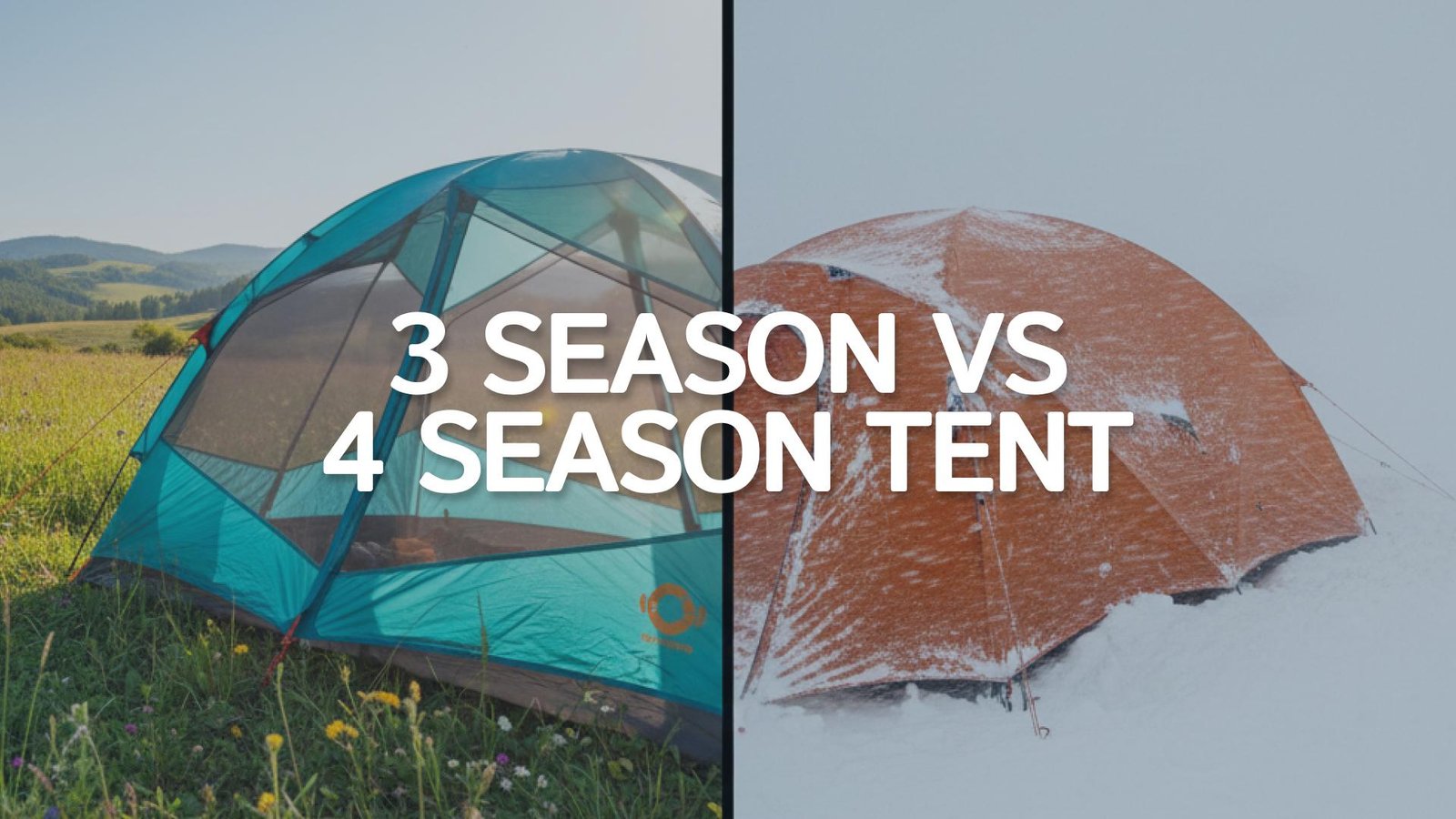
One of the most common and expensive mistakes new campers make is misunderstanding the difference between a 3 season vs 4 season tent. It is a logical assumption: if a 3-season tent is good, a 4-season tent must be better, stronger, and warmer, right?
Not necessarily. In the world of outdoor gear, “more” often means heavier, hotter, and less breathable.
If you are planning a trip and staring at two tents, one mesh-heavy dome and one solid nylon bunker, making the wrong choice can ruin your adventure. A 3-season tent in a blizzard can collapse and kill you. A 4-season tent in July will turn into a sauna and suffocate you.
In this exhaustive 3 season vs 4 season tent guide, we strip away the marketing jargon to explain the physics, materials, and structural differences between these two shelter types. We dive deep into geodesic engineering, fabric hydrostatics, condensation management, and the nuances of winter living.
We will help you decide if you actually need a mountaineering fortress or if your summer dome is enough for that October trip.
The Core Distinction: It Is Not About Temperature
The biggest myth in camping is that 4-season tents are insulated. They are not. A tent does not keep you warm; your sleeping bag and sleeping pad do that. Understanding the difference between 3 and 4 season tent starts with their primary function:
- 3-Season Tent: Designed to keep you cool and dry. It prioritizes ventilation, airflow, and rain protection. It sheds water but allows air to pass through.
- 4-Season Tent: Designed to keep you safe from crushing snow loads and gale-force winds. It prioritizes structural integrity and drift protection. It blocks air movement to prevent evaporative cooling.
This fundamental winter vs summer tent distinction is the first step to building the right kit.
What Is a 3-Season Tent? (The Standard)
A 3-season tent is the standard “camping tent.” If you walk into an REI or browse our best camping tents roundup, 90% of what you see are 3-season models. They are engineered for Spring, Summer, and Fall, the seasons when bugs and rain are the primary threats.
Key Characteristics
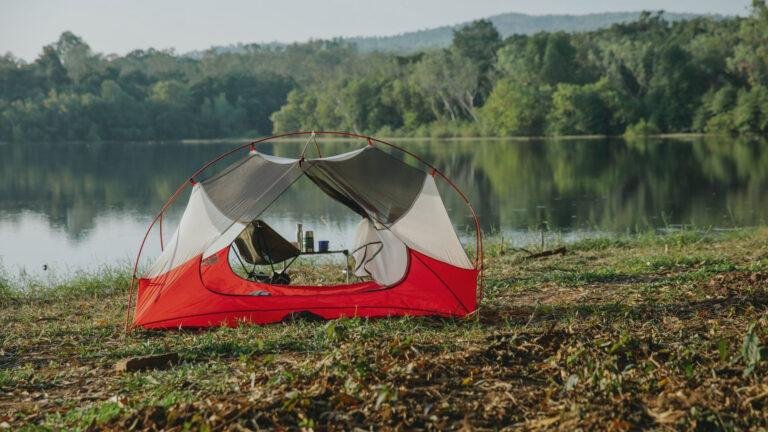
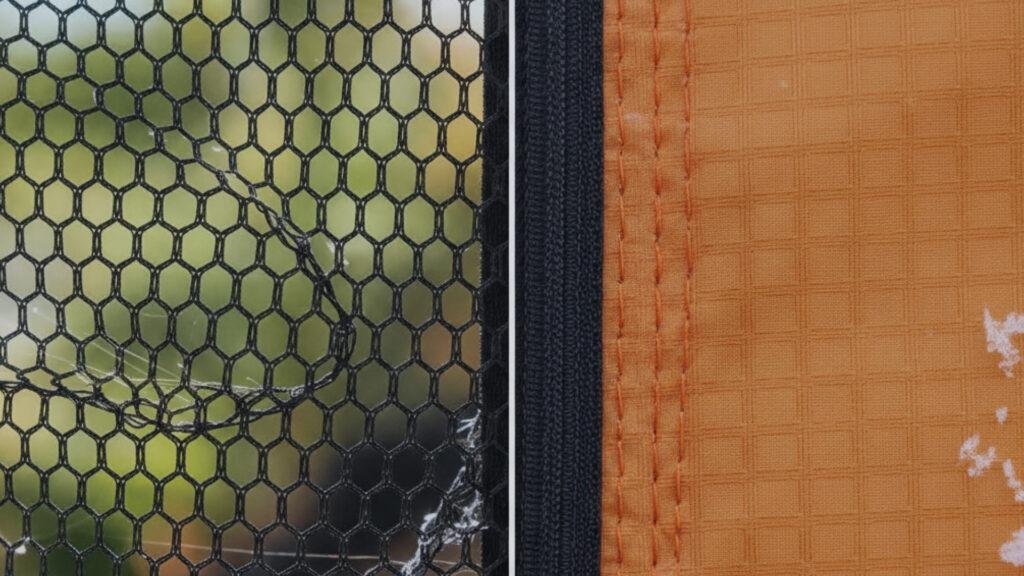
- Mesh Bodies (Double Wall): The inner tent is composed largely of mesh (often 50-70% of the surface area). This serves two purposes: it keeps even the smallest insects (no-see-ums) out, and it encourages massive airflow to prevent condensation. In hot weather, this mesh is vital for survival.
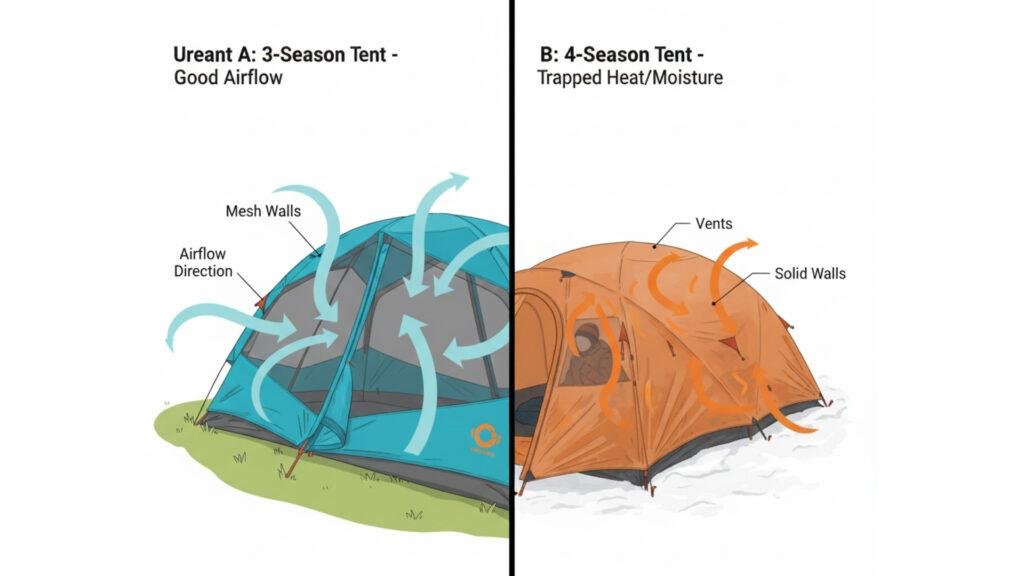
- Rainfly Gap (The Chimney Effect): The rainfly often sits a few inches off the ground, allowing cool air to be sucked in from the bottom while hot, moist air escapes through roof vents. This constant circulation keeps the interior dry.
- Lightweight Poles: Usually made of aluminum (7000-series alloy) or fiberglass (like the Coleman Sundome 4). These are designed to flex in the wind to shed energy, but they are not designed to withstand heavy vertical pressure.
- Static Loading: They are designed to hold their own weight plus a light rainfly. They are not designed to hold 50lbs of wet snow on the roof. A heavy snowfall will flatten the poles, potentially ripping the fabric.
When to Use It
- Summer Heat: The mesh allows the slightest breeze to cool you down.
- Heavy Rain: They are excellent at shedding water because the rainfly acts as an umbrella.
- Mild Snow: A dusting of snow (1-2 inches) is fine, but anything over that requires you to actively knock snow off the roof throughout the night.
The Verdict
For most people debating 3 season vs 4 season tent options, a 3-season tent is all they will ever need. It is lighter, cheaper, and far more comfortable in temperatures above 40°F (4°C).
What Is a 4-Season Tent? (The Fortress)
A 4-season tent should really be called a “Winter Storm Tent.” They are specialized tools built for mountaineering, ski touring, and expeditions where weather can turn lethal. They are designed to survive conditions that would shred a standard tent.
Key Characteristics
- Solid Walls: Instead of mesh, the inner tent is made of solid nylon or polyester (often ripstop). This blocks spindrift (blowing snow) from entering and traps a small amount of radiant heat. It also prevents the “wind stripping” effect that pulls heat out of your sleeping bag.
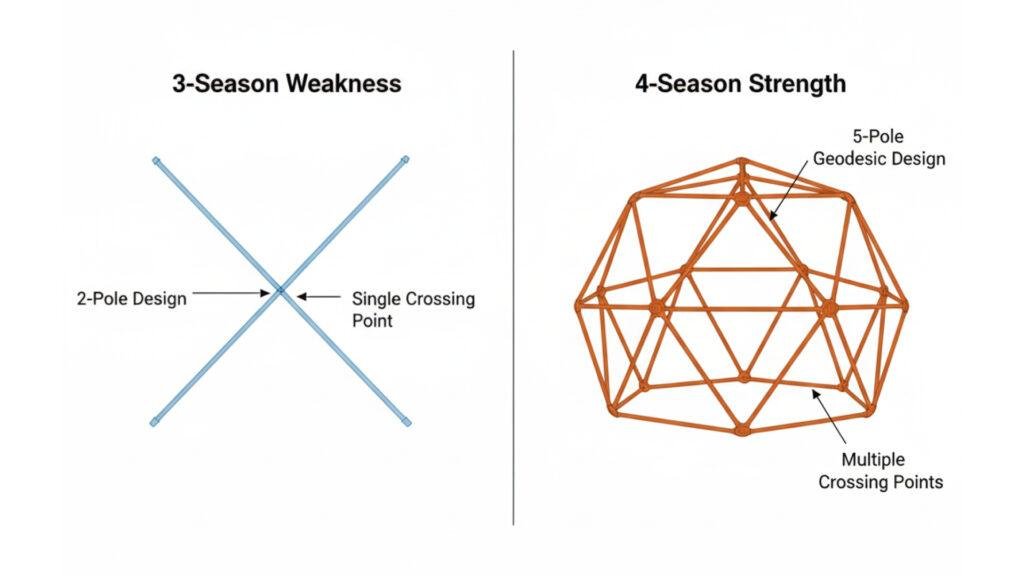
- Robust Geometry: They often feature more poles (3-5) crossing at multiple points to create a rigid exoskeleton. This allows them to support heavy snow loads without collapsing.
- Full-Coverage Fly: The rainfly extends all the way to the ground to seal out drafts. It creates a dead air space between the inner and outer wall.
- Limited Ventilation: Vents are smaller and located high up to release moisture without letting in cold drafts. They often feature “snow-proof” vents that can be zipped shut from the inside.
Sub-Categories of 4-Season Tents
Not all 4-season tents are the same. Understanding the sub-types is critical when reading 4 season camping tent reviews.
- Tree-Line Tents (Double Wall): Designed for winter camping in the forest. They have a solid inner tent and a heavy rainfly. They are heavy but handle condensation well. Great for basecamps.
- Mountaineering Tents (Single Wall): Designed to fit on small alpine ledges. They use a single layer of waterproof-breathable fabric (like ToddTex or Gore-Tex). They are lightweight and strong but prone to condensation if not vented.
- Expedition Domes (Geodesic): Large, heavy geodesic domes (like The North Face 2-Meter Dome) designed to sit on a glacier for weeks. They are bombproof bunkers.
When to Use It
- High Winds: If you are camping above the treeline where winds exceed 50mph.
- Heavy Snow: If you expect more than 3 inches of snow accumulation overnight.
- Extreme Cold: The solid walls block wind chill, making the interior feel 10-15 degrees warmer than the outside air due to the lack of convective cooling.
Structural Engineering: Geodesics vs. Simple Domes vs. Tunnels
The primary difference in the 3 season vs 4 season tent lies in the physics of the frame. The shape dictates the strength.
3-Season Physics: The Simple Dome
Most 3-season tents use a simple “X” pole structure. Two poles cross at the apex.
- Strength: Low. The large panels of fabric between the poles are unsupported. In high wind, these panels deform, reducing interior space and flapping loudly.
- Snow Load: Poor. Heavy snow pushes the “X” down, creating a flat spot on top where more snow accumulates, eventually snapping the poles.
4-Season Physics: The Geodesic Dome
True 4-season tents use complex pole geometries involving 3, 4, or even 5 poles.
- Triangulation: The poles cross each other multiple times. Every time poles cross, they create a node of strength. This divides the fabric panels into smaller triangles. Smaller panels deflect wind better than large ones.
- Static Load Strength: Because the fabric panels are smaller and supported by more poles, the tent can support massive weight. Some expedition tents can hold the weight of a person sitting on top.
- Wind Shedding: The rigid structure refuses to deform in the wind. While a 3-season tent flattens in a 50mph gust, a 4-season tent stands rigid. To understand the physics behind this, look at the principles of the Geodesic Dome, which distributes stress across the entire structure.
4-Season Physics: The Tunnel Tent
Popular in Europe (brands like Hilleberg), tunnel tents use hoop poles that do not cross.
- Strength: Excellent wind resistance if pitched into the wind. Poor snow loading capability compared to geodesics.
- Space: Incredible space-to-weight ratio.
- Requirement: They are not freestanding. You must stake them out perfectly.
Thermodynamics: Condensation & Heat Retention
This is the most misunderstood aspect of winter camping. Managing moisture is harder than managing cold.
The Condensation Trap
In winter, the temperature differential between your warm breath/body and the freezing cold tent wall is extreme. This causes moisture to condense instantly on the walls.
- 3-Season: The mesh body allows this moisture to pass through to the rainfly, where it rolls down to the ground. The airflow under the fly carries it away.
- 4-Season: Because the tent is sealed against drafts, moisture gets trapped. If you do not manage your vents perfectly, you will wake up with “snow” inside your tent (frozen breath) which melts onto your sleeping bag when you move. This is why single-wall mountaineering tents are risky for beginners.
Heat Retention
While tents aren’t insulated, a 4-season tent does feel warmer.
- Dead Air Space: The solid walls create a layer of “dead air” between you and the rainfly. This dead air acts as mild insulation.
- Wind Chill Block: A 3-season tent lets the wind strip heat away from your sleeping bag. A 4-season tent stops the air movement completely. In a 30mph wind at 0°F, a 4-season tent can feel significantly warmer simply by blocking the convection cooling.
Fabric Science: Nylon vs. Polyester in Winter
The materials used in 4-season tents differ significantly from summer tents. It isn’t just about thickness; it’s about chemistry in winter tent vs summer tent.
Silnylon (Silicone Impregnated Nylon)
High-end 4-season tents often use Silnylon.
- Strength: Extremely strong for its weight.
- Slippery: Snow slides off it easily.
- The Winter Problem: Nylon absorbs water and stretches when wet or cold. In a winter storm, a taut pitch can become saggy after an hour. You must get out and re-tighten your guy lines.
Polyester (PU Coated)
Common in 3-season tents and heavier basecamp tents (like the Coleman WeatherMaster 6).
- Stability: Polyester does not stretch when wet. It holds a pitch well.
- UV Resistance: Better than nylon.
- The Winter Problem: It is structurally weaker than nylon by weight, meaning the fabric must be thicker (and heavier) to achieve the same strength.
Hydrostatic Head (Waterproofing)
- 3-Season: Usually 1200mm – 1500mm. Enough for rain.
- 4-Season: Often 3000mm – 5000mm on the floor. In winter, you are often kneeling on the floor, pressing your knees into the snow. This pressure forces water through thin fabrics. 4-season floors are beefed up to prevent this “pressure leaking.”
The “3+ Season” Hybrid (The Shoulder Season Solution)
There is a middle ground often ignored: the “3+ Season” or “Convertible” tent. Examples include the Gazelle T4 Hub (due to its robust frame) or specific “extended season” models.
These tents feature:
- Zip-up Panels: Fabric panels that zip over the mesh windows. You can open them for ventilation in summer or zip them shut to block wind in winter.
- Sturdier Poles: Often thicker diameter aluminum (9mm+) than summer tents.
- Midpoint Weight: Heavier than a backpacking tent, lighter than an expedition bunker.
Who is this for? This is perfect for shoulder season campers (Late November/Early March) who might encounter a surprise snowstorm but don’t want to carry a 10lb expedition bunker. It is the most versatile option for generalists.
Modifying Your 3-Season Tent for Winter
If you aren’t ready to buy a 4-season tent, you can “winterize” your 3-season tent for moderate conditions. Many people ask, ‘Can you use a 3 season tent in winter?’ The answer is yes, if you modify your setup. This is a DIY approach that works for forest camping.
1. The DIY Snow Skirt
Wind blowing under the rainfly is the biggest heat thief.
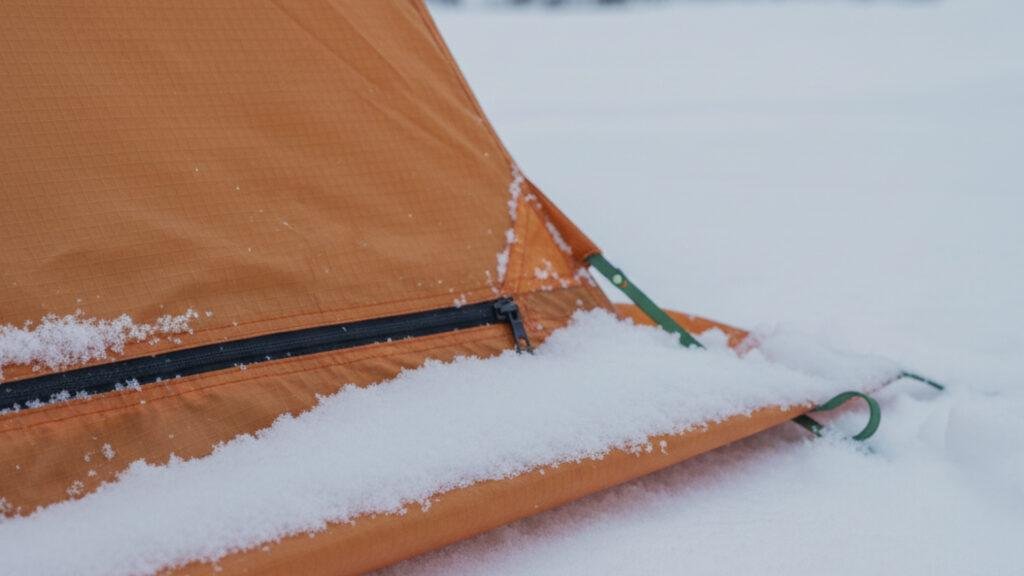
- The Fix: Sew a 10-inch strip of Tyvek or nylon to the bottom edge of your rainfly. Pile snow on this skirt to seal the tent to the ground. This mimics a 4-season design.
2. Double Poling
Many 4-season tents are just 3-season designs with stronger poles.
- The Fix: If you have an extra set of tent poles (or can buy replacements), run two poles through each sleeve or clip set. This doubles the rigidity of the frame, allowing it to hold significantly more snow weight.
3. The Frost Liner
To fight condensation in a single-wall or 3-season tent used in winter.
- The Fix: Hang a lightweight sheet of fabric (cotton or breathable nylon) inside the tent roof. This catches the frost from your breath so it doesn’t fall on your face.
Winter Tent Living: Skills Over Gear
Owning a 4-season tent doesn’t make you a winter camper. You need to change how you live inside it.
The Vestibule Trench
In a 4-season tent, the vestibule is your kitchen, freezer, and mudroom.
- Technique: Dig a pit in the snow inside the vestibule area (about 2 feet deep). This allows you to sit in the tent with your legs dangling into the pit, making it easier to put on boots. It also creates a “cold sink” where the coldest air settles, keeping the main tent slightly warmer. Remember to follow Leave No Trace principles and fill your trench back in before you depart.
Cooking Inside?
Mountaineers cook inside their vestibules.
- Warning: This is dangerous due to Carbon Monoxide (CO).
- The Rule: If you cook in the vestibule, the top vent MUST be open, and you must have a knife ready to slash the wall if the stove flares up. Never cook inside the main sleeping body of a 3-season tent; the floor is too flammable.
Anchoring in Snow
Standard stakes are useless.
- Deadman Anchors: Bury a stuff sack filled with snow, a branch, or a ski pole sideways in the snow. Pack snow on top. It freezes into concrete.
- Snow Stakes: Use wide aluminum stakes with holes in them.
Can You Use a 3-Season Tent in Winter?
Yes, but with significant caveats.
How to make it work:
- Pick a Protected Site: Camp below the treeline. The trees break the wind. Never pitch a 3-season tent on an exposed ridge.
- Manage Snow: You cannot sleep through a storm. You must wake up every 2-3 hours to knock snow off the roof from the inside. If you let 6 inches of wet snow accumulate, your 3-season poles will snap.
- Block Drafts: Build snow walls around the perimeter of the tent (about 2 feet high) to stop wind from blowing under the rainfly. Do not seal it completely, or you will suffocate from CO2 buildup.
- Use a Footprint: 3-season floors are thin. Use a Tyvek sheet or tarp underneath to protect against sharp ice.
The Danger Zone: Do not take a 3-season tent above the treeline in winter. If a storm hits, the poles will fail, the fabric will shred, and you will be left in a survival situation without shelter.
Buying Guide: Key Features to Look For
If you have decided you need a 4-season tent, look for these specific features.
1. Guy-out Points
A 3-season tent might have 4 guy-out points. A 4-season tent will have 10-20. Look for reinforced patches on the fly where guy lines attach. This is what keeps the tent on the mountain.
2. Pole Clips vs. Sleeves
- Clips (3-Season): Fast setup, better ventilation. Weaker because stress is concentrated on plastic points.
- Continuous Sleeves (4-Season): The poles slide into full-length fabric sleeves. This distributes wind stress across the entire length of the pole. Much stronger, but harder to set up in the wind.
3. Vestibule Space
In winter, your gear is bulky. You have wet boots, snowshoes, shovels, and bulky packs. You need a massive vestibule to store this gear so it doesn’t soak your sleeping bag. Look for a “hooped” vestibule that adds volume.
4. Snow Flaps
Some 4-season tents have “snow flaps” or “sod cloths” sewn to the bottom edge of the fly. You pile snow on these to seal the tent to the ground. This is great for storms but increases condensation.
Cost Analysis & Longevity
- 3-Season: Cheap to buy, cheap to replace. A $200 tent might last 5 years of moderate use. Sunlight eventually kills the lightweight fly.
- 4-Season: High investment. A $800 Hilleberg can last 20 years if cared for. The fabrics are heavier and more UV resistant. However, they are overkill for 99% of users.
Resale Value: 4-season tents hold their value incredibly well. If you buy a high-end winter tent and use it for one expedition, you can often resell it for 80% of what you paid. 3-season tents depreciate faster.
FAQ: Common Questions About Winter Tents
No. 4-season tents use single or double layers of nylon fabric. They rely on your sleeping bag and pad for insulation. However, the solid walls block wind chill, which makes the interior feel 10-15°F warmer than the outside air compared to a breezy mesh 3-season tent.
Yes, but only in moderate conditions. A 3-season tent works fine for cold-weather camping in a forest with light snow (1-2 inches). It is not safe for high winds or heavy snow loads, as the poles may collapse.
Condensation. Because 4-season tents seal out drafts to keep you warm, they also trap the moisture from your breath. To fix this, you must keep the roof vents open, even when it is cold, to allow moisture to escape.
Probably not. If you only camp in snow once a year, you are better off renting a mountaineering tent or modifying your 3-season tent with a snow skirt and warmer sleeping bag.
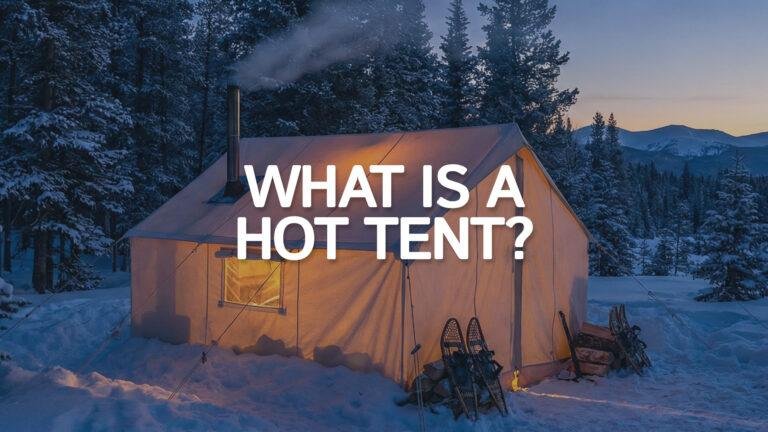
A “winter tent” (like a canvas hot tent) is designed for comfort, space, and heating. A “mountaineering tent” is designed for survival, low weight, and extreme wind resistance. One is for living in; the other is for surviving in.
Final Verdict: Which One Do You Need?
The choice between a 3 season vs 4 season tent comes down to one question: Are you expecting heavy snow?
Buy a 3-Season Tent If:
- You camp primarily between April and October.
- You might do occasional winter camping in protected forests with light snow.
- Weight and ventilation are your priorities.
- Top Pick: Naturehike Cloud Up 2 (Backpacking) or Coleman Skydome 6 (Car Camping).
Buy a 3+ Season (Convertible) Tent If:
- You camp in shoulder seasons (late fall/early spring).
- You want one tent to do it all (mostly).
- You hate drafts.
- Top Pick: Gazelle T4 Hub (Car Camping).
Buy a 4-Season Tent If:
- You plan to camp on exposed ridges, mountains, or tundras.
- You expect significant snowfall (6+ inches) or high winds (50mph+).
- You need a survival shelter that won’t fail in a blizzard.
- Top Pick: Look for brands like Hilleberg or Black Diamond (or a heavy canvas tent for basecamp).
Most campers are better off investing in a high-quality 3-season tent and upgrading their sleeping bag/pad, rather than buying a 4-season tent they will hate using in July.